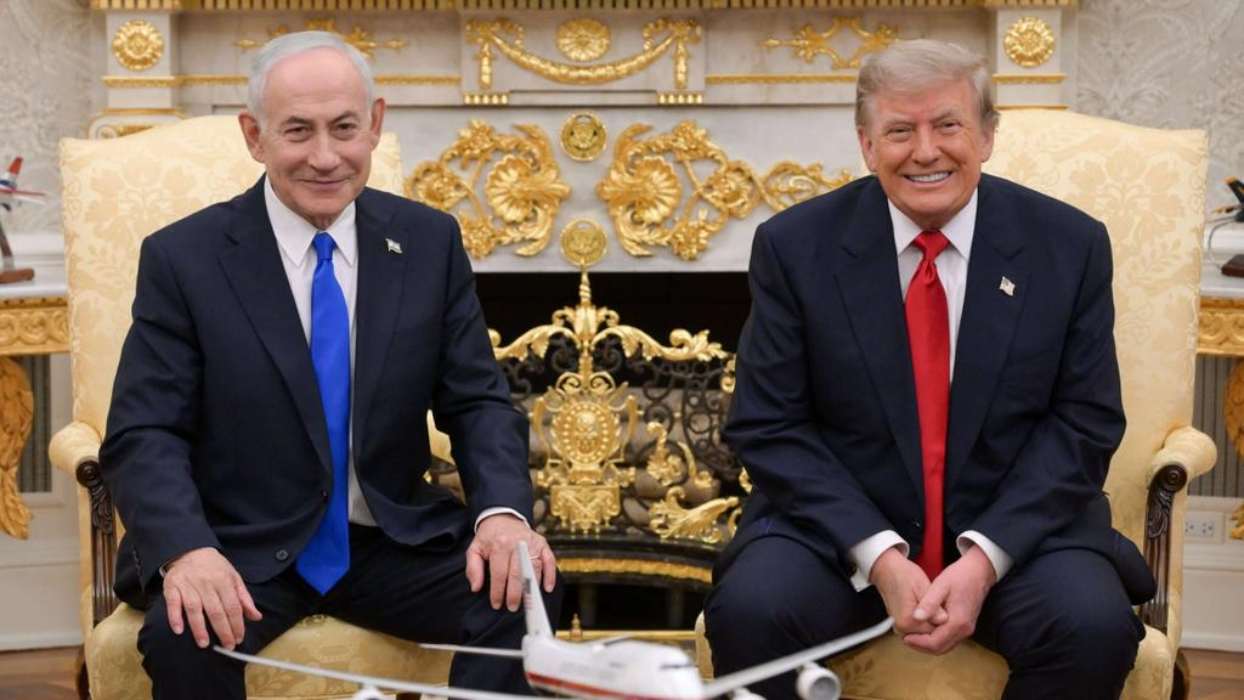
For nearly eight decades, Israel has relied on one fundamental strategic assumption: regardless of who occupied the White House, the United States would remain its most important military, diplomatic and political partner.
That assumption is now being tested.
President Donald Trump’s reported intention to end the annual $3.8bn in US military assistance to Israel has raised questions about the future of a relationship that helped define the modern Middle East.
As examined in a major Financial Times analysis, How Israel Lost America, the crisis extends far beyond disagreements between two leaders. It reflects profound changes in American politics, public attitudes towards Israel and the strategic priorities of the United States.
At the centre of the controversy stands Israeli Prime Minister Benjamin Netanyahu, whose political strategy has long depended on maintaining close ties with Republican administrations, particularly Trump.
Yet the consequences of the war in Gaza, the confrontation with Iran and growing American frustration over the costs of Middle Eastern conflicts have placed unprecedented pressure on that strategy.
Trump’s $3.8bn Warning: A Turning Point in US-Israel Relations
The immediate controversy erupted when Trump announced during an interview with Fox News that he intended to discontinue annual American military assistance to Israel.
The announcement reportedly surprised Israeli officials who had been negotiating the renewal of the bilateral military assistance agreement.
The existing memorandum of understanding, negotiated during Barack Obama’s presidency, provides for approximately $3.8bn annually in US security assistance through 2028.
An Israeli military official involved in discussions about the agreement expressed disbelief at the announcement.
“Just like that, he cancelled it?” the official reportedly asked.
The assistance represents a substantial share of Israel’s peacetime defence spending and supports the purchase of advanced American weapons systems, missile defence capabilities and military cooperation.
However, Trump’s statement should not be confused with an immediate termination of existing funding.
The legal and practical implications remain uncertain, and there has been no confirmed suspension of payments under the current agreement.
Nevertheless, the political significance is considerable.
For decades, American military support for Israel enjoyed broad bipartisan backing. Trump’s willingness to question that commitment suggests that even longstanding strategic arrangements may no longer be politically untouchable.


A Seismic Shift in Washington: Israel’s Bipartisan Consensus Is Eroding
Former US Middle East negotiator Dennis Ross has described a fundamental change in American attitudes towards Israel.
“The American public always supported Israel. Now, for the first time, 60 per cent of Americans disapprove of Israel and its policies,” he told the Financial Times.
Democratic Senator Peter Welch has similarly argued that the relationship is entering a new phase.
The change is particularly significant because criticism of Israel is no longer confined to progressive Democrats or traditional opponents of Netanyahu’s government.
It is increasingly visible among younger Republicans, conservative commentators and figures associated with Trump’s political movement.
For much of the postwar period, support for Israel was one of the few foreign policy positions that consistently united large sections of both major American parties.
That consensus has weakened as disagreements over Gaza, settlements in the occupied West Bank and American involvement in regional conflicts have intensified.
The Iran War and Growing American Frustration
The confrontation with Iran has become another source of tension.
Critics of Netanyahu argue that Israel’s strategic priorities have contributed to American involvement in a costly regional conflict.
The economic consequences, including energy market volatility and concerns about shipping through the Strait of Hormuz, have added to political dissatisfaction.
Senator Peter Welch offered a particularly sharp assessment of Netanyahu’s influence over Washington.
“Netanyahu persuaded our foolish president to get involved in a foolish war,” he told the Financial Times.
That statement represents Welch’s political interpretation rather than an established finding about how American decisions were made.
Nevertheless, it illustrates a broader argument emerging in Washington: that the United States must reconsider whether its regional commitments always serve American strategic interests.
The debate has become especially sensitive among voters concerned about fuel prices, military spending and the possibility of further American involvement in Middle Eastern conflicts.
JD Vance and Donald Trump Jr: Dissent Reaches the MAGA Movement
One of the most striking developments is the emergence of criticism from within Trump’s political coalition.
Vice-President JD Vance has linked Republican electoral setbacks to public dissatisfaction with the Iran conflict and Washington’s relationship with Israel.
In a post on X, Vance argued that voters wanted the United States to “change our relationship with Israel.”
Donald Trump Jr publicly endorsed the message, responding:
“100, 100, 100.”
The exchange suggested that criticism of the US-Israel relationship was becoming increasingly acceptable within influential sections of the MAGA movement.
Trump himself acknowledged the changing political atmosphere.
“There is a tremendous dislike, as incredible as it sounds, for Israel,” he said while discussing the political consequences of the conflict.
These comments do not necessarily mean that the administration intends to abandon Israel as a strategic partner.
They do, however, demonstrate that the political costs of unconditional support have become part of the administration’s domestic calculations.
Gaza Changed the American Conversation
The war in Gaza remains central to the deterioration of Israel’s image in the United States.
Following the Hamas-led attacks of October 7, 2023, which killed approximately 1,200 people in Israel and resulted in 251 hostages being taken, Israel launched a military campaign that caused extensive destruction and a devastating humanitarian crisis.
According to figures cited by the Financial Times, more than 74,500 Palestinians have been killed in Gaza since the beginning of the war.
The scale of civilian suffering, destruction of residential neighbourhoods and repeated humanitarian emergencies has profoundly affected international perceptions of Israel’s military operations.
Images from Gaza have also influenced American political debate, particularly among younger voters.
Republican donor Eric Levine, a supporter of Israel, acknowledged the impact.
“People are appalled,” he said.
Levine nevertheless argued that Israeli authorities had failed to communicate the military rationale behind their operations effectively.
The wider problem for Israel is that its explanations of military necessity have struggled to overcome the humanitarian consequences visible to international audiences.
The Polling Revolution: Americans Are Reconsidering Their Sympathies
Public opinion surveys reveal the extent of the change.
A Gallup poll conducted in February 2026 found that 41 per cent of Americans expressed greater sympathy for Palestinians, compared with 36 per cent who sympathised more with Israelis.
Although the difference was not statistically significant, the figures marked a striking departure from decades in which Israelis consistently enjoyed a substantial advantage.
In 2025, the corresponding figures were 46 per cent for Israelis and 33 per cent for Palestinians.
A Pew Research Center survey conducted in July 2026 found that 62 per cent of Americans held an unfavourable opinion of the Israeli government.
Negative attitudes were particularly pronounced among Democrats, but dissatisfaction had also expanded among younger Republican voters.
The distinction between attitudes towards Israel as a country, the Israeli government and Netanyahu personally remains important.
Nevertheless, the overall trend indicates that American political support for Israeli government policies can no longer be assumed.
Netanyahu’s Strategic Gamble: Republicans Over Democrats
Several former Israeli officials and American diplomats believe Netanyahu contributed to the erosion of bipartisan support by aligning himself too closely with the Republican Party.
The tensions became particularly visible during Barack Obama’s presidency.
In 2015, Netanyahu addressed the US Congress to criticise the proposed nuclear agreement with Iran, despite strong objections from the Obama administration.
The decision was widely interpreted as an attempt to challenge the sitting American president through Congress.
A former senior Israeli official described the episode as:
“A huge miscalculation.”
The official explained:
“If you want good relations with the administration, you don’t go around the administration to Congress. You just don’t do that.”
The relationship between Netanyahu and Democratic lawmakers deteriorated further during subsequent years.
When Netanyahu addressed Congress again in 2024, approximately 50 Democrats boycotted the speech or walked out.
The cumulative effect was to transform Israel from a broadly bipartisan foreign policy priority into an increasingly divisive domestic political issue.
Former Israeli Prime Minister Ehud Olmert Sounds the Alarm
Former Israeli Prime Minister Ehud Olmert has warned against taking American support for granted.
Speaking to the Financial Times, Olmert emphasised that preserving the relationship had always required careful political management.
“As long as I was prime minister, we never took for granted that Israel could enjoy the wholehearted support of the American people, the American government, the White House or Congress.”
He added:
“We always knew that losing this support would carry a significant cost for our interests, our security and our prosperity.”
Olmert has criticised Netanyahu’s coalition and its policies, arguing that they have contributed to Israel’s international isolation.
He also points to the deterioration of relations with sections of the American Jewish community, traditionally an important source of political and social support.
His warning reflects a concern shared by several former Israeli officials: military strength alone cannot compensate for the erosion of political legitimacy among essential allies.
AIPAC Spent $70mn, but Its Political Influence Faces New Challenges
The changing political environment is also affecting the American Israel Public Affairs Committee, or AIPAC, one of Washington’s most influential pro-Israel advocacy organisations.
According to OpenSecrets data cited by the Financial Times, AIPAC’s affiliated electoral organisation, United Democracy Project, spent approximately $70mn during the midterm elections.
Roughly half of that amount was directed towards Michigan, where Democratic candidate Abdul El-Sayed, a prominent critic of Israeli government policy, won his Senate contest.
Other candidates opposed by the organisation also secured victories.
AIPAC maintained that more than 245 candidates it supported were elected, while acknowledging that approximately 10 per cent of its endorsed candidates lost.
Michael Makovsky, president of the pro-Israel think tank JINSA, acknowledged the difficulties.
“Clearly, these were not good elections for the pro-Israel community,” he said.
The debate is not simply about the effectiveness of political spending.
It concerns whether an endorsement from a major pro-Israel organisation continues to provide an electoral advantage in a political environment where criticism of Netanyahu’s government has become increasingly prominent.
More Than $300bn in Assistance: The Strategic Relationship at Stake
The US-Israel alliance is among the most substantial bilateral security relationships in modern history.
According to the Congressional Research Service, Israel has received more than $300bn in American assistance and missile defence funding since the Second World War, measured in inflation-adjusted dollars.
Between 2023 and 2025 alone, US military assistance amounted to approximately $17bn.
The relationship extends far beyond financial transfers.
It includes intelligence sharing, military technology, missile defence cooperation and American commitments to preserving Israel’s qualitative military edge over potential regional adversaries.
Washington has also provided crucial diplomatic support to Israel in international institutions.
Any significant reduction in this cooperation would have consequences for regional security calculations.
However, the relationship also benefits American defence manufacturers, since a substantial proportion of US military assistance is used to purchase American-made weapons systems.
The economic and strategic interests of both countries therefore remain deeply intertwined, even as political disagreements intensify.
Could a Post-Netanyahu Government Repair the Alliance?
Some former Israeli diplomats believe the deterioration in relations could be reversed under a different government.
Jeremy Issacharoff, a former senior Israeli diplomat, argues that a new administration in Jerusalem could seek to rebuild bipartisan support in Washington.
“If a new government comes in with a new approach and seeks to reshape a more bipartisan relationship, I think the situation can be reversed,” he said.
Former Israeli ambassador to the United States Michael Oren has suggested that a future government could attempt to restore confidence by addressing settlement expansion and violence by settlers against Palestinians in the occupied West Bank.
He argued that a new leadership could deliver a message largely absent from recent political discourse:
“We are interested in peace.”
Nevertheless, changing the prime minister would not automatically resolve the underlying disagreements.
Questions surrounding Palestinian statehood, the occupation of the West Bank, regional military threats and Israel’s long-term security strategy would remain.
The challenge is therefore broader than the political future of Netanyahu himself.
From Unconditional Support to Strategic Bargaining
The next phase of the crisis will depend on whether Trump’s statements translate into concrete policy.
If Washington ultimately decides not to renew the military assistance agreement after 2028, it would represent a substantial change in the terms of the alliance.
If the announcement remains political rhetoric, existing military and intelligence cooperation could continue despite public disagreements.
Republican strategist Doug Heye has cautioned that Trump frequently makes dramatic announcements without necessarily implementing them.
That uncertainty makes it premature to describe the alliance as broken.
Yet the transformation of American public opinion is a deeper challenge that cannot be resolved through personal diplomacy alone.
Israel’s security establishment, political leadership and international supporters face a strategic environment in which American assistance may increasingly be debated in terms of conditions, costs and competing national priorities.
For Washington, the question is how to reconcile its longstanding commitment to Israeli security with growing domestic demands for restraint in Middle Eastern conflicts.
For Israel, the question is whether it can preserve its most important international partnership while rebuilding confidence among Americans who increasingly question the policies of its government.
The US-Israel alliance has not collapsed. Its military, intelligence and diplomatic foundations remain substantial. But the era in which Israeli leaders could assume nearly automatic political support from Washington is facing an unprecedented challenge — one whose consequences could reshape the balance of power across the Middle East.
Source: pagenews.gr