Donald Trump still sits at the head of America’s diplomatic negotiating table. But following the November 3 midterm elections, he is no longer the only political authority foreign governments must consider when negotiating with Washington.
The Democratic takeover of the House of Representatives and the Senate has introduced a new dimension to American foreign policy at a particularly sensitive moment: the United States is confronting the war with Iran while simultaneously pursuing negotiations over Ukraine.
When the new Congress takes office on January 3, 2027, Trump will retain his constitutional authority to conduct diplomacy and exercise executive power. Yet his administration will face a legislature capable of restricting new military funding, shaping sanctions legislation and determining the fate of treaties requiring Senate approval.
For Ukraine, the shift could create new opportunities to secure military assistance and stronger security guarantees.
For Russia, it complicates the prospect of reaching an agreement with the White House that can be implemented without congressional involvement.
For Iran, it introduces another variable into negotiations with a president whose political room for manoeuvre has narrowed.
Washington still has one president negotiating on America’s behalf. But it now has two centres of power capable of determining whether those negotiations produce lasting commitments.
The Midterm Shock: Democrats Take Control of Congress
The November 3 elections fundamentally altered the balance of power in Washington.
According to the election figures cited in the original reporting, Democrats captured seven Republican-held Senate seats and approximately two dozen House districts without losing any of their own.
The results were expected to give the party at least 55 Senate seats and a substantial majority in the House when the new Congress convenes in January.
The victory gives Democrats control over legislative priorities, committee leadership and the scheduling of congressional votes.
It does not, however, give them unlimited power over the president.
Overriding a presidential veto requires a two-thirds majority in both chambers. Ratifying a treaty under Article II of the Constitution requires the consent of two-thirds of senators present, equivalent to 67 votes if all 100 senators participate.
The new Democratic majorities therefore cannot simply impose every foreign-policy decision on Trump.
What they can do is determine which legislation advances, what funding Congress approves and which agreements receive the institutional backing needed to endure beyond a single presidency.
That distinction is particularly important for the wars involving Iran and Ukraine.
Seventy-One Percent of Americans Want Congress to End the Iran War
Public opinion is adding pressure to the political consequences of the midterms.
According to a Reuters/Ipsos poll cited by Iran International, 71% of Americans want the new Congress to pass legislation ending the war with Iran.
Support reaches 93% among Democrats and approximately half of Republicans.
The findings illustrate the domestic political burden of the conflict and the growing demand for congressional involvement in decisions about its continuation.
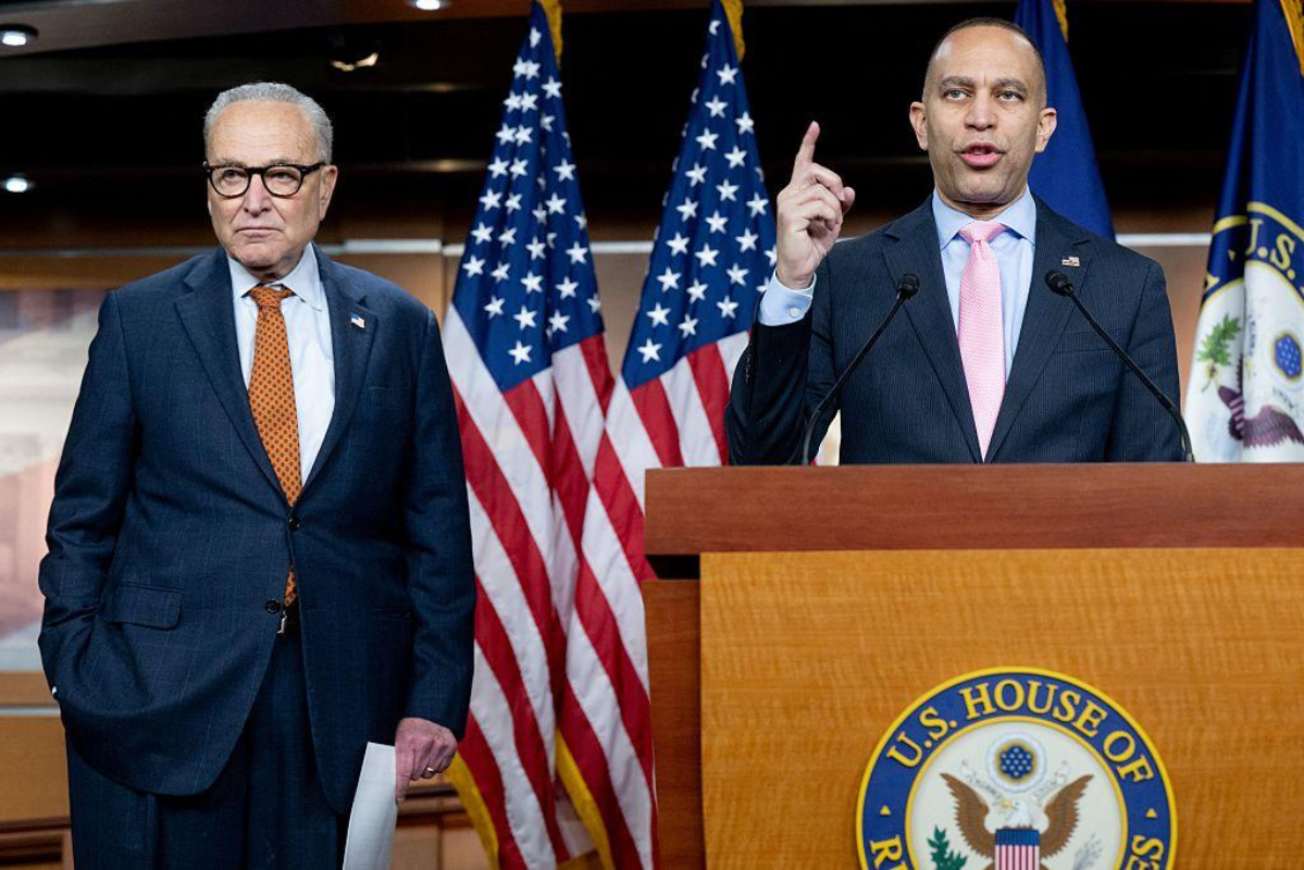
Vice President JD Vance has linked Republican electoral losses to the Iran war, while Hakeem Jeffries, expected to become Speaker of the House, has identified ending the conflict as an early priority.
Senate Democratic leader Chuck Schumer has pointed to Congress’s spending authority as a potential instrument for influencing the administration’s decisions.
Yet there is a crucial difference between passing a resolution opposing a war and compelling a president to end military operations.
Congress can invoke the War Powers Resolution, demand explanations and seek legislative restrictions on the use of military force.
But if Trump vetoes such measures, Democrats would need substantial Republican support to override him.
That makes direct legislative confrontation difficult.
The more consequential battle may instead concern the money required to sustain military operations.
The Power of the Purse: Congress’s Strongest Weapon
The Constitution gives Congress central authority over federal spending.
The executive branch can conduct military operations within its lawful powers and available appropriations, but it cannot independently create unlimited new funding.
This becomes especially important as Washington approaches the December 11, 2026, deadline for the temporary federal government funding measure described in the source reporting.
Until January 3, Republicans continue to control the outgoing Congress.
That leaves the White House a limited period in which to seek additional appropriations or advance legislative measures before Democrats assume control.
Once the new Congress convenes, requests for additional military funding will face a different political environment.
Democrats will be able to refuse proposed appropriations, attach conditions to funding legislation or demand greater oversight of military expenditure.
That does not mean existing military operations would automatically cease.
Previously appropriated funds and existing executive authorities would remain relevant.
But a president who requires new money for a prolonged conflict must ultimately confront Congress’s constitutional spending powers.
Trump can veto legislation. He cannot use a veto to create appropriations that Congress has refused to enact.
This is the central source of leverage available to the incoming Democratic majority.
Ukraine: Kyiv Looks Beyond the White House
For Ukraine, the change in congressional control presents a different set of opportunities.
President Volodymyr Zelenskyy has acknowledged the need to adjust Kyiv’s approach to Washington and strengthen relationships with both major American parties.
The objective is to ensure that American support for Ukraine does not depend exclusively on decisions made by the White House.
According to the original reporting, Democratic lawmakers have discussed a new military assistance package worth approximately $15 billion.
Such a proposal could gain greater access to the legislative agenda once Democrats control the House.
Under Republican leadership, measures supporting Ukraine have sometimes faced procedural obstacles.
The Ukraine Support Act, for example, required a discharge petition to reach the House floor in June, according to the source material.
With a Democratic majority, supporters of additional assistance would have greater control over scheduling and committee proceedings.
However, congressional approval would still have to navigate the Senate’s legislative rules and the possibility of a presidential veto.
The significance of the election is therefore not that Ukraine has secured new American assistance automatically.
It is that Kyiv may gain additional institutional channels through which to pursue it.
Security Guarantees: The Battle Over 67 Senate Votes
Beyond military funding, Ukraine’s most consequential objective may be obtaining credible security guarantees that survive changes of administration.
Zelenskyy has discussed the possibility of an American security agreement being submitted to Congress and the Ukrainian parliament for ratification.
The legal form of any agreement would be decisive.
If structured as an Article II treaty, it would require the consent of two-thirds of the senators present.
If structured as an executive agreement or political declaration, different constitutional and statutory rules would apply.
For Kyiv, Senate approval could strengthen the institutional durability of American commitments.
It would also introduce another negotiating arena.
Senators could demand conditions concerning implementation, oversight, financial obligations or the circumstances under which American commitments could be modified.
A Democratic majority of 55 seats would not be sufficient on its own to ratify a treaty with all senators present.
Bipartisan support would be necessary.
Conversely, a group of 34 senators could prevent ratification under those attendance conditions.
That creates a powerful incentive for Ukraine to cultivate support across party lines rather than rely exclusively on the administration.
Moscow’s Dilemma: A Deal With Trump May Not Be Enough
The new congressional landscape also complicates Russia’s calculations.
An agreement reached directly with the White House may be easier to negotiate if it relies primarily on executive actions, political commitments or existing waiver authorities.
But such arrangements may also be more vulnerable to future policy changes.
A treaty requiring Senate approval would involve a broader political process and could include conditions unacceptable to Moscow.
This creates different incentives for Russia and Ukraine.
Moscow could prefer a settlement that minimises congressional involvement, particularly if it includes sanctions relief or commitments from Washington.
Kyiv, by contrast, may see congressional participation as a means of strengthening the credibility of security guarantees.
The approaching January transition therefore matters to both sides.
The Kremlin must consider not only what Trump is prepared to offer, but also which parts of an agreement the American political system can legally and financially sustain.
Sanctions Relief: Congress’s Second Major Lever
Congress also has important powers concerning sanctions imposed on Iran and Russia.
Under the Iran Nuclear Agreement Review Act of 2015, qualifying agreements relating to Iran’s nuclear programme are subject to a congressional review process.
The law establishes procedures and restrictions that can affect the timing and implementation of certain sanctions-related commitments.
Congressional review does not automatically mean every agreement requires affirmative legislative approval.
Nevertheless, the process can create delays, public scrutiny and opportunities for political opposition.
In the case of Russia, Section 216 of the Countering America’s Adversaries Through Sanctions Act of 2017, known as CAATSA, establishes congressional review procedures for certain actions involving sanctions relief.
The framework does not automatically encompass every measure introduced after Russia’s full-scale invasion of Ukraine in 2022.
That has prompted proposals to extend congressional oversight.
For foreign governments, these provisions matter because sanctions relief negotiated with the White House may still face statutory constraints.
A presidential promise does not necessarily guarantee that every relevant economic restriction can be removed immediately or permanently.
The details depend on the legal authority underlying each sanction and the form of relief being proposed.
Tehran’s Calculation: Wait for Congress or Negotiate With Trump?
Iranian political and media reactions to the midterm elections illustrate how closely foreign governments are watching the changes in Washington.
According to Iran International, newspapers associated with Iran’s political establishment portrayed Republican losses as a setback for Trump.
The incoming Democratic majority could increase pressure on the administration to pursue a diplomatic settlement rather than prolong the conflict.
The Reuters/Ipsos polling figures also suggest that congressional action to end the war would have substantial public support.
However, the new Congress cannot automatically prevent every military decision.
The president retains significant executive authority, subject to constitutional and statutory limits.
For Tehran, the approaching transition creates both opportunities and uncertainty.
Waiting until January could mean negotiating in an environment where the White House faces greater congressional scrutiny.
But delaying negotiations could also expose Iran to additional military or economic pressure before the new Congress takes office.
The calculation is therefore more complicated than simply assuming that Democratic control guarantees a softer American position.
Capitol Hill Becomes a New Diplomatic Battleground
The congressional transition means foreign governments will have to devote greater attention to the lawmakers who control key committees.
The House Foreign Affairs Committee, the appropriations committees and the Senate Foreign Relations Committee will play important roles in the legislative and oversight processes affecting international agreements.
Democratic Representative Gregory Meeks is among the figures expected to gain greater influence over foreign-policy proceedings in the House.
For Ukraine, European governments and countries across the Middle East, diplomacy in Washington will increasingly involve direct engagement with congressional leadership and committee members.
A foreign government seeking American financial assistance must understand the appropriations process.
A government negotiating sanctions relief must consider the relevant statutory review mechanisms.
A country seeking treaty-based security guarantees must build sufficient support in the Senate.
These requirements are not new.
What has changed is the political alignment between the presidency and Congress.
With opposing parties controlling the executive and legislative branches, the potential for disagreement becomes considerably greater.
December 11 and January 3: The Two Dates That Matter
Two dates dominate the immediate political calendar.
December 11, 2026: The reported expiration of the temporary federal government funding arrangement.
January 3, 2027: The new Democratic-controlled Congress takes office.
Between those dates, the outgoing Republican majority may have opportunities to approve funding or other legislation sought by the White House.
After January 3, Democrats will control both chambers and gain greater influence over the legislative agenda.
The administration will retain executive powers and the presidential veto.
But it will face more difficult negotiations over new spending, statutory changes and congressional oversight.
For foreign governments, the transition creates uncertainty over which commitments Washington can deliver quickly and which will require broader political agreement.
Three Scenarios for Trump’s Ukraine and Iran Agreements
Scenario One: Agreements Before the Congressional Transition
The administration seeks to advance as many diplomatic and executive measures as possible before January 3.
On Iran, that could involve actions permitted under existing presidential authorities.
On Ukraine, it could mean pursuing a political framework that does not immediately require treaty ratification.
The new Congress would subsequently examine the legislative, financial and legal consequences.
Such agreements might move quickly but could remain vulnerable to later political disputes.
Scenario Two: Escalation and Institutional Confrontation
The White House takes military or diplomatic actions that provoke strong opposition from the incoming congressional majority.
Funding disputes, sanctions disagreements and challenges concerning executive authority follow.
The result could be greater uncertainty for American allies, adversaries and international markets.
In this scenario, the executive branch would continue to act within its asserted powers while Congress attempted to impose constraints through legislation and appropriations.
Scenario Three: Congress Becomes a Guarantor
The administration and congressional leaders reach bipartisan agreements supporting major international commitments.
For Ukraine, that could involve security arrangements with stronger institutional backing.
For Iran, it could create a diplomatic framework capable of surviving congressional review and attracting broader political support.
Such agreements would be more difficult to negotiate initially but could prove more durable because they would rest on support beyond the executive branch.
None of these scenarios is predetermined.
Their outcomes will depend on the decisions of the administration, congressional leaders and the foreign governments involved.
Trump Can Negotiate Peace. Congress Can Determine Whether It Lasts.
The Democratic takeover of Congress does not strip Donald Trump of his authority to conduct American diplomacy.
But it changes the political and institutional environment in which his agreements must operate.
For Ukraine, the new majority may provide additional opportunities for military assistance and stronger congressional involvement in security commitments.
For Russia, it introduces another source of uncertainty into negotiations over sanctions and the terms of a settlement.
For Iran, it increases the prospect of political confrontation in Washington over the costs and continuation of the war.
The most important test will come when diplomatic agreements require new appropriations, legislative changes or treaty ratification.
Trump can negotiate the peace. But the new Congress will have a decisive say in who pays for it, which commitments receive legal approval and how long those commitments can endure.
Source: pagenews.gr