“Nuclear weapons must be completely banned and ultimately eliminated. A nuclear war cannot be won and must never be fought.”
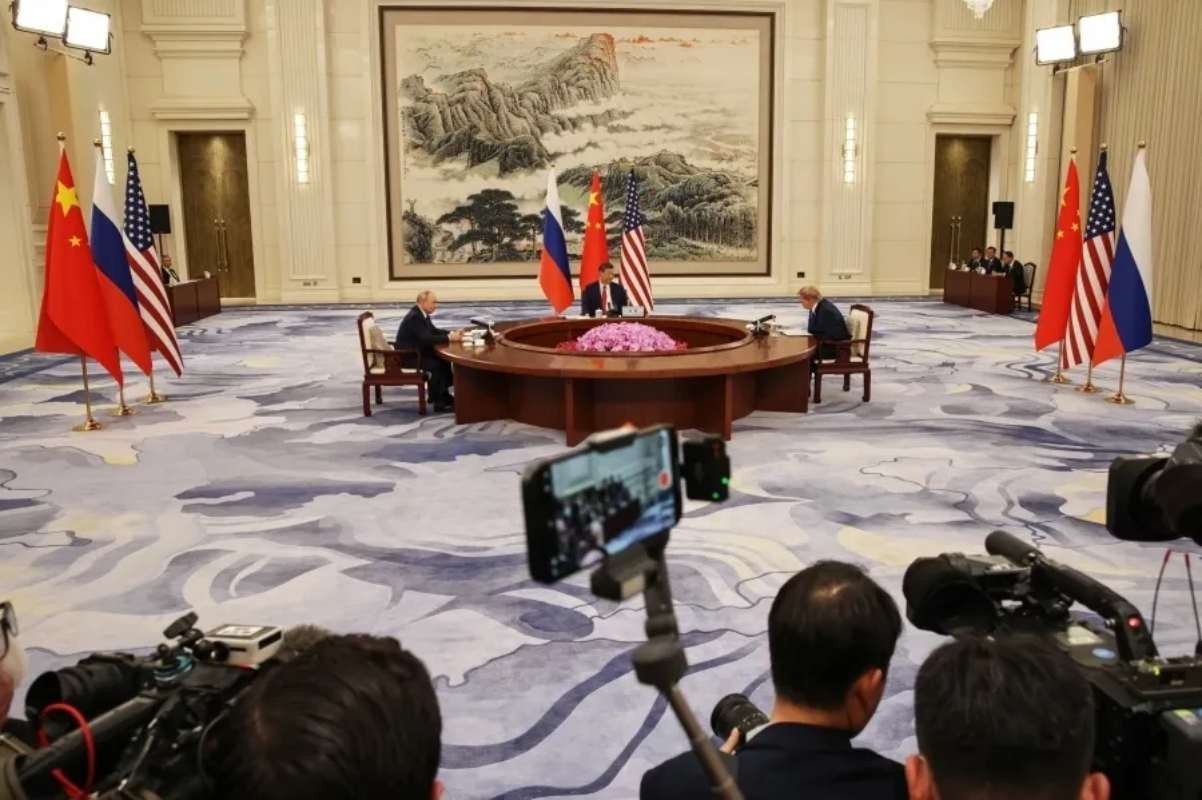
With that declaration, Chinese President Xi Jinping set the tone for the first official trilateral meeting with US President Donald Trump and Russian President Vladimir Putin in Shenzhen, China.
The meeting concluded at Qilin Villa, on the sidelines of the Asia-Pacific Economic Cooperation (APEC) summit, with Trump’s motorcade departing for the airport, as shown in footage broadcast by China’s CCTV.
The three leaders addressed some of the most consequential issues shaping international relations: the war in Ukraine, nuclear arms control, energy security, trade tensions and the technological rivalry surrounding artificial intelligence.
Although the summit was presented as a historic diplomatic encounter, the available reporting did not establish that the leaders had reached a binding agreement on ending the Ukraine war or eliminating nuclear weapons.
The most significant immediate development was the direct engagement between Washington, Beijing and Moscow, alongside China’s proposal for a permanent mechanism designed to prevent dangerous misunderstandings between the three nuclear powers.
Xi Jinping Calls for Nuclear Disarmament and a Three-Way Crisis Hotline
Xi placed nuclear security at the centre of the discussions.
His call for the complete elimination of nuclear weapons carried particular symbolic significance because it was delivered in the presence of the leaders of the United States and Russia, which possess the world’s largest nuclear arsenals.
The Chinese president also proposed establishing a direct emergency communication mechanism between Beijing, Washington and Moscow.
According to the Greek broadcaster SKAI, Xi emphasised the need for “communication and crisis-prevention mechanisms to ensure that miscalculations are minimised.”
The proposal resembles the concept of a diplomatic and military hotline that would allow the three governments to communicate rapidly during periods of heightened tension.
Such a mechanism could become particularly important in the event of a nuclear emergency, a military confrontation or an unexpected escalation involving major powers.
However, it remains unclear whether Washington and Moscow formally accepted the proposal or whether any implementation timetable was agreed.
The distinction matters.
A crisis hotline could reduce the danger of accidental escalation, but it would not itself constitute a nuclear disarmament agreement.
Binding arms-control arrangements would require specific commitments, verification procedures and agreed limitations on nuclear capabilities.


Trump: “We Are Truly Making History”
Donald Trump adopted an optimistic tone at the opening of the summit.
“We are truly making history. Too often, leaders in the past avoided talking to nations with which they had disagreements. We believe the opposite,” he declared.
The US president presented direct dialogue with China and Russia as an essential instrument for managing international crises.
His remarks reflected his preference for personal diplomacy with powerful leaders, even when relations between their governments remain deeply strained.
Ukraine was among the most important issues he raised.
“I believe Putin, and hopefully the other side, would like to see an end to the war in Ukraine. It is an honour to be with Vladimir,” Trump said.
The statement indicated his determination to maintain direct communication with Moscow while exploring the possibility of a negotiated settlement.
Yet the fundamental obstacles remain unresolved.
Ukraine continues to insist on protecting its sovereignty and security, while Russia seeks to link any settlement to broader demands concerning Europe’s security architecture.
Without agreement on these issues, personal diplomacy alone cannot guarantee an end to the fighting.
Putin Invokes International Law and Global Stability
Vladimir Putin used the meeting to emphasise cooperation between major powers.
“It is our duty to strengthen international law,” the Russian president told his counterparts.
Putin argued that constructive engagement between Russia, China and the United States could contribute to greater international stability.
He also called for discussions on global and regional security challenges, including energy security.
His invocation of international law is particularly significant against the backdrop of Russia’s continuing invasion of Ukraine, which has been condemned by the United Nations General Assembly.
Moscow has consistently sought recognition as an indispensable participant in negotiations over European security.
Participation in a high-profile summit with Washington and Beijing gives the Kremlin an opportunity to reinforce that position.
For Russia, the diplomatic importance of the meeting extends beyond any immediate agreement.
It demonstrates that Moscow remains directly engaged with two of the world’s most influential governments despite the sanctions and diplomatic tensions arising from the Ukraine war.
Trump and Putin’s Private Meeting: Warm Handshakes and Optimistic Statements
Before the trilateral talks, Trump and Putin held a separate meeting lasting approximately 40 minutes.
Images released from the encounter showed the two leaders exchanging a warm handshake and appearing relaxed in front of the cameras.
As they entered the meeting room, Trump leaned towards Putin and whispered something, while the Russian president briefly touched his elbow.
The two leaders subsequently posed for photographs.
Trump emphasised their longstanding personal relationship.
“We have had an excellent relationship for many years. We have known each other for a long time, and I believe many wonderful things can come from this meeting, or at least the foundations can be laid for them. But I believe they will happen,” he said.
According to Reuters reporting cited by SKAI, Putin left the bilateral meeting in a particularly positive mood.
Nevertheless, the cordial atmosphere was not accompanied by the announcement of a concrete agreement on Ukraine.
The contrast between the leaders’ personal warmth and the unresolved strategic differences remains central to understanding the summit.


Why Xi Jinping Emerges With Diplomatic Advantages
Hosting the first official trilateral meeting offered Beijing an important diplomatic opportunity.
Xi positioned China at the centre of discussions involving the United States and Russia on nuclear security, the Ukraine war and global stability.
His proposal for a crisis-prevention mechanism reinforced Beijing’s ambition to play a greater role in international diplomacy.
At the same time, China has not abandoned its established economic priorities.
Xi has continued to advocate open international trade, even as Washington and Beijing remain divided over tariffs, advanced technology and industrial competition.
China wants to avoid an uncontrolled confrontation with the United States while preserving its strategic relationship with Russia.
The Shenzhen meeting allowed Xi to demonstrate that Beijing can maintain direct dialogue with both powers.
That positioning offers China diplomatic visibility, although it does not automatically translate into influence over the outcome of the Ukraine war.
Ukraine: Decisions Affecting Europe Are Being Discussed Without Europe
The absence of European leaders from the trilateral meeting raises important questions about the European Union’s influence in global diplomacy.
Ukraine is fighting a war on European territory.
European governments have committed substantial financial and military resources to supporting Kyiv and have imposed extensive sanctions on Russia.
The conflict has also reshaped Europe’s energy markets, defence budgets and relations with Moscow.
Yet Washington continues to play a decisive role in diplomatic initiatives concerning the war.
The Shenzhen summit was not a formal negotiation over Europe’s security arrangements, nor could it replace Ukraine’s participation in any peace settlement.
Nevertheless, it highlighted concerns that major diplomatic initiatives could develop without direct European representation.
For Brussels, the central challenge is ensuring that any future agreement takes account of Ukraine’s sovereignty and the long-term security requirements of the European continent.
The issue extends beyond diplomatic protocol.
A settlement affecting territorial arrangements, sanctions, security guarantees or Ukraine’s relationship with NATO would have profound implications for European security.
European governments therefore have a direct interest in the substance of any negotiations between Washington and Moscow.
Europe Has Economic Power but Struggles to Speak With One Voice
The European Union remains one of the world’s largest economic and trading powers.
It possesses a vast single market, significant industrial capabilities and considerable influence through trade policy, regulation and economic sanctions.
However, foreign policy and defence remain areas in which national governments retain substantial authority.
Many important decisions require unanimity among the EU’s 27 member states.
That institutional structure can make rapid and coordinated action difficult.
European governments have different geographical concerns, historical experiences and strategic relationships with Russia, China and the United States.
Countries in Eastern Europe generally regard Russia as a direct security threat.
Other member states have historically placed greater emphasis on economic engagement or diplomatic dialogue.
The EU has demonstrated its ability to act collectively through sanctions against Moscow and assistance to Ukraine.
But converting economic influence into unified geopolitical power remains a persistent challenge.
The Shenzhen summit has brought that debate back into focus.
Iran and the Strait of Hormuz: Energy Security Enters the Negotiations
Energy security was another major issue surrounding the summit.
Trump has expressed concern about oil shipments through the Strait of Hormuz amid the continuing conflict involving Iran.
The waterway is one of the world’s most important maritime energy corridors.
Disruptions can affect international oil prices, shipping insurance, transport costs and global supply chains.
China has a strong interest in maintaining stable energy flows because of its substantial oil imports.
Russia, by contrast, is a major energy exporter and approaches global oil markets from a different economic position.
For Europe, instability in the Gulf can increase pressure on industrial production, transportation and consumer prices.
These competing interests help explain why energy security is a central issue for the three governments, even when their broader geopolitical priorities diverge.
The discussions also illustrate the increasingly close relationship between military conflicts and global economic stability.


Artificial Intelligence and Nvidia: The Technological Rivalry Behind the Diplomacy
Beyond traditional security issues, the US-China competition over artificial intelligence remains a major source of tension.
Advanced semiconductors are essential for developing powerful AI systems, processing large datasets and supporting technologies with potential military applications.
American export restrictions targeting advanced chips have transformed semiconductor access into a strategic negotiating issue.
Nvidia has become central to this confrontation because of the importance of its processors in AI infrastructure.
Washington argues that restrictions on certain technologies are necessary to protect national security.
Beijing is seeking access to advanced computing capabilities while investing heavily in domestic alternatives.
The dispute also affects Europe.
European companies and research institutions play important roles in the semiconductor and AI ecosystems, but the continent remains dependent on international supply chains for several critical technologies.
The competition between Washington and Beijing therefore has implications far beyond their bilateral relationship.
Nuclear Arms Control Could Redefine European Security
Xi’s proposal for the complete elimination of nuclear weapons raises another fundamental issue for Europe.
European security continues to rely heavily on NATO’s nuclear deterrence framework, in which the United States plays a central role.
France possesses its own nuclear arsenal, while the United Kingdom, although no longer an EU member, remains a major European nuclear power and NATO ally.
Any future agreement between Washington, Moscow and Beijing on strategic nuclear forces could influence the balance of deterrence across Europe.
European governments consequently have a direct interest in the development of arms-control negotiations.
A three-way emergency hotline could help prevent dangerous misunderstandings.
But meaningful nuclear arms control would require much more.
It would involve negotiations over force levels, transparency, verification and the strategic concerns of each participant.
China’s reluctance to enter certain arms-control frameworks has historically complicated American efforts to establish broader multilateral arrangements.
The Shenzhen discussions may create an opportunity for further dialogue, but their practical significance will depend on whether the leaders move beyond general principles.
A Joint Declaration and New Questions About International Institutions
Subsequent reporting by SKAI indicated that the leaders adopted a joint declaration following the summit.
The available account also reported that Trump raised concerns about the authority of international organisations, including the International Criminal Court.
Separately, according to China’s Xinhua news agency as cited in the report, Trump reiterated that the United States does not support Taiwan’s independence.
These developments suggest that the summit’s agenda extended beyond Ukraine and nuclear weapons.
Questions concerning international institutions, sovereignty and the balance of power were also part of the wider diplomatic exchanges.
However, the precise legal and political significance of the joint declaration depends on its full published wording.
Its adoption should not be interpreted as evidence that the three governments reached comprehensive agreements on every issue discussed.
What Did Trump, Xi and Putin Gain From Shenzhen?
The summit offered different diplomatic opportunities to each participant.
Trump demonstrated his willingness to engage directly with the leaders of major geopolitical rivals.
Xi hosted the meeting and presented proposals concerning nuclear disarmament and crisis prevention.
Putin participated in a high-level diplomatic format that kept Russia involved in discussions on Ukraine and global security.
Yet the longer-term significance of the meeting will depend on subsequent developments.
No confirmed peace agreement for Ukraine emerged from the available reporting.
No binding nuclear disarmament framework was announced.
And the proposed crisis communication mechanism has not yet been accompanied by publicly established implementation arrangements.
The summit therefore represents an important diplomatic encounter rather than a comprehensive settlement of the disputes dividing the three powers.
The Message to Brussels: Economic Strength Is Not Enough
The Shenzhen meeting has renewed debate over Europe’s place in an increasingly competitive international order.
The leaders of the United States, China and Russia discussed wars, nuclear weapons, energy and technology — all issues that directly affect Europe’s future.
The European Union possesses substantial economic resources, military capabilities and diplomatic influence.
What it does not always possess is the political unity required to translate those assets into a single strategic position.
The challenge for Brussels is not to demand participation in every meeting between major powers.
It is to ensure that Europe has meaningful influence over decisions affecting its security, economy and technological development.
That requires stronger coordination between member states, greater defence capabilities and the ability to formulate common positions on major international crises.
Shenzhen has not yet produced a new global settlement. It has, however, demonstrated that Washington, Beijing and Moscow can engage directly on questions that will shape the future of entire continents.
For Europe, the question is becoming increasingly urgent: will it develop a stronger common geopolitical voice, or will it continue to seek influence over decisions negotiated elsewhere?
Source: pagenews.gr