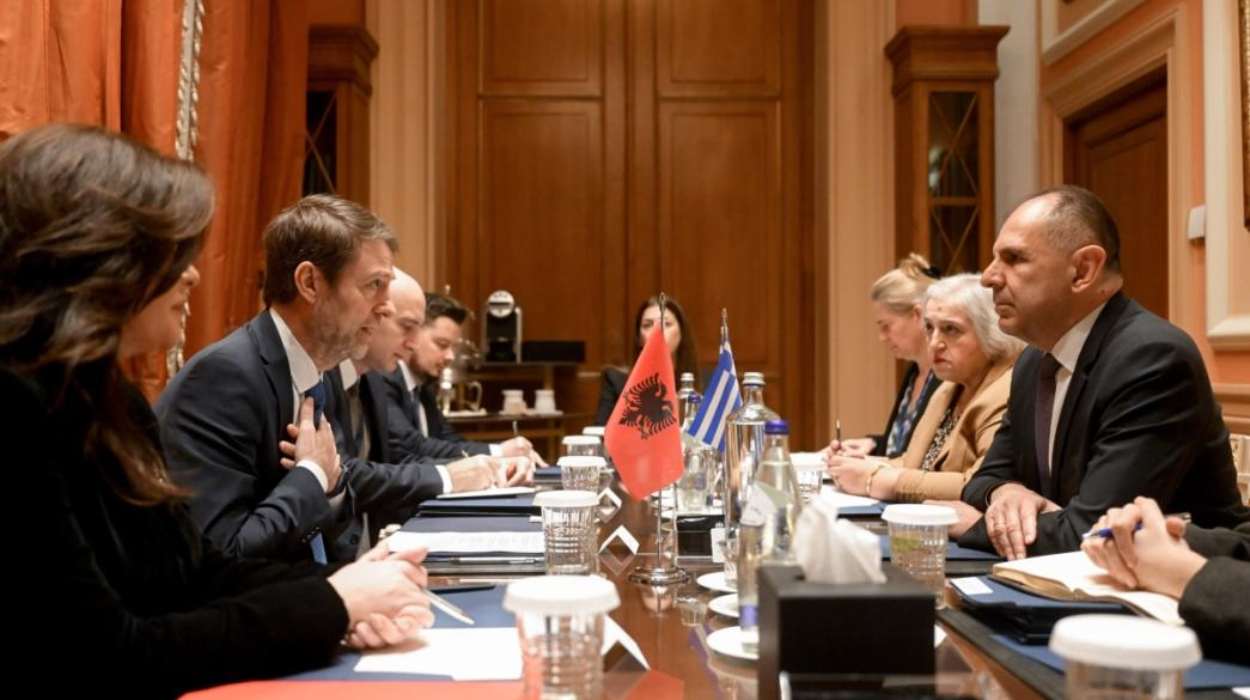
“The place of the Western Balkans is in the European Union,” Greek Foreign Minister George Gerapetritis declared at the ministerial meeting of the Group of Friends and Partners of the Western Balkans in Athens, while outlining the conditions under which the enlargement process should advance.
With the EU–Western Balkans Summit in Brussels approaching and Greece preparing to assume the presidency of the Council of the European Union in the second half of 2027, Athens is placing the European integration of the Balkan region high on its diplomatic agenda.
Gerapetritis’ bilateral meetings with his Albanian and North Macedonian counterparts also highlighted two longstanding Greek priorities: the protection of the rights of the Greek National Minority in Albania and the full implementation of the Prespa Agreement.
Gerapetritis: European Integration Must Come With Conditions
The Greek foreign minister outlined Athens’ position on enlargement, stressing that accession cannot be separated from the fulfilment of obligations undertaken by candidate countries.
“The central message of today’s meeting is clear: the place of the Western Balkans is in the European Union. This prospect must be realised on the basis of fulfilling the accession criteria, respecting the principle of individual merit, and fully respecting international agreements and good neighbourly relations,” Gerapetritis stated.
He emphasised that reforms concerning the rule of law, the judiciary, democratic governance, fundamental rights, press freedom and the fight against corruption constitute essential prerequisites for EU membership.
Athens supports the accession of the Western Balkan countries while insisting that each candidate’s progress must be assessed on its own merits and compliance with the EU acquis.
“This is our neighbourhood, a region with which we share strong historical ties, common challenges and a common future. In a region that has experienced bloody conflicts and deep divisions in the past, accession to the Union constitutes an investment in peace, stability, security and prosperity throughout the region,” he added.
The Message to Tirana: Greek Minority and Property Rights
During his bilateral meeting with Albanian Foreign Minister Ferit Hoxha, Gerapetritis reiterated Greece’s concerns regarding the protection of the Greek National Minority in Albania.
Greek Deputy Foreign Minister and career diplomat Alexandra Papadopoulou also attended the meeting.
The Greek side stressed the importance of respecting the rule of law and minority rights in accordance with the obligations arising from the EU acquis.
Athens’ longstanding priorities include:
- Protection of the property rights of members of the Greek National Minority.
- Safeguarding linguistic and educational rights.
- Effective implementation of the rule of law.
- Enforcement of minority protections in practice, rather than solely through legislative commitments.
Property rights remain particularly sensitive, especially in areas where growing tourism and investment activity have increased the economic value of real estate.
Greece seeks to ensure that these issues remain part of Albania’s assessment throughout its EU accession negotiations.
The Fredi Beleri Case and Unresolved Greek-Albanian Disputes
The case of Fredi Beleri, whose arrest in 2023, subsequent conviction and inability to assume office as mayor of Himara triggered diplomatic tensions, remains an important reference point in Greek-Albanian relations.
Athens expressed concerns over the handling of the case, linking it to broader questions regarding the rule of law and the protection of minority rights.
Despite periodic tensions with the government of Albanian Prime Minister Edi Rama, Greece continues to support Albania’s European aspirations while insisting that the country fulfil its obligations.
The accession process provides Athens with an institutional framework through which minority rights and bilateral concerns can be raised at the European level.
Skopje: The Prespa Agreement Remains Central
Gerapetritis delivered an equally clear message during his meeting with North Macedonian Foreign Minister Timcho Mucunski.
The Greek foreign minister stressed that full implementation of the Prespa Agreement and respect for good neighbourly relations are prerequisites for further progress.
A central issue remains the use of North Macedonia’s constitutional name in accordance with the obligations established by the international agreement.
The matter has also been addressed in the European Commission’s annual Enlargement Report, which noted instances in which government members and senior officials in North Macedonia failed to use the country’s constitutional name.
Athens maintains that compliance with international agreements is a binding obligation directly connected to good neighbourly relations and the country’s European integration.
Energy and Economic Cooperation: Shared Interests Despite Political Differences
Despite disagreements over the implementation of the Prespa Agreement, Gerapetritis and Mucunski also discussed opportunities to strengthen bilateral cooperation in the economic and energy sectors.
Greece’s geographical position, energy infrastructure and commercial connections with Southeastern Europe provide opportunities for deeper economic integration.
Energy interconnections, diversification of supply sources and improved freight transport links are areas where regional cooperation could generate mutual benefits.
Athens seeks to maintain channels of economic and diplomatic cooperation while continuing to raise outstanding issues concerning international commitments.
From the Thessaloniki Agenda to Greece’s 2027 EU Presidency
The Athens ministerial meeting forms part of a broader diplomatic effort to advance the Western Balkans’ integration into the European Union.
The Thessaloniki Agenda of 2003 established a European perspective for the region, while the Delphi Declaration adopted last April represents a more recent initiative aimed at strengthening the accession process.
Representatives from Albania, Bosnia and Herzegovina, North Macedonia, Kosovo, Montenegro and Serbia participated in the Athens meeting.
Austria, Hungary, Slovakia, Slovenia, Croatia, the Czech Republic and Italy were also represented, alongside European Commissioner for Enlargement Marta Kos.
On the sidelines of the meeting, Gerapetritis held bilateral talks with counterparts from Albania, North Macedonia, Austria, Slovenia, Hungary, Slovakia and Kosovo.
The upcoming EU–Western Balkans Summit in Brussels represents the next diplomatic milestone, while Greece’s presidency of the Council of the EU in 2027 is expected to provide Athens with an opportunity to advance enlargement discussions.
The Geopolitical and Economic Stakes of Balkan Enlargement
The European integration of the Western Balkans extends beyond diplomacy and regional security.
For Greece, it is also linked to expanding trade relations, developing energy and transport corridors, strengthening cross-border investment and improving connectivity between Southeastern European markets.
Thessaloniki, Alexandroupolis and Greece’s broader network of port, logistics and energy infrastructure could acquire greater economic importance within a more integrated Balkan market.
Closer European integration also has geopolitical implications for a region where several international and regional powers maintain economic, diplomatic and strategic interests.
Greater alignment with European regulatory frameworks could facilitate investment, infrastructure financing and commercial cooperation, although the pace of integration will depend on the progress of individual candidate countries.
Athens’ Dual Message Ahead of 2027
Greece is seeking to advance the Western Balkans’ European integration while ensuring that outstanding obligations remain central to accession negotiations.
For Tirana, Athens’ priorities include the effective protection of the Greek National Minority and its property rights.
For Skopje, the focus remains on full implementation of the Prespa Agreement and consistent use of the country’s constitutional name.
Gerapetritis summarised Greece’s position by calling for “full respect for international agreements and good neighbourly relations.”
As Greece prepares for its 2027 EU presidency, Athens aims to combine progress on European enlargement with adherence to the rules, reforms and international commitments that underpin the accession process.
Source: pagenews.gr