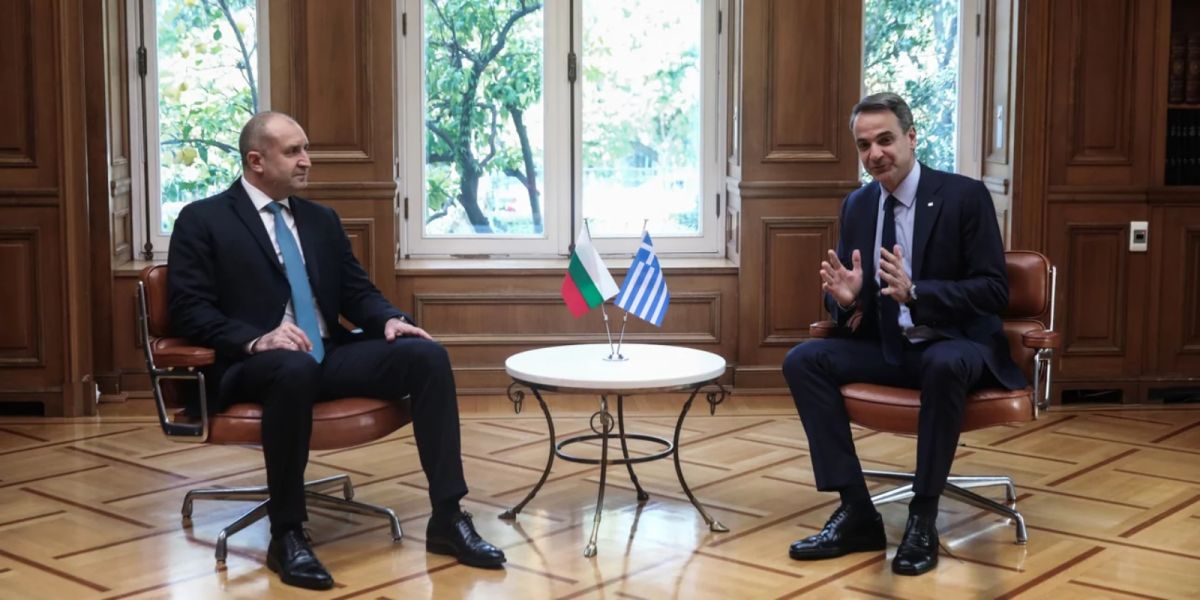
Prime Minister Kyriakos Mitsotakis on Thursday spoke of agreements that “change the energy map of Southeast Europe” in joint statements with the President of Bulgaria, Ruben Radev, in Athens after the signing of two memoranda on energy infrastructure with the neighboring country. According to the prime minister, these agreements (which may include the possible construction of an Alexandroupolis-Burgas pipeline) will make the two countries energy providers in the European Union and will contribute to Europe’s energy security.
Talking about the first memorandum, which was signed between the energy ministries of the two countries and concerns the security of supply and storage of natural gas, the prime minister said that this development is especially timely due to the geopolitical situation. He noted that “Russian revisionism has stumbled on the brave defense of the Ukrainian people, but causes economic pain by turning energy into a means of state blackmail. The Bulgarians are well aware of this because last year Russia cut off the natural gas to the neighboring country.”
According to the prime minister, the answer was to rapidly end dependency on Russian fuel, while pointing out that the energy companies of the two countries can be served by the Chiren facilities in Bulgaria and Revythoussa facilities in Greece.
Mitsotakis spoke of “critical infrastructure” that will ensure energy security and noted that this was a bilateral agreement “which, however, has a European scope as it turns our countries into a crossroads for the movement of gas to the whole of Europe.” The specific agreement is a follow-up to a treaty Greece has signed with Italy, in this way forming an alternative network of strategic importance, he added.
The second Memorandum of Cooperation concerns oil and “breaking free from Russian sources,” Mitsotakis said. In particular, the second memorandum calls for examining the possibility of building a new pipeline that will connect Alexandroupolis to Burgas – rather than the opposite, as envisaged by a previous similar project – which will supply Bulgaria with energy.
“The new pipeline is being revived in the light of the new conditions as the Alexandroupolis-Burgas pipeline, not as Burgas-Alexandroupolis, offering new alternative sources of supply. Not because it replaces the tankers that have to cross the straits of the Bosphorus, but in this way it will be added to other energy facilities, such as the IGB and the FSRU in Alexandroupolis. The ultimate goal is for natural gas to reach even Ukraine,” Mitsotakis stated.
Finally, he underlined that the floating natural gas regasification unit in Alexandroupolis is progressing, he also mentioned other similar facilities “so that we can export to the neighboring countries. In our region, a new dense network of energy roads is being formed in the Balkans, in Europe and beyond. Greece and Bulgaria have a crucial role to play in Europe’s energy security, they can offer wider services to the EU,” Mitsotakis said and concluded: “We can become providers of energy security for the wider region.”
The Bulgarian President
On his part, Bulgaria’s President Rumen Radev underlined that the traditionally good cooperation between the two countries was further strengthened by the two memoranda and thanked the Greek prime minister for the access to Revythoussa.
“I remind you how important were the things we implemented through our relations and cooperation in the past year,” he noted and referred to the completion of natural gas pipeline connections and the increase in exports of electricity to Greece.
“All this transcends the dimensions of a cross-border agreement. Greece and Bulgaria have shown themselves to be pillars of stability for the region,” he said and added: “This cooperation changes the map in Southeast Europe, opening new perspectives for the two countries. The signing of the two memoranda is the continuation of the effort made by Greece and Bulgaria in the same direction.”
The two memoranda
The first memorandum provides for the collaboration of the energy ministries of both countries in the field of security and natural gas supply. According to this, Greek companies will be able to store gas at the Chiren facilities in Bulgaria, while correspondingly, Bulgarian companies will be able to use Revythoussa. “Thus both countries have access to critical infrastructure for their energy security,” as the prime minister pointed out.
The second memorandum concerns oil. “Athens and Sofia are committed to exploring the possibility of building a new pipeline that will connect the two hub ports of Alexandroupolis and Burgas, as well as two seas, the Aegean and the Black Sea,” Mitsotakis said, adding that it is “a project that is being revived in the light of new conditions, not as the Burgas-Alexandroupolis pipeline, but as the Alexandroupoli-Burgas pipeline, offering Bulgaria alternative sources of supply.” [AMNA]
Διαβάστε όλες τις τελευταίες Ειδήσεις από την Ελλάδα και τον Κόσμο
Adonis Builds a Health Bridge With Israel: Greece Eyes Partnership With World-Leading Sheba
The Greek Health Minister is seeking to turn the strategic Greece-Israel relationship into practical cooperation in healthcare, bringing Israeli medical know-how, digital health and clinical innovation into the Greek system while positioning Greece as a potential European gateway for Sheba Medical Center.
Dendias: FREMM Frigates Will Transform Greece’s Fleet — “We Will Make Them Formidable”
Athens and Rome have signed the agreement for the transfer of the Carlo Bergamini and Virginio Fasan, scheduled for 2028 and 2029. But Greece is already looking beyond the first two ships: two additional FREMM frigates are under discussion, as FDI, FREMM and upgraded MEKO vessels emerge as the future core of Hellenic naval power.
El Alamein Summit: Greece, Egypt and Cyprus Build a New Strategic Axis in the Eastern Mediterranean
The trilateral meeting goes far beyond diplomatic symbolism: Mitsotakis, Sisi and Christodoulides are bringing energy, maritime security and regional stability under the same strategic framework, with the GREGY electricity interconnector emerging as a potential gateway linking Africa to Europe through Greece.
Netanyahu Bombshell: UAE Leader Reportedly Warned Him Hamas Was Planning a “Major Operation”
An investigation by Haaretz for the new book Hostages: 843 Days of Abandonment claims UAE President Mohammed bin Zayed personally warned Benjamin Netanyahu roughly 10 days before October 7 that Yahya Sinwar was preparing a major operation against Israel. Netanyahu’s office categorically rejects the account as an “absolute lie.”
Europe’s Fruit Map Is Shifting: Greece Faces a New Battle Over Water, Climate and Competitiveness
Climate change is no longer simply threatening crop yields — it is beginning to reshape where, how and at what cost Europe can grow fruit. For Greece, citrus and stone fruit are on the front line, while access to water is rapidly becoming the defining factor in agricultural competitiveness.
Wall Street Buys Into Greek Shipping: The Capesize Comeback and Four Greek Bets Riding the Rally
This is more than a one-week shipping-stock rally. Capesize rates above $50,000 a day, resilient tanker markets and strong LPG fundamentals are creating a rare moment of strength across multiple shipping segments — with Diana Shipping, Star Bulk, Dorian LPG and Okeanis Eco Tankers positioned directly where global trade is generating cash.
Morgan Stanley: Greece’s Rerating Is Not Over — Banks, PPC and Metlen Lead the Next Investment Cycle
Morgan Stanley expects Greece’s real GDP to grow by 2% in both 2026 and 2027, with listed-company investment reaching €11.2 billion — Alpha Bank remains its top banking pick, while PPC and Metlen offer exposure to the country’s accelerating energy, infrastructure and industrial investment cycle.
Greece Posts Best Job-Creation Performance in 25 Years as Unemployment Falls Below 8%
A record 323,136 net new jobs were created in the first seven months of 2026, while unemployment fell to 7.9% from 17.9% in 2019 — shifting Greece’s labour-policy challenge from simply creating jobs to delivering better-paid, more productive and fully declared employment.