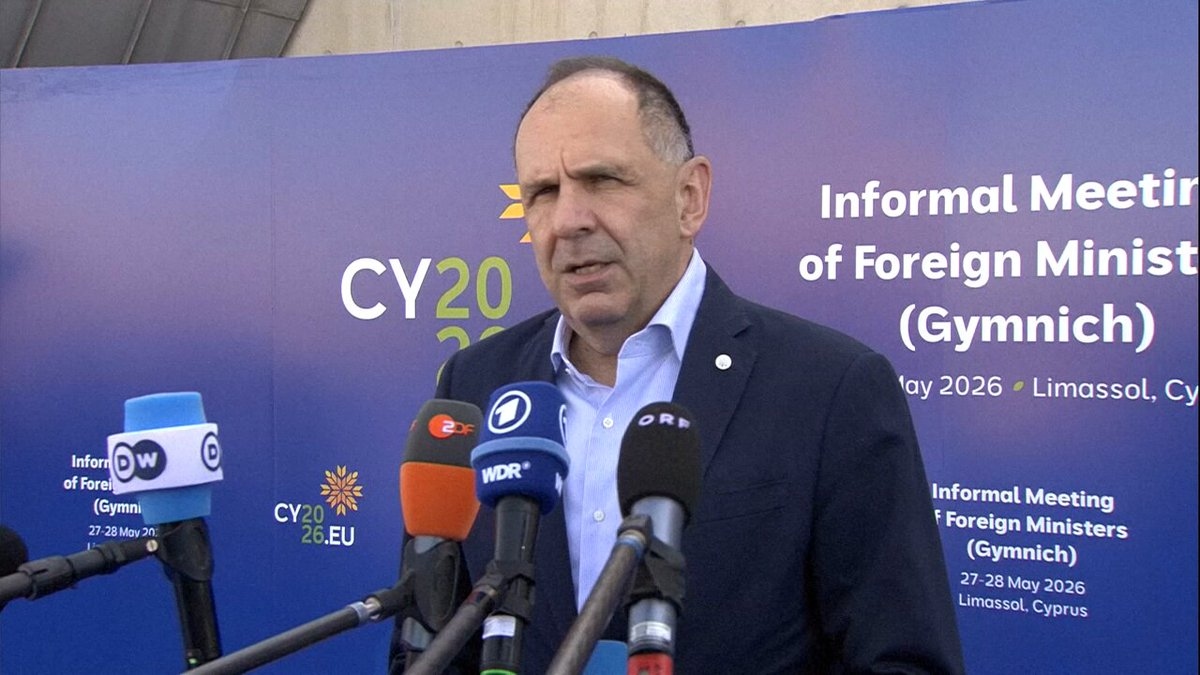
Greek Foreign Minister Giorgos Gerapetritis used the informal EU Foreign Affairs “Gymnich” meeting in Limassol to deliver one of Athens’ clearest geopolitical messages in recent months — combining warnings against revisionism with a renewed call for stronger European strategic autonomy.
Speaking upon his arrival at the high-level gathering of EU foreign ministers in Cyprus, Gerapetritis stressed the urgent need for full respect of international law and warned that attacks against civilian infrastructure and non-combatants could not be tolerated under any circumstances.
“No attack against civilian infrastructure, no attack against civilians can be accepted,” the Greek minister stated.
Diplomatic sources interpreted the remarks as extending beyond the war in Ukraine, reflecting broader concerns within Athens over growing instability across the Eastern Mediterranean and the wider Middle East.
“A united and strong voice against revisionism”
The most politically significant part of Gerapetritis’ intervention came when he addressed the issue of revisionism directly.
“We must all articulate a united and strong voice against any form of revisionism,” he declared, warning that in an already fragile geopolitical environment, revisionist policies risk generating wider global instability.
According to Greek officials, Athens increasingly views the coming period as highly sensitive for:
- EU-Turkey relations,
- regional stability in the Eastern Mediterranean,
- and the cohesion of the European Union itself amid mounting external pressures.
Government sources say Greece is seeking to position itself as a stabilizing actor and diplomatic bridge between Europe, the Middle East and the Indo-Pacific region.

Strategic autonomy returns to the center of the debate
Gerapetritis also strongly emphasized the importance of European strategic autonomy — a concept that has regained momentum following:
- the war in Ukraine,
- Europe’s energy crisis,
- escalating security threats,
- and growing uncertainty over the global balance of power.
“Strategic autonomy means competitiveness — but competitiveness with cohesion and convergence. It means resilience, both energy and defense resilience,” he stressed.
The Greek position reflects a broader push within parts of the EU for:
- stronger collective defense capabilities,
- greater energy independence,
- more coordinated industrial policy,
- and enhanced geopolitical leverage.
Athens believes the European Union can no longer operate solely as an economic bloc, but must evolve into a more autonomous strategic actor.
Focus on the “Global South”
In a notable diplomatic signal, Gerapetritis also called for a broader “360-degree” European foreign policy approach focused on the so-called Global South.
“We need a policy that looks comprehensively at the world, especially at the Global South,” he said.
The statement aligns with the EU’s growing effort to deepen ties with emerging economies and strategically important regions outside the traditional Euro-Atlantic sphere.
Greek diplomacy has increasingly prioritized outreach toward:
- Gulf states,
- India,
- Africa,
- and emerging trade and energy corridors linking Europe with Asia and the Middle East.
Saudi Arabia and India seen as strategic partners
The Limassol meeting also includes discussions between EU foreign ministers and their counterparts from Saudi Arabia and India — two countries that Greece now openly describes as strategic partners.
Over the past several years, Athens has significantly upgraded its political, economic and security relations with both countries as part of a wider effort to strengthen its geopolitical footprint.
Within diplomatic circles, Greece’s role is increasingly viewed through the lens of:
- energy connectivity,
- regional security cooperation,
- maritime trade routes,
- and Europe’s diversification strategy.
That is why officials in Athens see meetings such as the one in Cyprus as far more than routine diplomatic gatherings.
In today’s geopolitical environment, alliances themselves have become a frontline.
Source: pagenews.gr