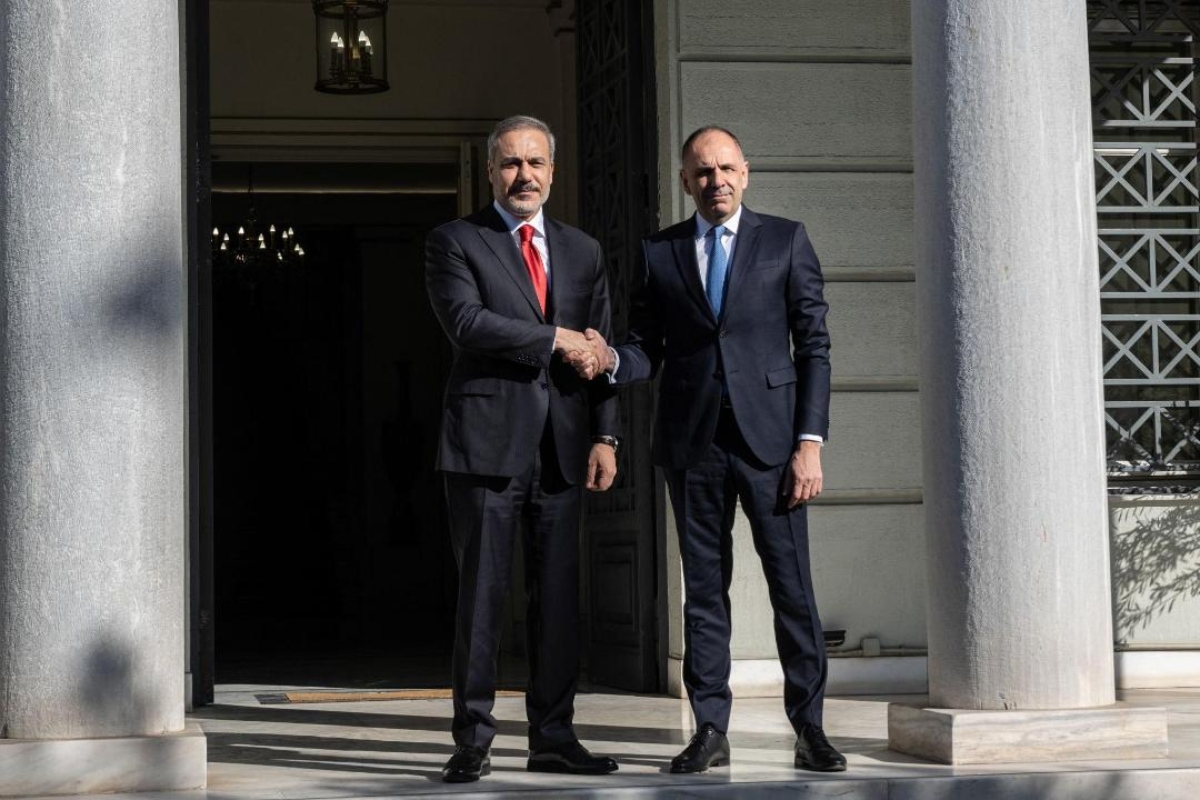
DIPLOMATIC BACKDROP: CONTROLLED TENSION IN SOFIA
A high-stakes meeting took place in Sofia between Greek Foreign Minister Gerapetritis and Turkish Foreign Minister Fidan the sidelines of the SEECP summit.
While publicly framed as constructive, the encounter reflected a carefully managed diplomatic tension rather than substantive convergence.
At the center of discussions was Turkey’s emerging legislative and strategic framing linked to the so-called “Blue Homeland” doctrine, which Greece views as a unilateral and destabilizing narrative in the Eastern Mediterranean.
GREEK POSITION: RED LINES AND LEGAL FRAMEWORK
According to diplomatic briefings, the Greek side reiterated a firm message:
Unilateral actions do not produce legal effects and do not contribute to regional stability.
Athens maintains that the only bilateral dispute between the two countries concerns:
- Delimitation of the Exclusive Economic Zone (EEZ)
- Continental shelf boundaries
Everything else, according to Greece, falls under established international law and sovereignty rights, not negotiation.


TURKISH STRATEGIC FRAMEWORK: “BLUE HOMELAND” CONTINUES
Ankara continues to promote its maritime doctrine, widely referred to as “Mavi Vatan” (Blue Homeland), which expands Turkey’s strategic maritime claims across the Aegean and Eastern Mediterranean.
From Turkey’s perspective, the issue is framed not as escalation but as maritime rights assertion and regional balance correction.
The Sofia meeting confirmed that both sides are still operating on fundamentally different legal and strategic interpretations of maritime space.
THE LONG-STANDING DEADLOCK
The Cyprus issue was also a key topic, ahead of upcoming UN-led consultations involving the Secretary-General’s Personal Envoy.
Key divergence remains unchanged:
- Greece and the Republic of Cyprus support a bi-zonal, bi-communal federation framework
- Turkey continues to signal openness to a two-state or loose confederation model
The gap remains structurally entrenched, with little indication of convergence ahead of future informal talks.
TRANSATLANTIC AND REGIONAL SHIFTS
The ministers also discussed:
- Preparations for the upcoming July summit in Ankara
- The evolving state of transatlantic relations
- Escalating instability in the broader Middle East
- Security dynamics in the Eastern Mediterranean
These overlapping crises are increasingly shaping the strategic environment in which Greek–Turkish relations unfold, limiting the space for bilateral breakthroughs.

TWO PARALLEL WORLDS
Greece:
- Emphasizes international law and maritime delimitation
- Rejects unilateral maritime doctrines
- Frames dispute as narrowly legal and technical
Turkey:
- Promotes strategic maritime doctrine (“Blue Homeland”)
- Seeks broader regional maritime influence
- Frames disputes as geopolitical balance issues
The result is a parallel narrative structure, where both sides speak diplomatically but operate from incompatible strategic assumptions.
POLITICAL SIGNALS AND BEHIND-THE-SCENES READINGS
Diplomatic observers note that the Sofia meeting served three functions:
- Maintaining communication channels
- Preventing escalation in a sensitive period
- Signaling red lines to domestic and international audiences
There was no indication of breakthrough, but also no breakdown — a familiar pattern in recent Greek–Turkish engagement cycles.

MANAGED STABILITY, NOT RESOLUTION
The Sofia encounter reinforced a central reality of current Eastern Mediterranean diplomacy:
stability is being managed, not resolved.
While dialogue continues, structural disagreements over maritime law, sovereignty, and Cyprus remain firmly in place.
For now, both Athens and Ankara appear committed to controlled engagement without strategic compromise.
Source: pagenews.gr