Fidan from Egypt:Pressure on Cairo,attack on the Greece–Cyprus–Israel trilateral and Ankara’s“Mecca” strategy
 ΧΡΟΝΟΣ ΑΝΑΓΝΩΣΗΣ 12 '
Πηγή Φωτογραφίας: AP Photo//Fidan from Egypt: Pressure on Cairo, attack on the Greece–Cyprus–Israel trilateral and Ankara’s “Mecca” strategy



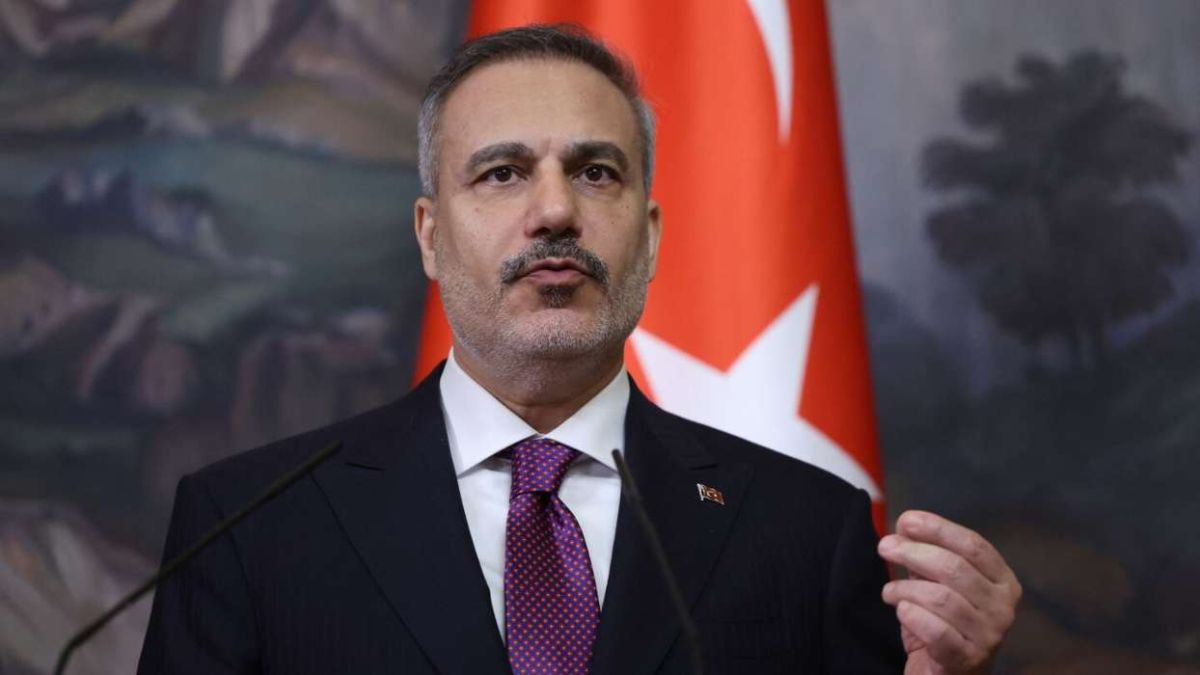
In a move with clear geopolitical depth, Hakan Fidan is attempting to use the rapprochement between Turkey and Egypt for something much larger than a bilateral reset: the gradual construction of a new regional security and influence framework in which Ankara wants to play a central role.
The Turkish foreign minister’s visit to Egypt carries particular significance just days after the signing, on 7 August 2026, of the Mecca Joint Defense Agreement between Turkey, Saudi Arabia and Pakistan.
The agreement provides that an attack against one of the three states will be regarded as an attack against all, creating for the first time an explicit framework of collective deterrence between Ankara, Riyadh and Islamabad.
And the next major question is obvious:
Will Egypt join?
Fidan’s move: Bring Cairo into the new framework
The effort did not begin now.
On 21 June 2026, the foreign ministers of Egypt, Turkey, Saudi Arabia and Pakistan had already met in Cairo within the R4 quadrilateral format.
The joint statement spoke of deeper coordination aimed at regional security and stability. Egyptian President Abdel Fattah el-Sisi had also underlined that the four countries are key pillars of regional security and had supported the evolution of the format into a more effective institutional mechanism.
After the Mecca Agreement, however, the framework changed.
What had previously been a four-way political consultation mechanism now has a harder strategic core: Turkey, Saudi Arabia and Pakistan are bound by a defense commitment.
Fidan has said that other countries could eventually join the new arrangement and has publicly referred to Egypt as a potential future partner.
That is the real significance of his visit.
Ankara is no longer discussing merely the normalization of relations with Cairo.
It is testing whether Egypt is prepared to move from political coordination to a much deeper strategic alignment.
The attack on Greece, Cyprus and Israel
It is within this broader context that Fidan’s latest attack on the Greece–Republic of Cyprus–Israel trilateral cooperation should be read.
The Turkish foreign minister does not view the format as a simple partnership among three states.
He has repeatedly portrayed it as a mechanism designed to strategically contain Turkey.
Earlier in April 2026, he argued that the cooperation among Greece, Cyprus and Israel in the Eastern Mediterranean gave Ankara the impression of an attempt to “encircle” Turkey.
He later went even further, describing the cooperation as a military alliance and claiming that concrete military structures were being developed.
The Turkish line, therefore, is not new.
But the key factor now is where Fidan is making the argument: inside Egypt.
Why the reference to Egypt is the real message
Ankara is trying to persuade Cairo that the Greece–Cyprus–Israel arrangements do not only affect Turkey, but may also restrict Egypt’s regional role.
This is a clear attempt to alter the way Cairo views the geopolitical balance in the Eastern Mediterranean.
Yet there is a major obstacle to that strategy:
Egypt is not an outside observer of the existing regional cooperation system. It is one of its principal architects.
Greece, Cyprus and Egypt have maintained an institutionalized trilateral cooperation framework since 2014.
Even more importantly, on 6 August 2020, Greece and Egypt signed their partial maritime delimitation agreement, creating a legal and strategic framework directly linking Athens and Cairo in the Eastern Mediterranean.
Fidan is therefore not attempting to win over a neutral Egypt.
He is attempting to gradually shift a country that already has deep strategic ties with Greece and Cyprus.
The East Mediterranean Gas Forum is another obstacle for Ankara
There is another structure Turkey cannot ignore.
The East Mediterranean Gas Forum, based in Cairo, includes Egypt, Greece, Cyprus and Israel among its members.
This is strategically significant.
Egypt is not merely Greece’s partner in the region.
It hosts one of the key institutional platforms for energy cooperation involving Greece, Cyprus and Israel.
Any Turkish effort to present the trilateral cooperation as a threat to Egypt therefore runs up against years of Egyptian policy.
The Mecca Agreement changes the equation
The real innovation lies elsewhere.
The new Turkey–Saudi Arabia–Pakistan agreement creates an axis with characteristics that no previous regional format possessed.
Saudi Arabia contributes financial power and political weight in the Arab and Muslim world.
Turkey brings one of NATO’s largest armed forces, a rapidly expanding defense industry and a growing military presence beyond its borders.
Pakistan adds a strategically decisive factor: it is a nuclear-armed state.
The Mecca Agreement provides for a collective-defense mechanism, regular meetings of foreign and defense ministers and a permanent secretariat in Saudi Arabia.
It is not yet a “Muslim NATO.”
But it is clearly more than an ordinary diplomatic consultation mechanism.
Ankara’s argument: “We are not targeting anyone”
Here, however, an interesting contradiction emerges in Turkish strategy.
Fidan insists that the Mecca Agreement is not directed against any particular country and that its purpose is collective deterrence.
At the same time, Ankara describes the cooperation of Greece, Cyprus and Israel as inherently hostile or military in nature.
That allows Athens to reverse the argument:
If Turkey has the right to construct its own regional defense partnerships, it cannot automatically brand every partnership among other states as hostile.
Sisi’s dilemma
For President Abdel Fattah el-Sisi, the issue is far more complicated than whether Egypt wants better relations with Turkey.
It already does.
The real decision is whether Cairo is willing to enter a new defense system in which Turkey and Saudi Arabia would inevitably seek leading political roles.
Egypt is the most populous Arab state and historically sees itself as a natural center of gravity in the Arab world.
It is by no means certain that it would accept the role of a fourth member in a structure designed elsewhere.
Then there is India
Pakistan’s participation adds another layer of difficulty.
Egypt has developed important ties with India and seeks a multidirectional foreign policy that avoids being trapped in rivalries between third countries.
Joining a defense pact involving Pakistan would therefore require careful management of relations with New Delhi.
This is one reason Cairo may prefer to remain engaged in the R4 as a political and diplomatic partner, without necessarily accepting a full collective-defense commitment.
Gaza as the glue of the new alignment
The area where Turkey and Egypt are currently much closer is Gaza.
Ankara and Cairo have both adopted a highly critical position toward Israeli policy and have repeatedly participated in joint statements with Saudi Arabia, Qatar, Jordan and other Muslim-majority states.
Gaza therefore functions as the strongest area of Turkish-Egyptian convergence.
But that does not automatically translate into a common strategic approach toward Israel.
Why Egypt cannot easily become part of an anti-Israel bloc
Egypt has a constraint Turkey does not face in the same way.
It shares borders with Israel and Gaza and was the first Arab state to formally recognize Israel, following the 1979 peace treaty.
That means Cairo can sharply criticize the Israeli government while still needing functioning channels of communication with Israel.
Without those channels, Egypt’s role as a mediator in Gaza would be weakened.
For that reason, Egyptian foreign policy has every incentive to maintain simultaneously:
relations with Israel, close cooperation with Greece and Cyprus, a channel with Turkey, partnership with Saudi Arabia, and strong ties with the United States and the UAE.
This multi-vector balancing strategy may be Cairo’s greatest geopolitical asset.
Libya is the second major test
Another field where the Turkish-Egyptian rapprochement could prove decisive is Libya.
For years, the two countries supported opposing camps.
Turkey developed a military presence and strong influence in western Libya, while Egypt maintained close relations with the eastern camp and Khalifa Haftar.
If Ankara and Cairo manage to turn rivalry into coordination, one of the major fault lines of the Eastern Mediterranean may begin to narrow.
For Greece, however, this has a dual significance.
Libya is directly connected to the 2019 Turkey-Libya maritime memorandum, which Athens rejects.
The major Greek question
For Athens, the central issue is not whether Turkey and Egypt restore their relations.
That process is already well advanced.
The crucial question is whether the improvement in Turkish-Egyptian ties will alter Cairo’s strategic choices in the Eastern Mediterranean.
So far, there is no clear evidence of Egypt abandoning its relationship with Greece.
The maritime delimitation agreement remains in force.
The Greece–Cyprus–Egypt trilateral remains institutionalized.
The East Mediterranean Gas Forum remains based in Cairo.
And Egypt has spent years investing in a role that allows it to talk to all sides without becoming dependent on any single one.
Fidan’s difficult game
None of this means Turkey’s move should be underestimated.
Quite the opposite.
Hakan Fidan is attempting something that only a few years ago would have appeared almost impossible: turning a relationship of deep hostility with Sisi’s government into strategic cooperation.
The rupture began after the overthrow of Mohamed Morsi in 2013, when Ankara entered into open confrontation with Egypt’s new leadership.
Thirteen years later, Turkey is no longer merely seeking diplomatic normalization.
It wants Cairo alongside it in a new regional mechanism.
That alone represents a major shift in the regional balance.
“Mecca” is not yet a rival NATO – but it is a message
It would be an exaggeration to describe the Turkey–Saudi Arabia–Pakistan framework today as a fully operational “Muslim NATO.”
There is still no institutional, operational and military integration comparable to NATO.
The three countries also have significant differences in their strategic priorities and regional relationships.
But the political significance is undeniable.
For the first time, three of the most important powers in the Muslim world are creating an explicit mechanism of mutual defense.
And Ankara wants to expand that circle.
The real battle is over the region’s future architecture
Fidan’s visit to Egypt is ultimately not just about bilateral relations.
It is about a much larger contest over who will shape the emerging security architecture of the Eastern Mediterranean and the Middle East.
On one side are the cooperation networks developed over the past decade among Greece, Cyprus, Egypt and Israel, centered on energy, maritime zones and security.
On the other, Turkey is seeking to build a new axis with Saudi Arabia and Pakistan, taking advantage of regional frustration with the existing Western security architecture and the crises surrounding Gaza and Iran.
And between those two structures stands Egypt.
Cairo may be the most valuable geopolitical prize in this regional realignment.
For Turkey, bringing Egypt into the Mecca framework would be a major strategic victory.
For Greece and Cyprus, the challenge is different: ensuring that Egypt remains a stable partner in the Eastern Mediterranean and that its rapprochement with Ankara does not evolve into a revision of existing agreements and balances.
Fidan has opened the game.
Whether Sisi chooses to play by Ankara’s rules or continues to balance among competing centers of power will determine far more than the outcome of a single diplomatic visit.
Source: pagenews.gr
Διαβάστε όλες τις τελευταίες Ειδήσεις από την Ελλάδα και τον Κόσμο