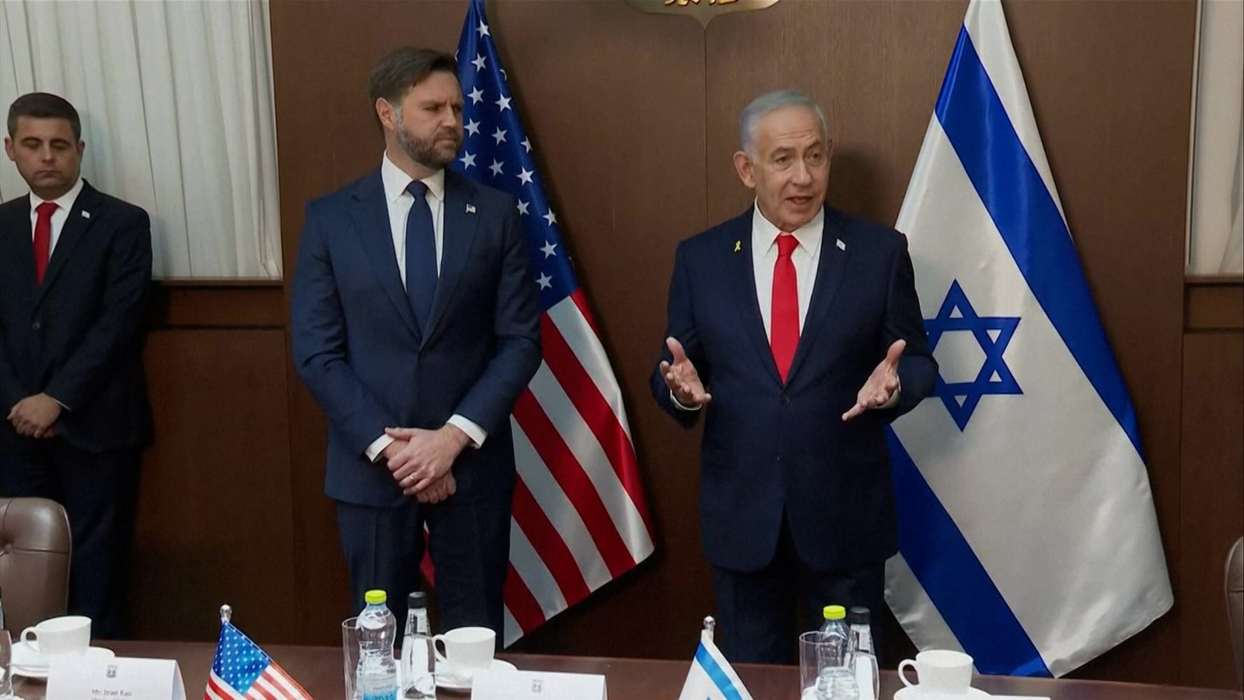
Vice President JD Vance delivered one of the sharpest public warnings ever directed at an Israeli government by a senior member of a Republican administration, cautioning Jerusalem against undermining President Donald Trump’s Iran deal and openly questioning the wisdom of attacking the only major ally still fully committed to Israel’s security.
The remarks represent more than diplomatic frustration.
They reveal a deeper strategic reality emerging inside the Trump administration: support for Israel remains strong, but Washington increasingly expects alignment with its broader regional strategy.
The message was unmistakable.
The White House views the Iran agreement as a cornerstone of its Middle East policy, and officials appear increasingly unwilling to tolerate public efforts by Israeli political figures to sabotage it.
A PUBLIC WARNING TO NETANYAHU’S GOVERNMENT
Asked about reports that Prime Minister Benjamin Netanyahu and his political allies were furious over the U.S.–Iran agreement, Vance responded with unusual bluntness.
While he noted that he had not personally experienced anger from Netanyahu himself, he admitted he was deeply troubled by members of the Israeli cabinet publicly attacking President Trump over the deal.
His warning was direct:
“Donald J. Trump is the only head of state in the entire world who is sympathetic to the nation of Israel at this moment in time.”
He went further.


“If I was in the cabinet of the Israeli government, I might not be attacking the only powerful ally that I have anywhere left in the entire world.”
For many observers, the statement marked a significant shift in tone.
Rather than emphasizing unconditional solidarity, Vance framed the relationship in transactional strategic terms, reminding Israeli leaders that geopolitical realities are changing rapidly.
THE MILITARY SUPPORT MESSAGE
The most consequential part of Vance’s remarks may have been his reference to American military assistance.
The Vice President noted that roughly two-thirds of the defensive weapons protecting Israel were built by American workers and funded by American taxpayers.
That observation was not merely descriptive.
It functioned as a strategic signal.


Washington was effectively reminding Jerusalem that Israel’s qualitative military edge remains deeply dependent on American industrial capacity, defense technology, and financial support.
The implication was impossible to ignore:
Strategic partnership does not eliminate strategic expectations.
While Vance stopped short of threatening a reduction in support, the underlying message suggested that continued friction could carry consequences.
THE GROWING FRICTION INSIDE THE ALLIANCE
According to Axios, frustration with Netanyahu’s government has been building within Trump’s inner circle for months.
Administration officials increasingly believe that parts of the Israeli political establishment are attempting to challenge or undermine a diplomatic initiative that Trump considers one of his most significant foreign-policy achievements.
Privately, Netanyahu is said to have expressed concerns about the agreement.
Publicly, however, he has largely maintained discipline, emphasizing the importance of preserving the U.S.–Israel relationship while protecting Israel’s national security interests.
Others inside his coalition have been less restrained.
Senior ministers, including Bezalel Smotrich and Itamar Ben Gvir, along with several figures within Likud, have openly criticized Trump’s approach toward Iran.
Pro-Netanyahu voices in Israeli media have also targeted key administration figures, including Vance, Jared Kushner, and Steve Witkoff.
For Washington, these attacks appear to have crossed a political red line.


LEBANON IS THE REAL BATTLEGROUND
Behind the dispute over Iran lies an even more sensitive issue: Lebanon.
The U.S.–Iran memorandum of understanding reportedly includes provisions linked to a broader ceasefire framework covering hostilities between Israel and Hezbollah.
Under any eventual comprehensive agreement, Israel could face pressure to withdraw from territories it currently occupies in southern Lebanon.
That is where strategic interests begin to diverge.
Netanyahu insists Israel will not leave areas it considers vital to its security.
Washington, meanwhile, increasingly expects all parties—including Israel—to support a wider de-escalation process.
Vance made that expectation explicit.
The United States expects Hezbollah not to attack Israel.
But it also expects Israel not to destabilize the peace process through unilateral military escalation.
In diplomatic language, that was a warning.
TRUMP’S NEW MIDDLE EAST DOCTRINE
President Trump has repeatedly signaled that his priority is no longer managing endless regional conflicts but bringing them to a close.
His criticism of Israeli operations in Lebanon, coupled with his calls for a comprehensive ceasefire, reflects a broader strategic objective.
Following Vance’s remarks, Trump reinforced the message publicly, urging all actors in the region to allow the agreement to proceed.
His goal appears increasingly clear:
Transform the Iran ceasefire framework into a broader regional security architecture that includes Israel, Arab states, Lebanon, and eventually Iran itself.
Such a vision requires discipline from allies as well as adversaries.
And that requirement now appears to include Israel.
STRATEGIC FRAMING
The significance of Vance’s intervention extends far beyond a disagreement over Iran.
It reflects an emerging shift in the balance between support and leverage inside the U.S.–Israel relationship.
For decades, American backing was often viewed as politically automatic.
The Trump administration is signaling something different.
Support remains strong.
But strategic coordination is now expected in return.
Washington is effectively telling Jerusalem:
• Do not undermine a diplomatic agreement the President views as a strategic success.
• Do not attack the administration that continues to provide unparalleled military support.
• Do not assume unlimited freedom of action when broader regional stability is at stake.
This is not a break in the alliance.
It is an attempt to redefine its terms.
JD Vance’s warning represents one of the clearest indications yet that the White House intends to enforce strategic discipline among its regional partners.
The administration continues to stand firmly behind Israel’s security.
However, it is increasingly unwilling to allow Israeli domestic politics to jeopardize a diplomatic framework that Trump views as central to his legacy and his broader Middle East strategy.
The core message is unmistakable:
Washington remains Israel’s strongest ally. But it is no longer prepared to grant unlimited strategic latitude if that freedom threatens a regional agreement the White House considers vital to long-term stability.
This article is based primarily on reporting by Axios regarding Vice President JD Vance’s remarks on the U.S.–Iran agreement and Israel’s reaction to the deal. The analysis focuses on the geopolitical implications of those statements and the evolving dynamics within the U.S.–Israel relationship. Interpretations, strategic assessments, and scenario projections reflect editorial judgment and should be understood as analytical commentary rather than official positions of the U.S. or Israeli governments.