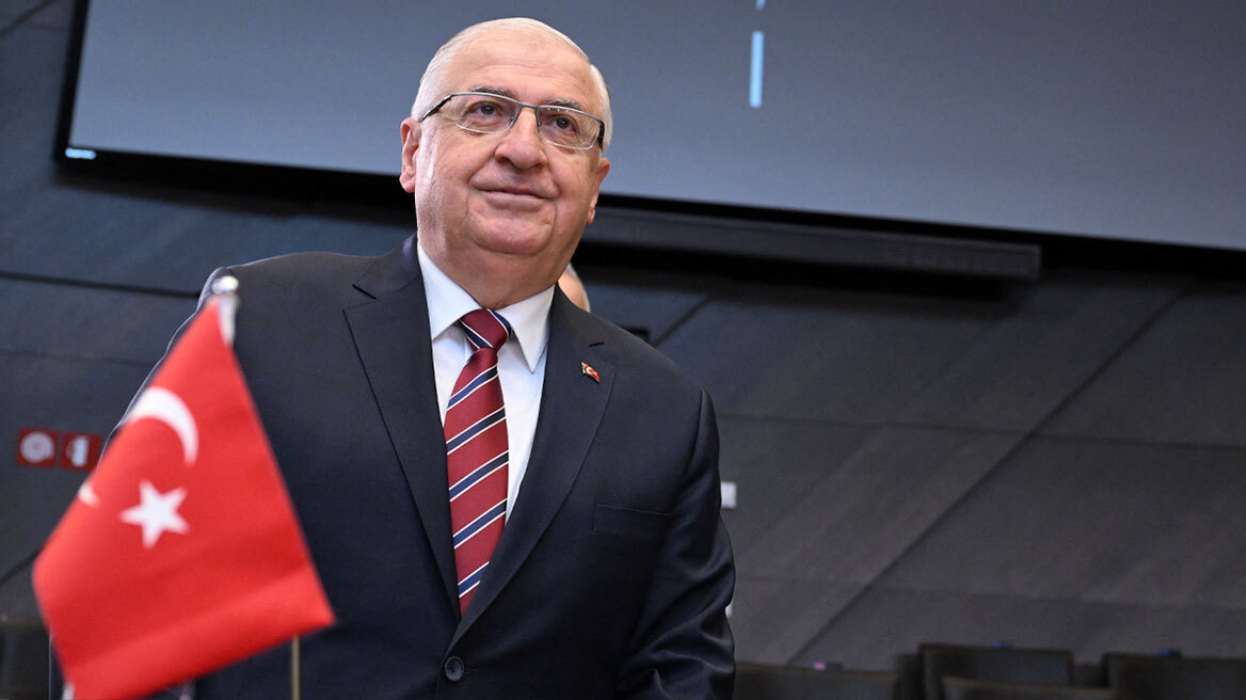
Turkey has once again elevated tensions in the Eastern Mediterranean, this time targeting the growing defense cooperation between the Republic of Cyprus and France. Statements made by Turkish Defense Minister Yaşar Güler reveal a broader geopolitical strategy aimed at challenging emerging security arrangements in the region while simultaneously preserving Ankara’s leverage in its relationship with the European Union.
Speaking to Turkish journalists in Brussels, Güler strongly criticized the military agreement between Nicosia and Paris, under which French forces may periodically be stationed on Cypriot territory. According to Ankara, the agreement represents a direct challenge to the existing security architecture in the Eastern Mediterranean.
“It is extremely important that all actors refrain from actions that could increase regional tensions and instead prioritize dialogue, cooperation, and a shared understanding of security,” Güler stated.
While presenting Turkey as a proponent of regional stability, the Turkish minister quickly shifted his focus toward the Cyprus-France agreement, describing it as both illegitimate and destabilizing.
“The agreement signed between the Greek Cypriot Administration of Southern Cyprus and France, which does not possess the status of a guarantor power, is in fact an initiative lacking legitimacy, one that disrupts sensitive balances and runs contrary to international law,” he argued.
The remarks reflect Ankara’s longstanding position that Cyprus-related security arrangements should remain linked to the 1960 Treaty of Guarantee, a framework that Turkey continues to invoke despite the Republic of Cyprus being a sovereign member state of the European Union.


A Message to Paris as Much as to Nicosia
Beyond its criticism of Cyprus, Ankara’s message appears equally directed at France, whose strategic footprint in the Eastern Mediterranean has expanded significantly in recent years through defense agreements with both Greece and Cyprus.
Turkey increasingly views the emerging security network involving Greece, Cyprus, France, and other regional actors as a challenge to its own geopolitical ambitions in the region.
Güler made this concern explicit.
“Considering Turkey’s military strength, deterrence capability, and geostrategic position, any alliance targeting the rights and interests of Turkey and the Turkish Cypriots has no chance of succeeding,” he declared.
This statement is widely interpreted as a warning that Ankara will not remain passive in the face of security initiatives it perceives as undermining its interests. It also reflects growing Turkish concern that France is becoming the leading European military power shaping the security environment of the Eastern Mediterranean.
Renewed Threats Regarding Northern Cyprus
The Turkish Defense Minister went even further by emphasizing Ankara’s readiness to respond to what it considers hostile developments affecting the self-declared Turkish Republic of Northern Cyprus, recognized only by Turkey.
“The Turkish Armed Forces possess both the capability and the determination to respond to faits accomplis and hostile actions targeting the security of the TRNC,” Güler warned.
Such rhetoric revives Turkey’s traditional security doctrine regarding Cyprus and signals that Ankara remains prepared to use hard-power language whenever it perceives strategic shifts on the island.
The statements come at a sensitive moment, as Cyprus continues to deepen its defense relationships with European partners and strengthen its role within broader regional security frameworks.
The Turkish Paradox: Confronting Cyprus While Reaching Out to Europe
What makes Ankara’s position particularly noteworthy is the apparent contradiction between its confrontational stance toward Cyprus and its simultaneous efforts to improve relations with the European Union.
While threatening consequences over defense cooperation involving an EU member state, Turkey is also attempting to present itself as an indispensable partner for Europe on issues ranging from defense and security to migration, energy, and regional stability.
This dual-track strategy was evident during discussions in Brussels, where Turkish officials emphasized Turkey’s strategic importance for European security while maintaining an aggressive tone regarding developments in the Eastern Mediterranean.
The approach reflects Ankara’s broader geopolitical calculation: maintaining pressure on regional rivals while preserving channels of cooperation with Western institutions.
Turkey’s reaction demonstrates that it views the Cyprus-France defense agreement as far more than a bilateral military arrangement. From Ankara’s perspective, the agreement is part of a wider strategic architecture that is gradually strengthening the European security presence in the Eastern Mediterranean.
The prospect of an expanded French military footprint in Cyprus carries implications beyond defense cooperation. It reinforces the strategic alignment between Nicosia, Athens, and Paris while increasing European involvement in a region where Turkey has long sought to preserve freedom of maneuver.
At the same time, Ankara is careful not to completely alienate Brussels. Even as it challenges Cyprus and France, Turkey continues to present itself as a critical geopolitical actor whose cooperation remains necessary for Europe’s security calculations.
The message from Ankara is therefore twofold: deterrence toward Cyprus and France, and strategic engagement toward the European Union. It is a familiar Turkish balancing act—applying pressure where it sees threats to its interests while ensuring that its geopolitical relevance to the West remains intact.
Source: pagenews.gr