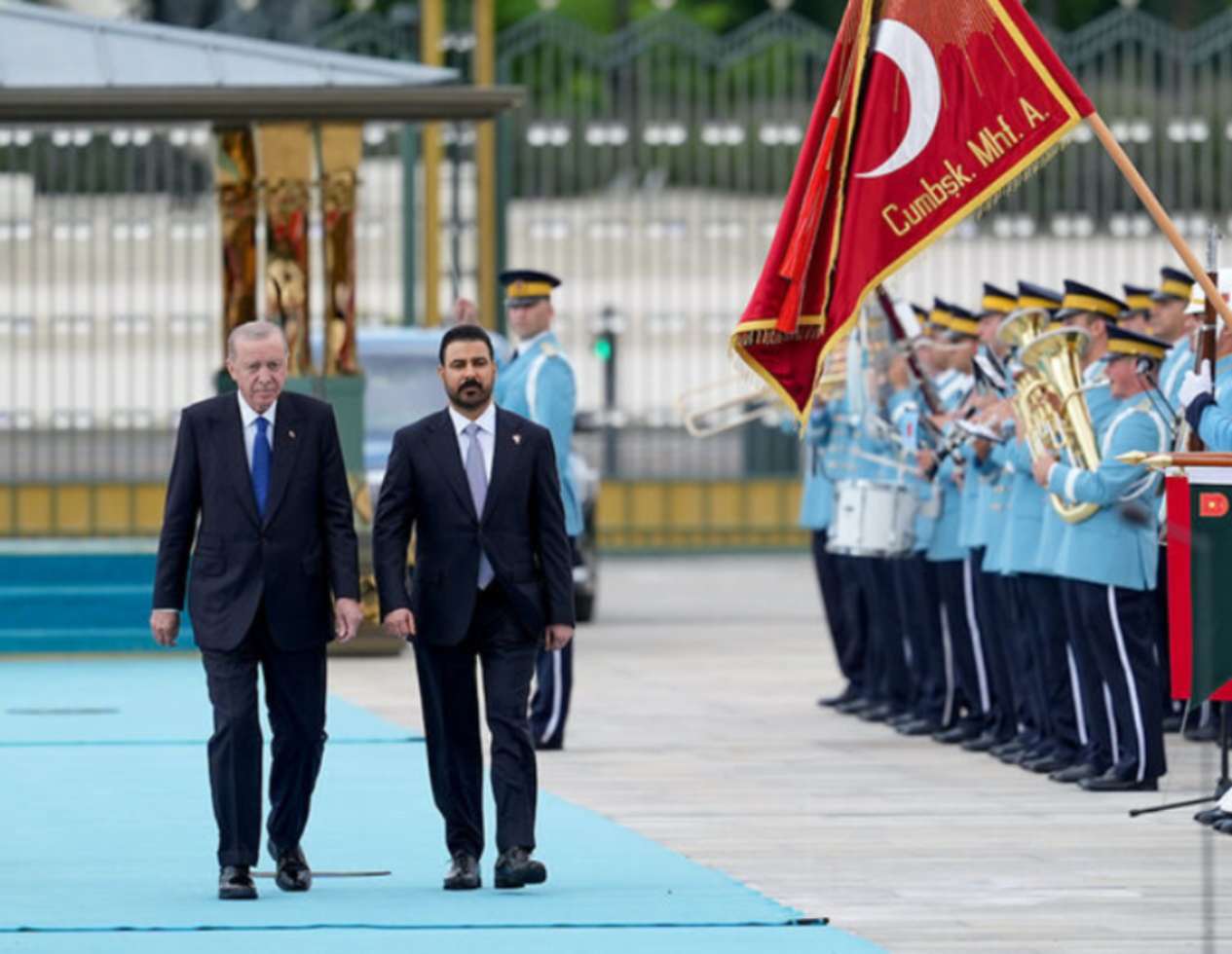
Erdogan hails a “historic step” in bilateral relations
Turkish President Recep Tayyip Erdogan and Iraqi Prime Minister Ali al-Zaidi announced a significant upgrade in energy cooperation following nearly three hours of talks in Ankara.
The meeting brought together senior officials from both governments, including Turkish Foreign Minister Hakan Fidan, Energy Minister Alparslan Bayraktar, intelligence chief Ibrahim Kalin, and Iraqi Foreign Minister Fuad Hussein, Finance Minister Faleh al-Sari, and Oil Minister Basim Mohammed Khudair, underscoring the strategic importance of the negotiations.
During the joint press conference, Erdogan declared:
“Our goal is to sign a comprehensive energy cooperation agreement as soon as possible that will benefit both countries.”
He described the agreement as a “historic step”, revealing that Iraq has offered to supply Turkey with up to one million barrels of crude oil per day.
Turkey secures stake in Kirkuk oil fields
One of the most important outcomes of the visit was Turkey’s entry into Iraq’s upstream oil sector.
Turkey’s state-owned energy company TPAO agreed to acquire a 15% stake in BP Energy Company of Kirkuk Limited, the consortium led by BP and ConocoPhillips responsible for redeveloping the Kirkuk oil and gas fields.


The project includes:
- redevelopment of mature oil fields,
- expansion of natural gas production,
- increased crude output,
- long-term investment in northern Iraq’s energy infrastructure.
Financial terms of the transaction were not disclosed.
Kirkuk–Ceyhan pipeline remains operational
Although the 53-year operating agreement governing the 986-kilometer Kirkuk–Ceyhan pipeline officially expired on July 27, Ankara and Baghdad agreed to keep oil flowing while negotiations continue on a replacement agreement.
According to Turkish officials, the new agreement is expected to apply retroactively from the expiration date, ensuring uninterrupted exports.
Key facts about the pipeline
- Length: 986 km
- Maximum capacity: 1.5 million barrels per day
- Current exports (June): approximately 180,000 barrels per day
- Primary export route linking northern Iraqi oil fields to Turkey’s Mediterranean terminal at Ceyhan
- One of the few major energy corridors bypassing the Strait of Hormuz
Turkey wants the corridor extended to Basra
Turkey’s ambitions extend well beyond maintaining the existing pipeline.
Ankara is seeking:
- an extension of the corridor southward to Basra,
- direct access to Iraq’s largest oil-producing region,
- substantially higher export volumes,
- a stronger role as the principal energy gateway connecting Middle Eastern oil with European markets.


Regional conflict reshapes energy strategy
The renewed Turkish-Iraqi energy partnership comes at a time when the Strait of Hormuz has become increasingly vulnerable due to the regional conflict involving Iran.
As maritime shipping faces heightened security risks, land-based export routes are becoming strategically more valuable for both producers and consumers.
Against this backdrop, the Kirkuk–Ceyhan pipeline has emerged as one of the Middle East’s most important alternative export corridors.
Diplomatic tensions in the background
The diplomatic context further highlights the significance of the Ankara meeting.


Prime Minister Ali al-Zaidi cancelled a planned visit to Riyadh following recent US-Saudi military strikes, reflecting Baghdad’s delicate balancing act between regional powers while simultaneously strengthening cooperation with Turkey.
The agreements announced in Ankara represent far more than a bilateral energy partnership. Turkey is pursuing a long-term strategy to position itself as the primary land-based energy hub linking Iraq and Europe. By combining ownership stakes in upstream production, control over strategic export infrastructure, and plans to extend the Kirkuk–Ceyhan corridor toward Basra, Ankara is strengthening its leverage over regional energy flows. At a time when instability around the Strait of Hormuz continues to threaten global oil markets, this emerging Turkey-Iraq energy axis could become one of the most significant alternative supply routes for Europe, reshaping the geopolitical landscape of Middle Eastern energy exports.
Source: pagenews.gr