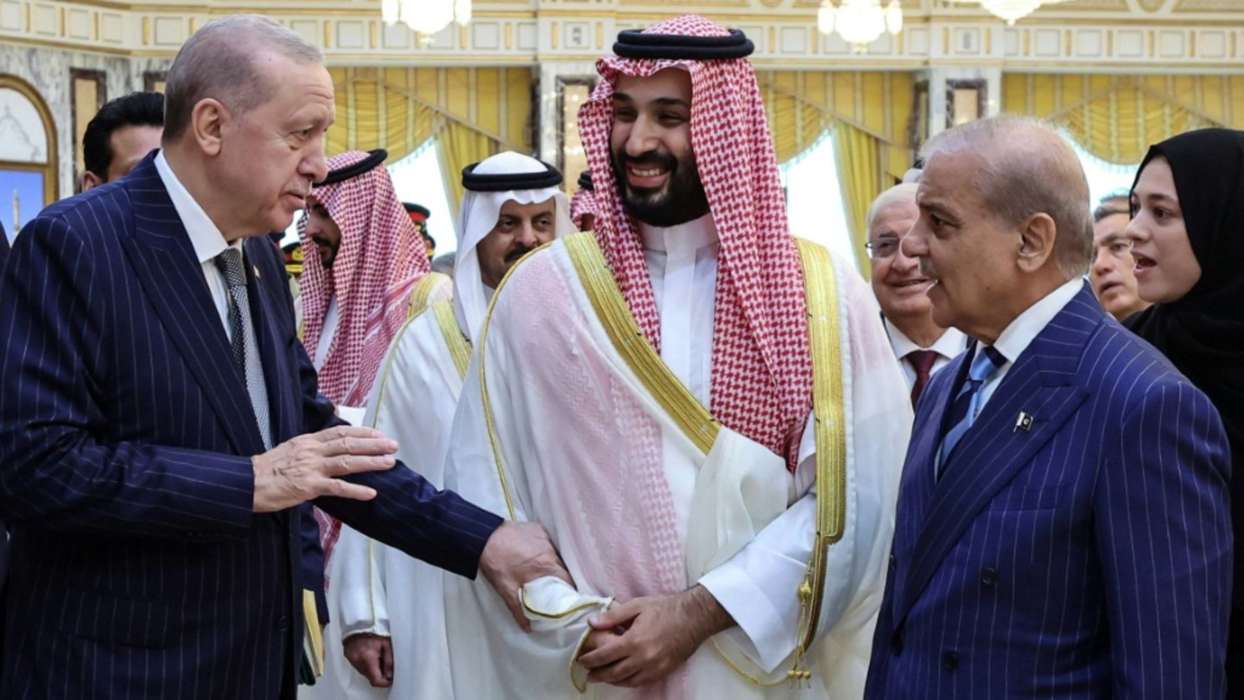
The Mecca Joint Defence Agreement has been presented as a potentially historic shift in the security architecture of the Middle East.
And on paper, the language is striking.
Saudi Arabia, Türkiye and Pakistan have agreed that an armed attack against one member will be considered an attack against all three — wording that deliberately echoes the logic of NATO’s Article 5.
That formulation immediately invites comparisons with collective defence.
But the real geopolitical question is more complicated:
Has Mecca created a new military alliance — or has it exposed how little confidence the three states now have that traditional security guarantees are enough?
It is not NATO — at least not yet
The comparison with Article 5 is useful, but it can also be misleading.
NATO is not simply one sentence in a treaty.
It is built on decades of integrated military planning, permanent command structures, political consultation mechanisms, common operational standards, interoperability, exercises, logistics, bases and established procedures for crisis response.
The Mecca Pact is only beginning to develop anything comparable.
Turkish and Saudi officials have stressed that the agreement is defensive, not directed against a specific state and not intended to replace existing alliances.
That flexibility is politically useful.
But it also exposes the pact’s main weakness.
What exactly constitutes an attack?
What threshold triggers collective action?
Who decides the response?
Would support mean troops, air defence, intelligence, weapons, financial assistance — or direct entry into war?
The phrase “an attack on one is an attack on all” sounds formidable.
It does not automatically mean that all three countries are obliged to fight the same war.
Fidan says “Article 5” — but the details matter
Türkiye has tried to give the pact a more institutional character.
Foreign Minister Hakan Fidan has described its collective-defence principle as technically similar to NATO’s Article 5 and has spoken of a ministerial committee and a permanent secretariat.
That is important.
It suggests the three governments want something more durable than a summit declaration.
But deterrence does not depend on organisational charts alone.
It depends on whether a potential adversary truly believes that, when one member is attacked, the other two will accept the political, economic and military costs of responding.
That has not yet been demonstrated.


Türkiye: Two Security Umbrellas, Two Strategic Worlds
Türkiye is the most complicated member of the arrangement.
It is simultaneously:
a NATO member,
a major Middle Eastern military power,
a competitor and partner of Iran,
a strategic partner of Pakistan,
and an increasingly important defence partner of Saudi Arabia.
Ankara insists that there is no legal contradiction between its NATO obligations and the Mecca Pact.
That may be correct in formal terms.
In practice, however, a real conflict could create very difficult questions.
Suppose Türkiye intervenes militarily in support of Saudi Arabia and is then attacked because of that intervention.
At what point does the Mecca commitment end and NATO’s Article 5 begin?
Would NATO allies regard the attack as one covered by collective defence if Türkiye had entered the conflict under a separate non-NATO pact?
There is no clear public answer.
That ambiguity could complicate deterrence rather than strengthen it.
Pakistan has already demonstrated the limits of solidarity
Pakistan is the second key piece of the puzzle.
Its security relationship with Saudi Arabia predates the Mecca Pact by decades.
The two states already signed a bilateral strategic mutual-defence agreement in 2025, also based on the principle that aggression against one would be treated as aggression against both.
Pakistan has shown that it is willing to contribute real military capability to Saudi security.
But there is an important distinction between defending Saudi territory and joining a full-scale war against Iran.
Islamabad has strong reasons to stop short of the latter.
It shares a border with Iran.
It must manage sensitive domestic sectarian balances.
Its principal strategic rival remains India.
And its economy gives it limited room for a prolonged external war.
The Mecca Pact does not erase any of those constraints.
The nuclear question remains deliberately blurred
Pakistan is a nuclear-armed state.
That immediately raises the most sensitive question surrounding the pact:
Does Pakistan’s nuclear deterrent now indirectly extend to Saudi Arabia?
No public text has established such a guarantee.
Indeed, all three governments have been careful to distance the agreement from nuclear ambitions.
But ambiguity has strategic value.
A nuclear umbrella does not always need to be formally declared to affect an adversary’s calculations.
If Tehran, New Delhi or another capital believes there is even a small possibility that a crisis could involve Pakistan’s strategic capabilities, the uncertainty itself becomes part of deterrence.
That is not the same as a formal nuclear guarantee.
But it is not irrelevant either.


Saudi Arabia: The Pact Makes Most Sense From Riyadh’s Perspective
For Saudi Arabia, the agreement may have the clearest strategic purpose.
Riyadh is not abandoning the United States.
Washington remains central to Saudi defence, intelligence and military procurement.
But the Gulf states have learned a difficult lesson over the past decade:
American partnership does not automatically mean that Washington will fight every war on their behalf.
Attacks on Gulf infrastructure, repeated regional crises and uncertainty over the long-term direction of US policy have all pushed Riyadh toward diversification.
The Mecca Pact gives Saudi Arabia access to two very different forms of strategic power.
From Pakistan:
a large military establishment and the shadow of a nuclear-armed state.
From Türkiye:
a major conventional military, NATO experience and an increasingly sophisticated defence-industrial base in drones, missiles, electronics and aerospace.
For Riyadh, that is classic strategic hedging.
The kingdom keeps Washington at the centre of its security system while building additional options outside it.
Mecca Is as Much a Confession of Insecurity as a Display of Strength
This is the deeper meaning of the pact.
States create alliances to become stronger.
But they also create new alliances when they conclude that existing security structures may no longer be sufficient.
Saudi Arabia fears missile and drone attacks, regional instability and uncertainty over external guarantees.
Türkiye wants greater strategic autonomy without leaving NATO.
Pakistan wants Gulf financing, diplomatic influence and additional strategic depth in a world where its competition with India remains paramount.
The three states therefore do not join because they share one identical enemy.
They join because they share one underlying concern:
none of them wants to depend completely on someone else for its security.
That may be the most important message of Mecca.
It is not an anti-Iran NATO — at least not openly
The timing inevitably makes Iran central to the debate.
Yet all three governments have insisted that the pact is not directed against Tehran or any other specific state.
There are practical reasons for that.
Türkiye does not want a strategic rupture with Iran.
Pakistan does not want a permanently hostile western frontier.
Saudi Arabia has spent years trying to preserve channels of de-escalation with Tehran.
A formally anti-Iran alliance would create risks that none of them currently appears eager to assume.
But this does not mean the agreement has no effect on Iran’s calculations.
From now on, Tehran must at least consider the possibility that a major attack against Saudi Arabia could trigger some level of Turkish and Pakistani involvement.
Even if the precise response is uncertain, uncertainty itself can deter.
India is watching too
For Pakistan, the pact cannot be separated entirely from South Asia.
Any serious Indo-Pakistani confrontation would immediately raise uncomfortable questions for Riyadh and Ankara.
Would the principle of collective defence apply?
Would Saudi Arabia risk its deep economic relationship with India?
Would Türkiye provide political support, military technology or something more?
The most likely answer is that both would seek to mediate while calibrating support carefully.
And that is precisely why the Article 5 comparison needs an asterisk.
A real NATO-style automatic response to an India-Pakistan war is extremely difficult to imagine.
The first real attack will be the crash test
Military alliances do not become credible when leaders sign them.
They become credible when they survive their first crisis.
If Saudi Arabia suffers a major missile strike, what does Türkiye do?
Send air-defence systems?
Fighter aircraft?
Naval assets?
Troops?
Intelligence?
If Pakistan enters another major confrontation with India, how far does Riyadh go?
And if Türkiye enters a serious confrontation in the Eastern Mediterranean, will Pakistan and Saudi Arabia regard that as a case covered by the pact?
Those questions remain unanswered.
Until they are answered in practice, the Mecca Pact is a powerful political signal with incomplete military certification.
The Bigger Picture
The importance of the agreement should neither be exaggerated nor dismissed.
It is not yet a new NATO.
There is no public basis for assuming an automatic Pakistani nuclear umbrella.
It does not create a single common enemy.
And it does not erase the very different strategic priorities of its three members.
But it is also not an empty photo opportunity.
Saudi Arabia has placed beside itself a nuclear-armed Pakistan and the most powerful NATO military in the Muslim world after the United States.
Türkiye gains another platform for strategic autonomy outside purely Western structures.
Pakistan increases its value as a security provider in the Gulf.
And Washington now has to watch three important partners build an additional layer of regional security that does not run exclusively through the United States.
That may be the real significance of Mecca.
The pact is not yet proof that a new formidable alliance has been born. It is evidence that the old regional security order is no longer considered sufficient.
And the real “Article 5” of Mecca will not be written in the treaty text.
It will be written the first time one member comes under major attack — and the other two have to decide whether solidarity is really worth going to war for.
Source: pagenews.gr