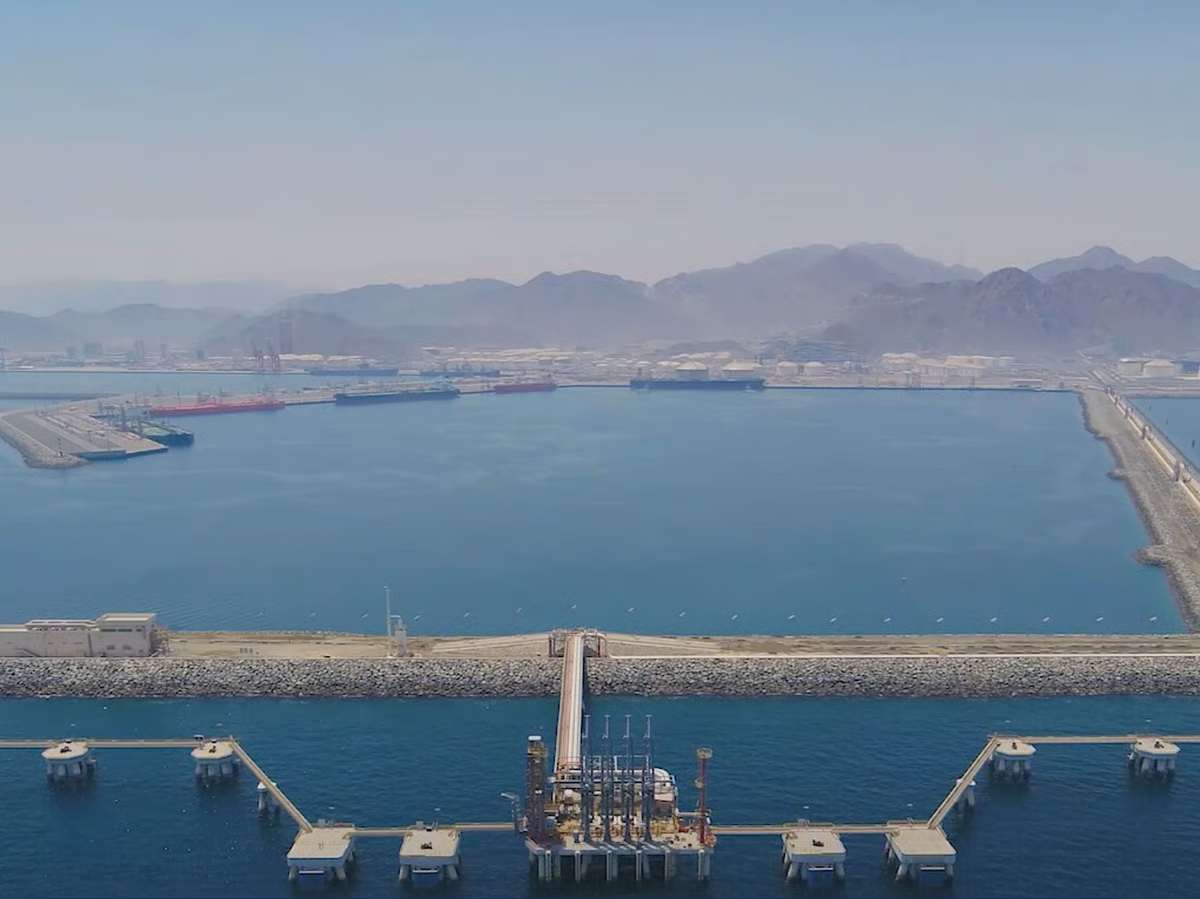
The United Arab Emirates is accelerating one of the most strategically important energy infrastructure projects in the Gulf: a second oil pipeline designed to bypass the Strait of Hormuz altogether.
According to ADNOC chief executive Sultan Ahmed Al Jaber, nearly 50% of the new pipeline has already been completed. The project will carry crude oil toward Fujairah, the UAE’s major energy hub on the Gulf of Oman, allowing exports to reach international markets without passing through Hormuz.
The pipeline is expected to become operational in 2027 and, once completed, could effectively double ADNOC’s export capacity through Fujairah.
The project is far more than another piece of oil infrastructure.
It represents a strategic response to one of the greatest vulnerabilities in the global energy system: the enormous concentration of oil and gas flows through a single narrow maritime chokepoint.
“Too much energy moves through too few chokepoints”
Al Jaber summarized the problem in stark terms.
Too much of the world’s energy, he argued, still moves through too few strategic passages.
The Strait of Hormuz is the clearest example.
Connecting the Persian Gulf with the Gulf of Oman and the wider Indian Ocean, Hormuz has for decades been one of the most important arteries of the global energy economy.
A prolonged disruption there does not affect only crude oil.
It can rapidly hit LNG supplies, refined fuels, petrochemicals, fertilizers, aviation, shipping and ultimately consumer prices around the world.
The current crisis has demonstrated just how dangerous that dependence can become.
For Abu Dhabi, the conclusion appears increasingly clear:
producing oil is not enough if geopolitical conflict can prevent that oil from reaching international markets.


Fujairah becomes the UAE’s strategic escape route
Fujairah’s geography explains why it has become so important.
Unlike Abu Dhabi and most major Gulf oil terminals, Fujairah sits on the UAE’s eastern coast, facing the Gulf of Oman and the Indian Ocean side of the Strait of Hormuz.
Oil transported there by pipeline does not need to pass through Hormuz before being loaded onto tankers.
The UAE already operates the Habshan-Fujairah pipeline, which can transport roughly 1.5 million barrels per day under normal conditions, with maximum capacity commonly cited at around 1.8 million barrels per day.
That existing infrastructure has given Abu Dhabi something many Gulf producers lack: a substantial alternative export route when maritime traffic through Hormuz is threatened.
The second pipeline dramatically expands that strategy.
If the planned capacity is delivered, Fujairah could become an even more powerful gateway connecting Emirati oil production directly with global shipping lanes outside the Strait.
War has accelerated the project
The new pipeline was not conceived overnight.
But the regional conflict and the disruption around Hormuz have dramatically increased its urgency.
Abu Dhabi has accelerated construction as policymakers confront the possibility that energy infrastructure can no longer be designed solely around efficiency and cost.
It must also be designed around war, blockades and geopolitical disruption.
That marks an important shift in Gulf energy policy.
For decades, the key question for oil-producing states was how much additional production capacity they could build.
Now another question is becoming equally important:
How much of that production can still reach customers if Hormuz becomes unavailable?
The energy-security doctrine is changing
The UAE’s strategy reflects a broader transformation in how governments think about energy security.
Oilfields matter.
Refineries matter.
But so do pipelines, ports, storage facilities and alternative shipping routes.
A country capable of producing millions of barrels per day can still face a severe economic shock if those barrels become trapped behind a geopolitical chokepoint.
That is why infrastructure redundancy is becoming strategically valuable.
Two export routes are safer than one.
Multiple terminals are safer than a single port.
Additional storage creates flexibility.
And pipelines capable of bypassing contested waterways can become geopolitical assets in their own right.
The second Fujairah pipeline is effectively an insurance policy against geography.
A historic disruption to energy flows
Al Jaber has described the Hormuz crisis as an extraordinary disruption to global energy supplies.
According to figures he cited, more than 1 billion barrels of oil flows have already been lost or disrupted, with roughly another 100 million barrels affected for every additional week that normal traffic through the Strait remains constrained.
Even if hostilities ended immediately, restoring normal flows would not necessarily happen overnight.
The ADNOC chief has warned that it could take at least four months for oil flows to recover to around 80% of normal levels, with full normalization potentially extending into the first or second quarter of 2027.
That illustrates an important reality often overlooked during geopolitical crises.
Stopping energy flows can happen quickly.
Restarting the entire system — tankers, terminals, production facilities, insurance, logistics and commercial contracts — can take considerably longer.
Hormuz is about much more than crude oil
The economic consequences also extend far beyond the price of Brent.
The Gulf exports LNG, refined petroleum products, petrochemicals and other strategically important commodities.
Shipping disruptions raise freight and insurance costs.
Higher fuel prices affect airlines and road transport.
Energy-intensive industries face greater production costs.
Fertilizer prices can feed into food prices.
And all of this can ultimately appear in inflation figures thousands of kilometres away from the original conflict.
For Europe and Asia in particular, Hormuz is not simply a Middle Eastern security issue. It is an inflation and economic-security issue.


The UAE gains a strategic advantage
This is where Abu Dhabi’s long-term investment in Fujairah begins to pay geopolitical dividends.
The UAE cannot eliminate the importance of Hormuz.
But it can reduce its own vulnerability to it.
The existing pipeline has already provided an alternative route for part of the country’s production. Adding a second line could significantly increase the volume that can reach international markets regardless of conditions inside the Strait.
That gives the Emirates a potentially valuable advantage over producers that remain overwhelmingly dependent on Hormuz.
In a future crisis, buyers may increasingly distinguish not simply between suppliers offering different prices, but between suppliers offering different levels of delivery security.
Reliability itself becomes commercially valuable.
Saudi Arabia and the Gulf are drawing the same lesson
The UAE is not alone.
The broader Gulf is increasingly focused on export infrastructure that reduces exposure to Hormuz.
Saudi Arabia has long maintained pipelines capable of carrying crude westward toward the Red Sea, providing its own strategic alternative to Persian Gulf terminals.
The current crisis could accelerate similar investments throughout the region.
That would gradually create a different Gulf energy architecture:
less dependent on one maritime passage and increasingly supported by pipelines running toward both the Indian Ocean and Red Sea.
Such a transformation would take years and require enormous investment.
But the geopolitical incentive has rarely been stronger.
Iran’s “Hormuz card” faces a long-term problem
This carries significant implications for Tehran.
For decades, Iran’s position beside the Strait of Hormuz has provided it with enormous strategic leverage.
Any serious threat to navigation can immediately shake global oil markets because so much energy depends on the passage.
But that leverage contains a paradox.
The more frequently Hormuz is perceived as vulnerable to disruption, the stronger the incentive becomes for neighbouring producers to build infrastructure that bypasses it.
In the short term, threatening a chokepoint can generate leverage.
In the long term, repeatedly demonstrating that vulnerability can encourage the rest of the region to engineer its way around it.
The second Fujairah pipeline is a perfect example.
The message to Tehran
Every additional barrel that can reach the Indian Ocean without entering Hormuz slightly reduces the Strait’s ability to function as a geopolitical pressure point.
That does not mean Hormuz will become irrelevant.
Far from it.
Its volumes, location and role in global LNG trade ensure that it will remain strategically critical for the foreseeable future.
But there is an enormous difference between being indispensable and being dominant.
If Saudi Arabia expands westward export capacity while the UAE builds additional eastward routes through Fujairah, the Gulf gradually acquires alternatives.
And alternatives weaken chokepoints.
Europe should be watching closely
Europe also has a major stake in this transformation.
Recent energy crises have demonstrated how rapidly geopolitical disruption can migrate into household budgets.
A conflict thousands of kilometres away can produce higher fuel prices, more expensive transportation, rising industrial costs and renewed inflationary pressure.
Infrastructure that provides alternative export routes cannot prevent every energy shock.
But it can reduce the danger that disruption at one geographic location removes enormous volumes from the international market simultaneously.
For Europe, therefore, the Fujairah pipeline should not be viewed merely as an Emirati oil project.
It is part of the emerging infrastructure of global energy resilience.
The new doctrine: redundancy
The strategic word increasingly defining energy infrastructure is redundancy.
More pipelines.
More terminals.
More storage.
More export corridors.
More options when the primary route fails.
This is essentially what Abu Dhabi is purchasing.
Not merely additional transportation capacity, but greater freedom of action during a crisis.
In financial terms, the pipeline is infrastructure.
In strategic terms, it is geopolitical insurance.
Fujairah could reshape the Gulf energy map
If the second pipeline enters service as planned in 2027 and substantially increases export capacity outside Hormuz, Fujairah’s strategic importance will rise dramatically.
The port could become one of the world’s most important energy gateways located beyond the Strait.
That would alter not only oil logistics but potentially the strategic calculations of governments throughout the Gulf.
For decades, the Strait of Hormuz has been treated almost as an unavoidable fact of geography.
The UAE is now demonstrating that geography, while it cannot be changed, can sometimes be bypassed with enough infrastructure, capital and political determination.
The second pipeline therefore carries more than crude oil from Abu Dhabi toward Fujairah.
It carries a much larger geopolitical message:
the Gulf’s energy powers are preparing for a world in which no single waterway can be allowed to hold their exports — and the global economy — hostage.