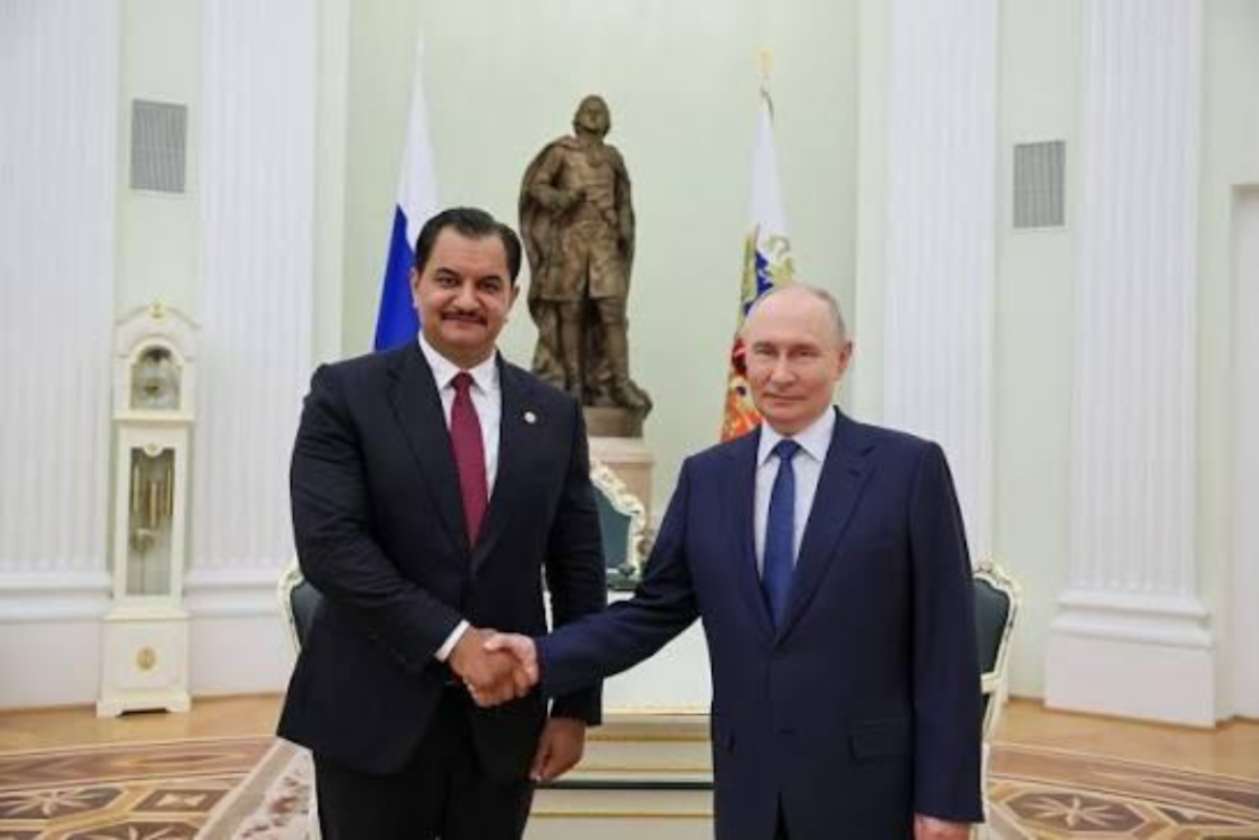
A meeting in Moscow could carry far greater geopolitical significance than it initially appears.
Russian President Vladimir Putin hosted Saddam Haftar, deputy commander of the Libyan National Army (LNA) and son of eastern Libya’s powerful military leader Khalifa Haftar, at the Kremlin as Russia seeks to deepen its influence in one of the Mediterranean’s most strategically important countries.
The visit comes at an exceptionally fragile moment for Libya. Protests, electricity shortages, attacks on energy infrastructure and renewed violence are once again raising concerns about the stability of a country that remains effectively divided despite the 2020 ceasefire.
For Moscow, however, Libya represents much more than another arena of influence in North Africa. Following the fall of Bashar al-Assad and the subsequent recalibration of Russia’s position in Syria, Libya has acquired even greater importance as a potential strategic bridge between the Mediterranean and Africa.
Saddam Haftar at the Kremlin
According to the LNA, Saddam Haftar stressed the depth of relations between the two sides during his meeting with Putin and expressed his commitment to expanding cooperation with Moscow.
“Commitment to strengthening cooperation with the Russian Federation across various fields,” was the message conveyed by Haftar’s side.
Putin, according to the LNA statement, expressed appreciation for the role of Haftar’s forces in maintaining security and stability in Libya, while supporting efforts to unify the country’s institutions and preserve its territorial integrity.
A day earlier, Saddam Haftar also met Russian Defence Minister Andrei Belousov, with talks focusing on ways to further develop cooperation between Russia and Libya.


Why Moscow Is Investing in the Haftar Camp
The relationship is hardly new.
Russia supported Khalifa Haftar’s forces during Libya’s civil war, while fighters from the Wagner Group operated alongside the LNA.
Moscow has since developed a more institutionalised military presence. Russian personnel and infrastructure have been maintained at bases located in Haftar-controlled territory, while activity involving the state-controlled Africa Corps has also been documented at Libyan airbases.
For Russia, Libya offers several strategic advantages:
• access to the Mediterranean and greater strategic depth on Europe’s southern flank;
• a logistical gateway for expanding Russian military and political influence across Africa;
• influence in one of Africa’s most important oil-producing countries.
Russia’s Post-Syria Calculation
Libya’s importance to Moscow increased substantially following the dramatic changes in Syria in late 2024.
For years, Syria served as the cornerstone of Russia’s military presence in the eastern Mediterranean. The collapse of Assad’s government forced Moscow to reassess that footprint and look for additional options to preserve its reach across the Mediterranean and Africa.
Eastern Libya fits naturally into that strategy.
Its geographic position could allow Russia to connect its Mediterranean presence with its expanding network of relationships and operations across the Sahel and sub-Saharan Africa.
For Europe, this adds another layer of strategic concern. A stronger Russian position in Libya would place Moscow close to southern Europe, important Mediterranean shipping routes, energy infrastructure and major migration corridors.
Oil, Blackouts and a New Wave of Instability
Haftar’s visit to Moscow also comes as Libya faces renewed domestic pressure.
Protests have erupted in Tripoli following widespread electricity outages, while energy infrastructure has been targeted in a series of incidents.
A drone recently struck a power substation in Zawiya, west of the capital.
Meanwhile, the Sharara oil field — Libya’s largest — was temporarily shut down earlier this month following protests.
The contradiction remains striking: Libya possesses enormous hydrocarbon wealth yet continues to struggle to provide reliable electricity and other essential public services.
Security concerns are growing as well. The killing of the LNA’s intelligence chief in a car bombing in Benghazi has further highlighted the fragility of the security environment.
Washington and Ankara Enter the Equation
Russia’s diplomatic activity comes as Washington and Ankara pursue their own efforts to encourage the reunification of Libya’s political and military institutions.
Turkey, which backed the Tripoli-based government against Haftar during the civil war, has increasingly sought to engage both sides of the divided country.
Turkish Foreign Minister Hakan Fidan recently visited both Tripoli and Benghazi, demonstrating Ankara’s determination to preserve a central role in Libya regardless of the shape of any future political settlement.
Washington has also opened a direct channel with the younger Haftar.
In June, US Secretary of State Marco Rubio hosted Saddam Haftar for talks that included possible avenues for advancing Libyan unity and peace.
That places Saddam Haftar in an increasingly interesting geopolitical position: within months, he has held high-level contacts in both Washington and Moscow.
Libya Returns to the Great-Power Chessboard
This is what makes the Putin-Haftar meeting particularly significant.
Russia wants to consolidate a strategic foothold that could provide military reach into the Mediterranean, political leverage in North Africa and a logistical corridor into the African continent.
The United States, meanwhile, is pushing for a political arrangement capable of bringing Libya’s rival power centres closer together.
Turkey is playing perhaps the most complex game of all: maintaining its entrenched interests in western Libya while simultaneously improving relations with the Haftar camp in the east.
Libya is therefore once again becoming an arena where Russian, American and Turkish interests overlap — and compete.
For Putin, stronger relations with the Haftars could compensate, at least partly, for the uncertainty surrounding Russia’s traditional position in Syria.
For Washington and Ankara, progress toward Libyan reunification could reduce the political vacuum and institutional fragmentation that have allowed external powers, including Russia, to expand their influence.
Behind the images from the Kremlin, therefore, lies a much larger geopolitical contest.
The real battle is over who will shape Libya’s next chapter — and, with it, the balance of power across one of the most strategically sensitive crossroads connecting Europe, the Mediterranean and Africa.
Source: pagenews.gr