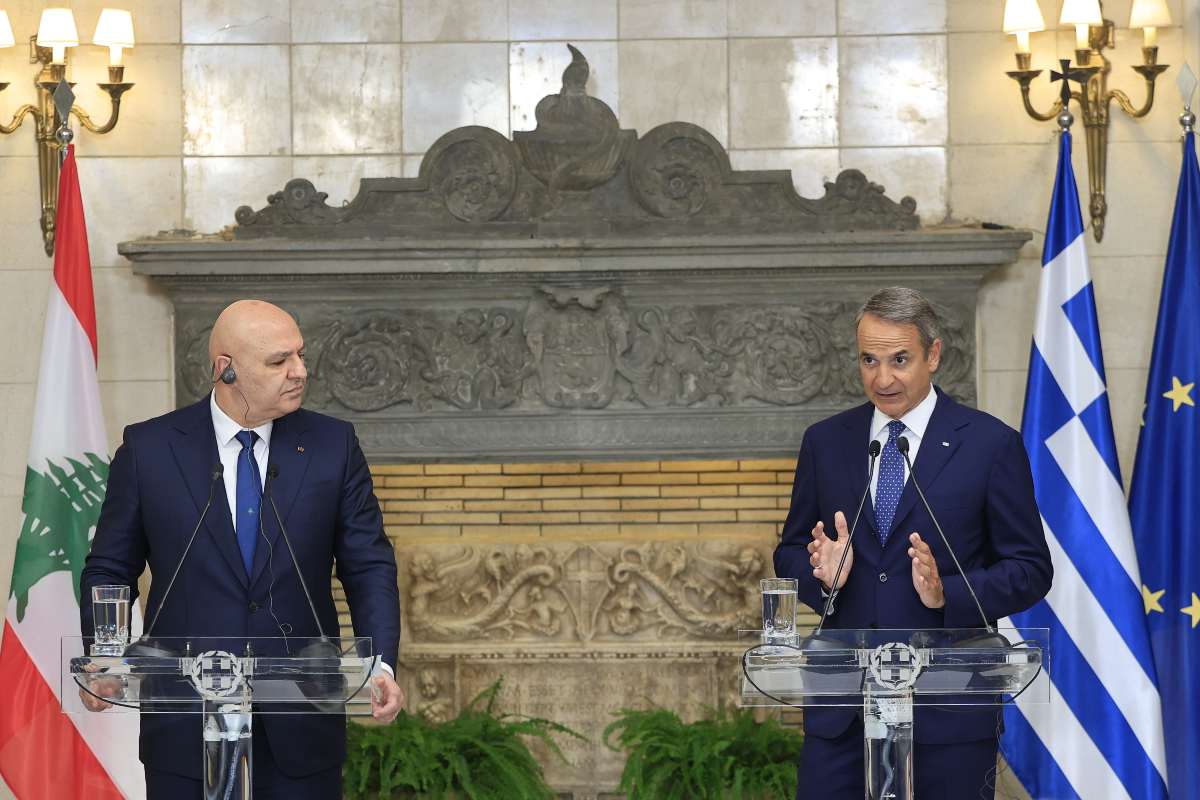
Greece and Lebanon are moving beyond traditionally close diplomatic ties toward a strategic partnership with potentially significant implications for the Eastern Mediterranean.
Prime Minister Kyriakos Mitsotakis met Lebanese President Joseph Aoun at the Maximos Mansion in Athens, announcing plans to establish a Greece–Lebanon High-Level Cooperation Council and reaffirming Greece’s support for Lebanon’s sovereignty, territorial integrity and state institutions.
But one sentence from the Greek prime minister points to the wider geopolitical significance of the meeting:
“We believe in energy bridges and common infrastructure. They bring the Eastern Mediterranean closer to Europe.”
That message places Lebanon within a much larger Greek strategy — one connecting energy, defense, maritime security, Israel, Cyprus and Europe.
Lebanon Becomes Another Link in Greece’s Eastern Mediterranean Strategy
The rapprochement with Beirut should not be viewed in isolation.
Over recent years, Athens has built an increasingly dense network of strategic relationships across the Eastern Mediterranean, with Cyprus, Israel and Egypt occupying central positions.
Lebanon adds another potentially important link.
Its geography alone explains much of its strategic value.
The country sits on the Levantine basin, opposite Cyprus and alongside Israel, in a maritime region where energy resources, exclusive economic zones, subsea infrastructure and military security have become increasingly interconnected.
For Athens, therefore, closer relations with Beirut are about much more than bilateral diplomacy.
They form part of a wider effort to connect the Eastern Mediterranean more closely to Europe.


Energy Is the Second Layer of the Partnership
Mitsotakis’ reference to “energy bridges” is particularly significant.
Greece has been positioning itself as an energy gateway between the Eastern Mediterranean and the wider European market, supported by LNG infrastructure, electricity interconnections and regional partnerships.
Lebanon is not currently a significant gas producer, and there is no announced Greece–Lebanon energy interconnector that would justify presenting the meeting as the launch of a specific energy project.
The strategic logic is broader.
Future electricity links, energy infrastructure, digital connectivity and potentially regional gas flows could create an increasingly interconnected Eastern Mediterranean energy system.
Greece wants to be one of the principal European entry points for that system.
Cyprus Is the Geographic Bridge
Cyprus is crucial to this emerging architecture.
Geographically, it sits between Greece and the Levant. Strategically, it has close relations with Greece, Israel, Egypt and Lebanon.
This gives the Greece–Cyprus axis significance beyond bilateral relations.
Electricity interconnections between Greece and Cyprus, broader European energy diversification and the development of Eastern Mediterranean infrastructure can gradually create a network in which geography itself becomes strategic leverage.
Lebanon’s inclusion in Greece’s connectivity agenda therefore strengthens a larger concept: linking the eastern shores of the Mediterranean to the EU through Cyprus and Greece.
Why Lebanese Sovereignty Matters to Athens
The second pillar of the meeting was security.
Mitsotakis stressed Greece’s unequivocal support for Lebanon’s sovereignty and unity.
“A strong state is a prerequisite for a strong Lebanon,” the Greek prime minister said.
The formulation carries considerable geopolitical weight.
For decades, one of Lebanon’s fundamental security problems has been the state’s limited ability to exercise uncontested authority throughout its territory, particularly in the south.
Athens is therefore backing not only Lebanon diplomatically but also its state security institutions.
And Greece is putting military hardware behind that policy.

Greece Sends More Military Equipment to Lebanon
Athens has proceeded with a second shipment of military equipment to the Lebanese Armed Forces, including armored vehicles.
Mitsotakis presented the move as tangible evidence of Greece’s commitment:
“It is another concrete demonstration that our solidarity is not limited to words.”
He also indicated that Greece’s Ministry of National Defense and Armed Forces would continue supporting their Lebanese counterparts.
The strategic objective is particularly important: strengthening the Lebanese Armed Forces’ ability to exercise state authority, especially in southern Lebanon.
That makes Greek assistance part of a wider international effort to strengthen Lebanon’s formal institutions as the legitimate security authority of the country.
The Delicate Israel Equation
This is where Greek diplomacy becomes particularly interesting.
Greece has simultaneously developed an increasingly important strategic and defense partnership with Israel.
Athens is therefore trying to sustain two positions at once: a strong strategic relationship with Israel and unequivocal support for Lebanese sovereignty.
Mitsotakis explicitly rejected the idea that these goals are contradictory.
“The security of Lebanon and the security of Israel are not conflicting objectives.”
He also welcomed efforts toward negotiations between Lebanon and Israel under US mediation and said Greece was prepared to support initiatives promoting de-escalation and mutual understanding.
That positioning could give Athens additional diplomatic relevance.
Greece is a strategic partner of Israel, an EU member state and a country with longstanding relationships across the Arab world.
It does not automatically make Greece a mediator between Beirut and Jerusalem.
But it gives Athens channels to different sides of an increasingly complex regional equation.
From Military Security to Energy Security
There is another reason southern Lebanon matters.
Security in the Eastern Mediterranean is increasingly inseparable from the protection of energy and maritime infrastructure.
Lebanon possesses an offshore exclusive economic zone with potential hydrocarbon resources, although exploration has so far failed to transform the country into the gas producer once anticipated.
That distinction matters.
Lebanon should not be presented as an established new Mediterranean gas power.
Its importance lies instead in its geographic position, offshore potential and possible role within a future regional infrastructure network.
For major energy investment to become viable, however, political stability, maritime security and functioning state institutions are prerequisites.
This explains why the security and energy components of the Mitsotakis–Aoun meeting ultimately converge.
A Strategic Triangle: Security, Energy and Connectivity
The emerging Greek approach can be understood through three interconnected pillars.
The first is security: stronger Lebanese state institutions and Armed Forces.
The second is diplomacy: de-escalation between Lebanon and Israel and a stronger European role in regional stability.
The third is energy and connectivity: infrastructure capable of bringing the Eastern Mediterranean closer to Europe.
This is where Greece sees a larger strategic opportunity.
Israel has significant energy resources and technological capabilities.
Egypt possesses major gas and LNG infrastructure.
Cyprus occupies the central geographic position.
Lebanon sits on the Levantine coast with offshore potential.
And Greece provides access to the EU’s energy and infrastructure networks.
There is no single project today connecting all these pieces.
But there is an increasingly visible geopolitical logic connecting them.
From a Sea of Crises to a Network of Infrastructure
Mitsotakis encapsulated that ambition when he said Athens and Beirut share the view that the Eastern Mediterranean can move from being an area of tension toward becoming a region of cooperation and connectivity.
This is a particularly important concept for Greek foreign policy.
Infrastructure can create geopolitical relationships that outlast governments.
Electricity cables, ports, LNG terminals, digital networks and energy corridors create mutual interests and increase the economic cost of instability.
For Greece, they also strengthen the argument that the country is not merely located on Europe’s southeastern frontier.
It can become the European gateway to the Eastern Mediterranean.
Greece Wants to Turn Geography Into Strategic Leverage
The upgrading of Greece–Lebanon relations should therefore be viewed against a much larger regional transformation.
Athens is seeking to build overlapping partnerships rather than a single exclusive alliance.
With Israel on defense and technology.
With Egypt on energy and maritime cooperation.
With Cyprus on strategic and energy connectivity.
And increasingly with Lebanon on security, infrastructure and regional stability.
The objective is not to create a formal anti-Turkish bloc — nor did the Mitsotakis–Aoun meeting announce one.
The broader Greek calculation is more sophisticated: to embed Greece in as many of the Eastern Mediterranean’s future security and infrastructure networks as possible.
That is why Mitsotakis’ reference to “energy bridges” matters.
The Greece–Lebanon strategic partnership is not yet an energy corridor.
But it can become another building block in an emerging architecture in which security enables infrastructure, infrastructure creates interdependence, and Greece connects the Eastern Mediterranean to Europe.
Source: pagenews.gr