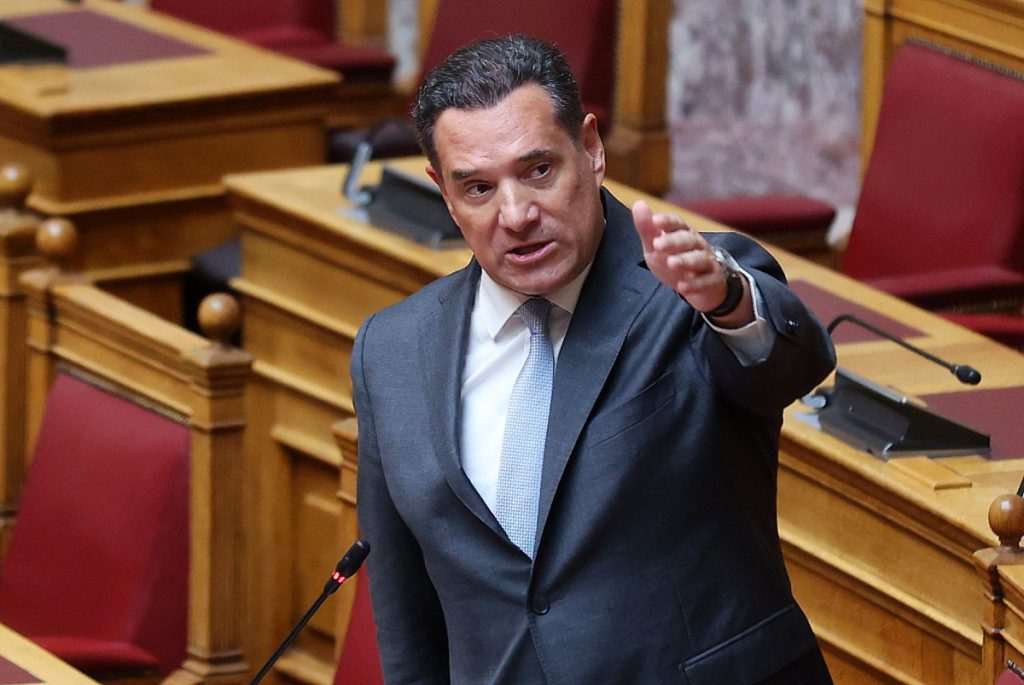
Adonis Georgiadis delivered one of his strongest political interventions in recent months on Tuesday morning, categorically ruling out a coalition between New Democracy and PASOK while warning that the opposition party’s proposals on private debt could put Greece’s hard-won fiscal stability at risk.
Speaking on Parapolitika radio, the Greek health minister went far beyond the immediate economic dispute.
He addressed the next government, the possibility of a new party led by former prime minister Antonis Samaras, the political threat posed by Ilias Kasidiaris, Alexis Tsipras and, crucially, the future of Prime Minister Kyriakos Mitsotakis.
His central message on PASOK was unequivocal.
“There is no possibility. I’m sorry, there is no possibility,” Georgiadis said when asked whether New Democracy could govern with PASOK.
He then escalated the attack:
“Is it possible for us to govern with a party that says Greece should be destroyed? Is it possible to talk about cooperation with a party that wants us to go back to bailouts?”
And he delivered his most politically explosive accusation:
“PASOK wants us to go back to bailouts.”


Private Debt Becomes the New ND–PASOK Battleground
At the heart of Georgiadis’ attack is PASOK’s proposal for tackling private debt.
The minister described the opposition party’s position as a “monument to stupidity” and focused particularly on proposals involving debt restructuring and the reduction of part of the original amount owed under certain conditions.
His argument is based on moral hazard.
According to Georgiadis, if taxpayers and businesses who allow their obligations to become overdue can subsequently secure a substantial reduction in the amount they owe, the state effectively creates an incentive for those currently paying their debts on time to stop doing so.
“If such a law were ever passed, the very next day, literally within 24 hours, everyone — and rightly so — would stop paying their debts,” he argued.
He then explained why:
“Because you would have to be very foolish to decide to pay 100% of your debt when, if you allowed it to become overdue for a while, you could pay 70%.”
For Georgiadis, therefore, the debate is not simply about providing relief to debtors.
It is about whether a policy designed to help those already in arrears could ultimately penalise consistent taxpayers and undermine Greece’s broader payment culture.
“You Have Not Understood the Scale of the Danger”
Georgiadis repeatedly stressed that what makes the proposal particularly striking, in his view, is that it comes from PASOK — a party with extensive governing experience that played a central role during Greece’s sovereign-debt crisis.
“Listen to what is being proposed by a party that has governed, a party that wants to govern again and a party that backed the bailout so that Greece could remain in Europe,” he said.
He returned to the same point later in the interview.
“It is shocking. A party that has governed, that implemented a bailout programme, that lost 30 percentage points so that Greece could remain in the euro, comes along in 2026 and says this…”
Georgiadis framed the issue as a warning against reopening the fiscal vulnerabilities that Greece spent years trying to overcome.
“You have not understood the scale of the danger.”
He added:
“If political parties start saying things like this, nothing will be left standing.”
Why Georgiadis Is Now Ruling Out PASOK
The categorical rejection of a PASOK coalition is politically significant because New Democracy and PASOK have governed together before, most notably during the debt-crisis years.
Georgiadis was reminded that he had previously viewed PASOK as the party with which New Democracy could most plausibly cooperate if a coalition became necessary.
His answer suggested that, in his view, PASOK’s current economic direction has fundamentally changed that calculation.
“Is it possible for us to govern with a party that wants us to go back to bailouts?”
The message is clear: Georgiadis is drawing an explicit dividing line between New Democracy’s economic strategy and the direction he believes PASOK is now taking.


“We Will Not Make a Coalition Proposal”
The conversation then moved to the broader question hanging over Greek politics ahead of the next national election: if New Democracy cannot govern alone, who could become its partner?
Asked directly whether the party would make a proposal for a coalition government, Georgiadis responded:
“We will not make a proposal.”
His position places the emphasis firmly on seeking a clear electoral mandate rather than entering the campaign with a pre-arranged coalition strategy.
It also underscores an emerging political reality: the more polarised the relationship between New Democracy and PASOK becomes, the narrower the apparent field of potential post-election partnerships.
What He Said About a Possible Samaras Party
Georgiadis was also pressed on former prime minister Antonis Samaras and speculation that he could establish a new political party.
Unlike his categorical answer on PASOK, Georgiadis refused to speculate about cooperation with a political formation that does not yet exist.
“When Mr Samaras forms a party, ask me again. Personally, I do not see a party yet.”
However, he added an important qualification:
“And if he forms a party and that party begins by attacking New Democracy, I will not view things favourably.”
His message leaves the door open to assessing developments if and when a Samaras party actually emerges, while making clear that a political project built around confrontation with New Democracy would make future cooperation far more difficult.
Kasidiaris: “A Political Talent – Unfortunately, a Very Dangerous Person”
One of the most striking sections of the interview concerned Ilias Kasidiaris.
Georgiadis acknowledged Kasidiaris’ political and rhetorical abilities but argued that those very qualities make him more dangerous rather than less so.
“Kasidiaris was a political talent from the beginning. Unfortunately. Because he is a very dangerous person and a very bad case. Kasidiaris is dangerous.”
He then explained his assessment:
“He is dangerous because, unfortunately, he resonates with a section of society and he has a rhetorical gift. But he is dangerous because his ideas are terrifying.”
The distinction is politically important.
Georgiadis is not dismissing Kasidiaris as electorally irrelevant. On the contrary, he acknowledges his ability to communicate with a section of the electorate while unequivocally rejecting the ideology he represents.
Could Kasidiaris Run?
Georgiadis also offered his interpretation of the legal framework governing a potential Kasidiaris candidacy.
“I do not think there is a legal way to prevent him from running as a candidate. He can be prevented from being the leader. That is what the law says,” he said.
The statement represents Georgiadis’ own legal and political assessment. Any eventual participation would depend on the applicable electoral framework and decisions by the competent judicial authorities.
Georgiadis Stands by His Attack on Tsipras
The minister was also asked whether he stood by his recent controversial characterisation of former prime minister Alexis Tsipras.
He did not retreat from the substance of his criticism.
Georgiadis accused Tsipras of attempting, while in government, to use criminal proceedings against political opponents.
“Tsipras, as prime minister, tried to put his political opponents in prison,” Georgiadis claimed.
Asked whether that meant he considered Tsipras to be of bad character, he replied:
“Obviously. Only someone of bad character would do something like that.”
These are Georgiadis’ political allegations and personal assessment of the former prime minister.
The Bigger Surprise: “I Am Fighting to Convince Mitsotakis to Run a Fourth Time”
Perhaps the most revealing statement about the long-term future of New Democracy came when Georgiadis turned to Kyriakos Mitsotakis.
The minister made clear that his support for the prime minister extends well beyond the next national election.
He revealed that he is actively trying to persuade Mitsotakis to reconsider his previously stated position regarding a fourth electoral bid.
“I am fighting to convince Mitsotakis to change the position he expressed in an interview — that he would not run a fourth time — and to run a fourth time.”
Georgiadis then summed up his reasoning in a simple political argument:
“We have already found a good prime minister. Why should we change him?”
The significance of the statement extends beyond the immediate electoral cycle.
Georgiadis is effectively arguing that Mitsotakis should remain the central political figure of Greece’s centre-right not merely through the next election but potentially well beyond it.


The Wider Political Message: Economy, Stability and the Battle for 2027
Behind the confrontational language, Georgiadis’ interview reveals an important shift in the political battle ahead of Greece’s next national election.
PASOK is attempting to challenge the government on private debt, borrowers and household financial pressure.
Georgiadis is seeking to turn that attack on its head.
His counterargument is that the real question is not whether struggling borrowers deserve support, but whether opposition proposals can provide that support without penalising citizens who continue to meet their obligations or destabilising public finances.
By invoking the bailout era, Georgiadis is also reopening one of the deepest political fault lines in modern Greek history.
Greece spent more than a decade moving from sovereign-debt crisis, bailout programmes and international supervision to investment-grade status and stronger fiscal credibility.
His warning is that policies creating large-scale incentives for non-payment could jeopardise that progress.
That is also why his rejection of a coalition with PASOK carries significance beyond ordinary partisan confrontation.
Georgiadis is presenting the next election as a choice between fundamentally different approaches to economic responsibility — while simultaneously arguing that New Democracy should seek a clear mandate, keep its distance from political extremes and continue to build its strategy around Mitsotakis.
The battle for 2027, in that reading, will not only determine who governs Greece next.
It could also determine whether the country continues along its post-bailout economic trajectory — or reopens debates that many Greeks believed had finally been left behind.
Source: pagenews.gr