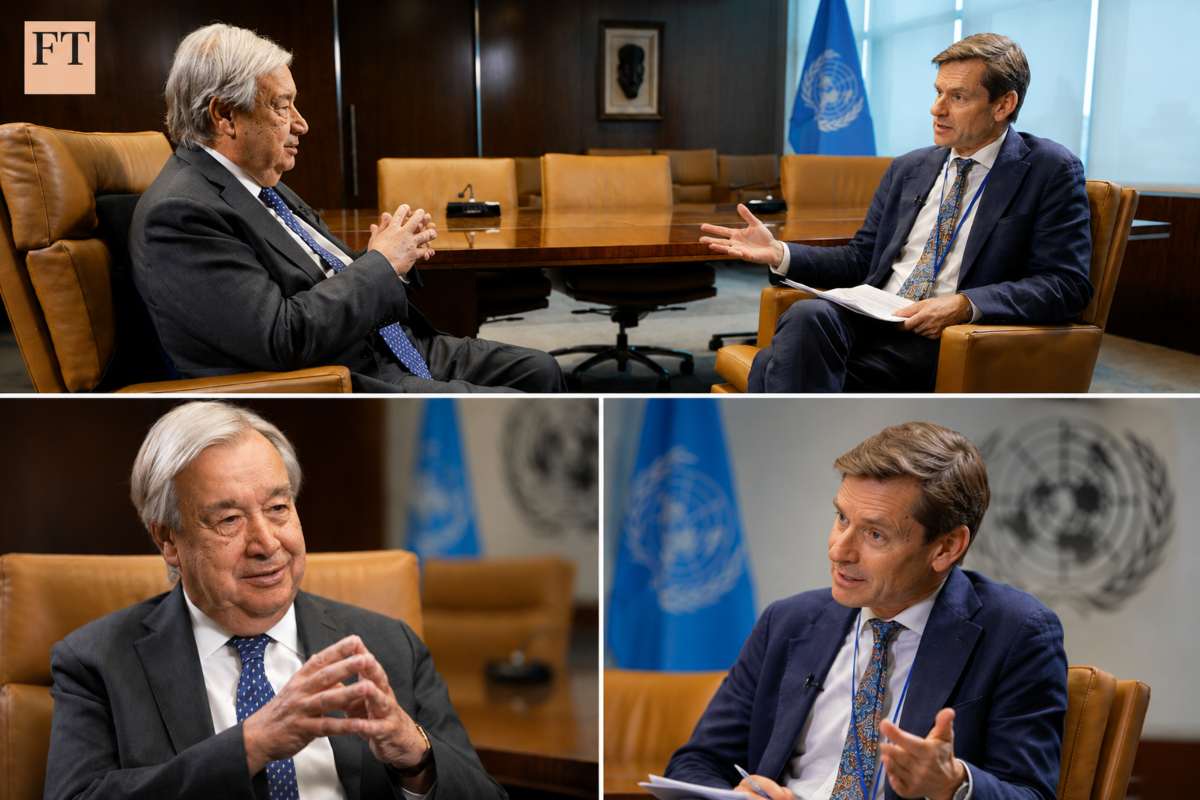
UN Secretary-General António Guterres has delivered one of his starkest assessments yet of the state of the international order, warning that the Security Council has become effectively paralysed by geopolitical divisions and that the world’s superpowers must recognise that their ability to impose their will is diminishing.
Speaking to the Financial Times as he approaches the end of almost a decade at the helm of the United Nations, Guterres described an international system dramatically different from the one he inherited: more fragmented, increasingly multipolar and characterised by growing competition between states.
At the heart of the problem, he argued, lies an institution still largely structured around the distribution of power that emerged from the Second World War.
“The truth is that the Security Council became, during these 10 years, practically paralysed by the geopolitical divides.”
Russia, the US and the Veto Paralysis
Guterres was explicit about what has driven that paralysis.
He pointed to successive Russian vetoes related to the war in Ukraine and repeated US vetoes concerning Israel’s actions in the Middle East, particularly Gaza.
The consequence, he argued, is much larger than diplomatic deadlock.
When the Security Council cannot act, the UN loses much of the leverage needed to persuade parties to conflicts that there will be consequences for violating international rules.
“A sense of impunity is now prevailing.”
According to Guterres, the UN Secretariat’s ability to prevent and resolve conflicts has been “dramatically diminished” because the Security Council is frequently unable to enforce meaningful measures.
“Superpowers Need to Understand the Limits of Their Power”
Perhaps the most geopolitically significant part of the interview concerned the changing position of the world’s great powers.
Guterres argued that the ability of superpowers to impose outcomes has become increasingly constrained.
“I think it’s time for superpowers to understand the limits of their power.”
He pointed directly to two conflicts:
“Look at what happened with Russia and Ukraine. Look at what happened with US and Iran.”
His conclusion was equally direct:
“Superpowers need to understand that things have changed. The weight of different countries has changed.”
The argument goes to the heart of the emerging international system: military and economic superiority remain enormously important, but neither automatically translates into the ability to dictate political outcomes.


The Multipolar World Is Already Here
Guterres believes the transition towards multipolarity is no longer theoretical.
“I think we are moving clearly into a multipolarity.”
He views the rise of emerging and middle powers as potentially positive — but only if the new distribution of power is accompanied by effective institutions and dense networks of economic, technological and diplomatic co-operation.
Otherwise, multipolarity could become dangerous.
“If we do not organise multipolarity the risk is that multipolarity will translate itself into more competition and, eventually, more confrontation.”
Guterres then invoked a powerful historical warning.
Europe before the First World War was itself multipolar. But without sufficiently strong multilateral institutions capable of managing competing powers, that system ultimately collapsed into catastrophic conflict.
That comparison encapsulates his central concern: multipolarity does not automatically produce balance. Without rules, it can produce confrontation.
“We Need Institutions for Today’s World, Not the World of 1945”
For Guterres, reforming international institutions is therefore not optional.
“We need multilateral institutions that correspond to the world of today and not to the world of 1945.”
The clearest example is the UN Security Council itself.
Its five permanent members — the United States, China, Russia, France and the United Kingdom — largely reflect the balance of power that emerged from the Second World War.
Guterres highlighted how far that architecture now stands from present global realities.
Counting Russia as European, three of the five permanent members are European powers.
“Europe is not three-fifths of the world.”
Africa, meanwhile, has no permanent member. Neither does Latin America.
“There are no African members, permanent members. There are no Latin American permanent members.”
His argument is that demographic, economic and geopolitical reality will eventually force the system to change — just as pressure is mounting for reform of the Bretton Woods institutions.
The Striking Admission: “Power Is Never Given. It Needs to Be Taken”
But why would countries possessing veto power voluntarily surrender any of it?
Guterres’ answer was unusually political for a UN Secretary-General.
“Power is never given. It needs to be taken.”
The challenge, he argued, is to organise the international community in a way that creates the conditions for a more representative distribution of power.
Increasing the role of emerging economies in global economic and financial decision-making is one part of that process.
It amounts to a recognition that meaningful UN reform will not come simply because the existing powers decide that reform is fair.
It will come when changes in the real balance of global power make the old architecture increasingly impossible to sustain.
UN Under Financial Pressure: $4bn in Arrears and 22% Fewer Posts
The existential challenge facing the UN is not only geopolitical.
It is also financial.
Guterres revealed that the organisation is dealing with approximately $4bn in arrears.
For its 2026 budget, the UN has cut the number of posts by 22 per cent.
“I do not know any public institution in the world that does, in a budgetary transition, a reduction of 22% of the posts.”
Guterres said the organisation began preparing two years in advance for the possibility of a change in the US administration and a sharp reduction in available funding.
Despite the liquidity pressure, he insisted salaries have continued to be paid and will remain covered until the end of the year.
But the consequences of reduced humanitarian funding are already visible.
“There is more people dying for hunger. There is more people dying because of lack of vaccines.”
Trump and the UN: Rhetoric Versus Reality
Guterres also offered a more nuanced assessment of relations with Donald Trump’s administration than the public rhetoric might suggest.
Despite Washington’s scepticism towards multilateral institutions, Guterres pointed to practical US-UN co-operation in Western Sahara, Libya, Sudan and Haiti.
“Sometimes, there is a difference between what people say and what people do, between the rhetoric and the reality.”
He said that despite significant differences in perspective, there had been “effective co-operation with the United States” across several areas of UN activity.
That distinction is significant.
Guterres is effectively arguing that even an American administration deeply sceptical of multilateralism continues to turn to the UN when it needs international legitimacy, mediation or operational capacity in difficult crises.
Israel and Gaza: “I Totally Refuse the Idea of Bias”
Guterres strongly rejected allegations that his Secretariat is institutionally biased against Israel.
He acknowledged that the UN is composed of multiple bodies, including independent rapporteurs and entities outside the direct control of the Secretary-General.
But regarding his own office, he was categorical:
“In the positions of the secretary-general and of the Secretariat, I totally refuse the idea of bias.”
He added:
“I think we have been on the right side of history.”
Guterres also reiterated the UN’s condemnation of Hamas’s October 7 attack while maintaining his strong criticism of what followed in Gaza and Lebanon and of Israeli policies he described as threatening international peace and security.
Cyprus: “If There Is a Difficult Mediation to Make, That Is the One”
The interview also contained an important reference to Cyprus.
Rejecting suggestions that the UN had stepped away from mediation, Guterres pointed directly to his recent involvement in the Cyprus issue.
“I just came from Cyprus. If there is a difficult mediation to make, that is the one.”
The remark highlights the continuing importance the UN attaches to one of the longest-running unresolved conflicts on its agenda, even as the organisation struggles to mediate far larger active wars.
Hormuz Has Turned Renewables Into a Security Issue
Guterres also made a particularly significant connection between the crisis in the Strait of Hormuz and the global energy transition.
He acknowledged that political momentum on climate change has weakened in some countries.
Economic and security realities, however, are moving in the opposite direction.
“Today renewables are cheaper. And today, we see that, from the security point of view, with what happened in the Hormuz strait, renewables are a much safer way to produce energy.”
This shifts the argument over renewables beyond climate policy.
For countries dependent on imported hydrocarbons passing through geopolitical chokepoints, renewable energy is increasingly also a matter of strategic autonomy and national security.
The UN’s Next Frontier: Artificial Intelligence
Artificial intelligence is another area where Guterres believes the UN can remain relevant despite its political paralysis on major wars.
He said the organisation now manages what he described as the only international independent scientific panel on AI and has created a global dialogue involving governments, civil society, academia and the private sector.
Before that initiative, according to Guterres, 111 countries had never participated in any international body dealing with artificial intelligence.
The implication is clear: the UN may struggle to stop wars when great powers wield their vetoes, but it can still attempt to build rules around challenges — from AI to climate — where global governance is only beginning to emerge.
The Real Question Is Not Whether the UN Survives — But What Kind of UN Survives
Guterres rejected comparisons between the current crisis facing the United Nations and the collapse of the League of Nations.
For all its failures, he argued, the UN has performed one historically crucial function: helping prevent direct war between the world’s superpowers.
He hopes that achievement alone will justify keeping a reformed United Nations at the centre of the multilateral system.
But the deeper message of his interview is difficult to ignore.
The world of 1945 is disappearing.
The United States remains an extraordinary global power, but it cannot dictate every outcome. China’s weight continues to rise. Emerging and middle powers are demanding a greater voice. Russia is challenging the existing order. Africa and Latin America remain dramatically under-represented in the institutions that make the world’s most consequential security decisions.
Meanwhile, an organisation created to prevent another global catastrophe is financially strained and politically constrained by a Security Council whose structure reflects the victors of a war fought more than eight decades ago.
Guterres’ warning is therefore bigger than the future of the United Nations itself.
Multipolarity is coming regardless. The decisive question is whether the new world will be governed through institutions and rules — or through raw power and competing spheres of influence.
That may be the defining challenge for his successor: not merely keeping the United Nations alive, but transforming it into an institution that reflects the world of the 2030s rather than the world of 1945.
Source: pagenews.gr