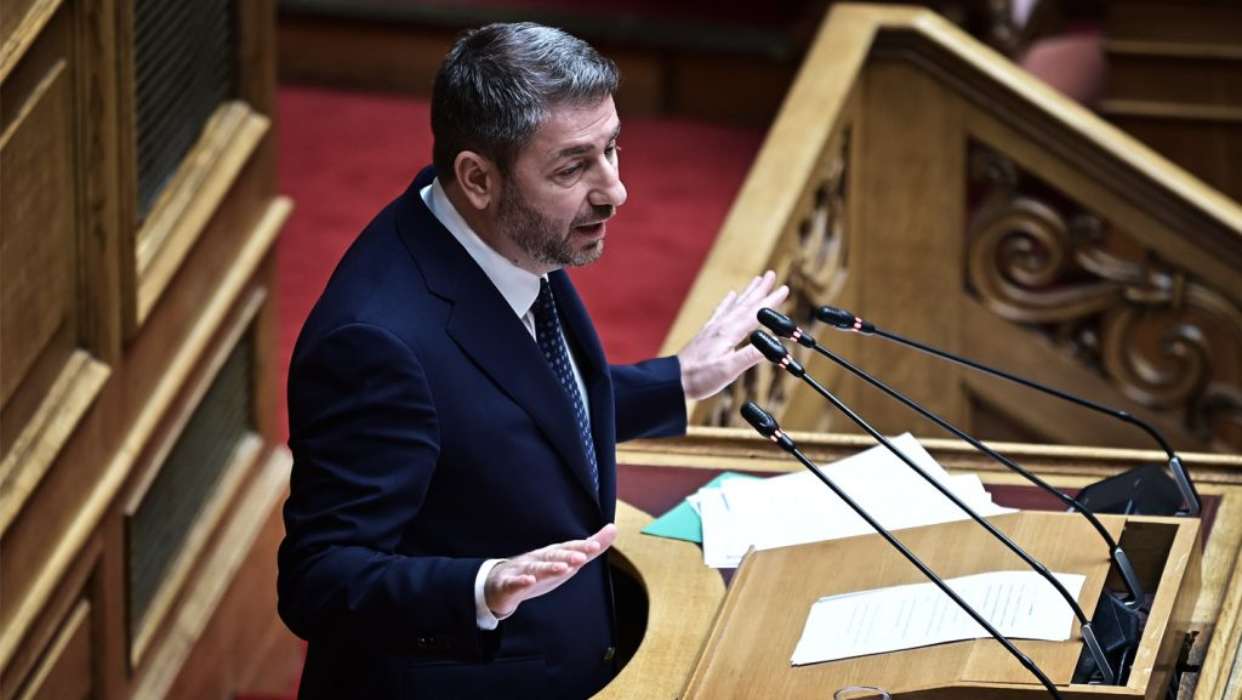
September 3 is becoming more than a symbolic anniversary for Nikos Androulakis and PASOK.
It is the starting point for a political offensive on two fronts.
Speaking from Crete as PASOK marks 52 years since its founding declaration, Androulakis sharply attacked both Prime Minister Kyriakos Mitsotakis and former prime minister Alexis Tsipras, making clear that PASOK does not intend to leave Tsipras uncontested space within the opposition.
In an interview with Iordanis Hasapopoulos and Anthi Voulgari on Meganews 104.6, the PASOK leader sought to position his party ahead of the Thessaloniki International Fair not merely as an opposition force, but as an autonomous alternative for government.
And this time, Tsipras was directly in his sights.
The Tsipras Attack: Golden Visa and Credibility
Androulakis’ sharpest criticism concerned the economic programme presented by Tsipras in Thessaloniki.
The PASOK leader focused on what he described as a contradiction involving plans to finance a new National Convergence Fund partly through revenues generated by the Golden Visa programme.
“When on September 2 you say you will create a fund and that a key source of its financing will be €1 billion from the Golden Visa, which you yourself said in July you would abolish, I think that shows there has been no change. We are dealing with the same factory settings of Mr Tsipras.”
The attack was deliberate.
Androulakis is attempting to turn credibility and consistency into a dividing line between PASOK and Tsipras as competition for the centre-left intensifies.
PASOK Does Not Want a Mitsotakis–Tsipras Rematch
This is where the bigger political battle lies.
Tsipras’ renewed political activity and the presentation of an extensive economic programme are creating fresh competition across Greece’s fragmented centre-left.
Androulakis wants to respond before a new political narrative becomes entrenched.
His strategic objective is clear: the next election must not become a binary contest between Mitsotakis and Tsipras, with PASOK squeezed between the two.
That is why PASOK is simultaneously drawing lines against New Democracy and the former prime minister.
Androulakis wants his party to emerge as an independent third pole capable of challenging for first place, rather than merely competing for leadership of the opposition.
“Low Incomes, High Prices”
The second front is the Mitsotakis government.
Androulakis compressed his economic criticism into four words:
“Low incomes, high prices.”
He then sharpened the attack:
“We have seen a 40% increase in food prices under the New Democracy government and a 50% increase in rents. How can a family cope?”
This is emerging as one of the central arguments PASOK intends to take into TIF.
The government will point to economic growth, higher employment, fiscal stability and tax relief.
Androulakis wants the political debate shifted away from headline macroeconomic indicators and directly towards household purchasing power.
Androulakis Targets the Supermarket Price Initiative
The PASOK leader was particularly critical of the government’s initiative aimed at lowering supermarket prices.
His argument is that the time between the measure being announced and implemented gave retailers sufficient room to adjust prices beforehand.
“Have you ever seen a measure announced in July and implemented in September?” he asked.
Androulakis continued:
“The reductions are not being made from July prices, but from prices that had already increased during the summer months.”
He cited Cyprus as an example of how tax reductions can reach consumers when authorities record prices before a measure is introduced and subsequently impose penalties where necessary.
“You do not announce a measure and implement it weeks later, allowing the market time to adjust.”
And he went further:
“These measures cannot be agreed with oligopolies. If they are, then what kind of measures are they?”


PASOK’s Prescription: Inspections and a Permanent Windfall Tax
Androulakis also set out the framework PASOK intends to present as an alternative.
He wants stronger market supervision, more inspections throughout supply chains and significantly heavier penalties for profiteering.
“Independent authorities and DIMEA must function properly. There must be extensive inspections at every stage of the supply chain before a product reaches the shelf, and very large fines must be imposed to restrict profiteering.”
Alongside enforcement, PASOK is proposing a permanent mechanism for taxing windfall profits.
The objective, according to Androulakis, is not simply to raise additional tax revenue.
It is to create a deterrent.
Companies operating in concentrated markets would know that excessive profits resulting from abusive market conditions could subsequently be taxed by the state.
Greek Banks Enter the Political Crosshairs
Androulakis also turned his fire on the banking sector.
He linked the strong profitability of Greek banks to the taxation of dividends, arguing that successive governments have offered shareholders overly favourable treatment.
“The banks had reached a disastrous position. The Greek people recapitalised them with billions, and now they are making €4.8 billion in annual profits and will distribute €2.6 billion in dividends taxed at 5%. PASOK had the tax at 15%, Mr Tsipras took it to 10% and Mr Mitsotakis to 5%.”
The political construction of that statement is important.
Once again, Androulakis places Tsipras and Mitsotakis on the same continuum.
His objective is to undermine the argument that voters dissatisfied with New Democracy should automatically return to the former prime minister.
“We Have No Dependencies on Special Interests”
Androulakis is simultaneously attempting to build a second line of differentiation around political credibility.
“We have no dependencies on special interests, so we will do what we say.”
He identified the welfare state, housing, justice, institutional reform and the fight against corruption as central components of PASOK’s programme.
For Androulakis, the argument is no longer simply about who promises the most.
It is about who voters believe can actually deliver.
“A large part of society sees all political parties as part of the problem. We have to prove that we will do what we say.”
From September 3 to Thessaloniki
Choosing Crete for PASOK’s September 3 anniversary is also politically calculated.
The party is attempting to turn the celebration of its 52nd anniversary in Heraklion into the launch of a broader political offensive under the slogan “A Start for Victory.”
Androulakis explained the symbolism himself:
“We are starting from here, where we brought green back onto the country’s political map in the European elections.”
The objective is to use one of PASOK’s strongest regions as a springboard towards the next major political event:
the Thessaloniki International Fair.
There, Androulakis says PASOK will present its economic programme in detail, followed by further documentation at his press conference the next day.
“With PASOK in Government…”
Androulakis also offered perhaps his clearest attempt to frame the coming election as a contest for government rather than opposition leadership.
“With PASOK in government, opacity, lack of meritocracy, corruption and impunity will come to an end.”
He added:
“The Greek people must believe that rules will apply everywhere. We must become a normal European country where every citizen feels that the state treats everyone in the same way.”
That language is designed to shift PASOK from protest politics towards a governing proposition.
But there is a significant obstacle.
Polls Remain the Hard Reality
Androulakis acknowledged the challenge when questioned about opinion polls.
“They are a snapshot of the moment. But the big picture will be taken by the Greek people on election day.”
He insisted that PASOK must continue fighting “until the last day for the goal of political change.”
The argument reflects the difficult strategic position facing the party.
Government dissatisfaction does not automatically translate into PASOK support.
And Tsipras’ renewed presence potentially creates another destination for voters seeking an alternative to Mitsotakis.
The Real Battle: Preventing a Mitsotakis–Tsipras Duopoly
This is ultimately what makes Androulakis’ intervention politically significant.
The PASOK leader is attempting to establish three distinct political narratives:
Mitsotakis: high prices, weak market controls and excessive tolerance of oligopolistic practices.
Tsipras: inconsistency, credibility problems and a return to familiar political formulas.
PASOK: institutional reform, market rules, social policy and a documented governing programme.
That is the political triangle Androulakis wants voters to see.
Whether he can impose it on the electorate remains an open question.
His first major test will come at TIF.
Because in Thessaloniki, attacking Mitsotakis and Tsipras will no longer be enough.
Androulakis will have to demonstrate why PASOK is not simply the third option — but the third option capable of becoming the first.
Source: pagenews.gr