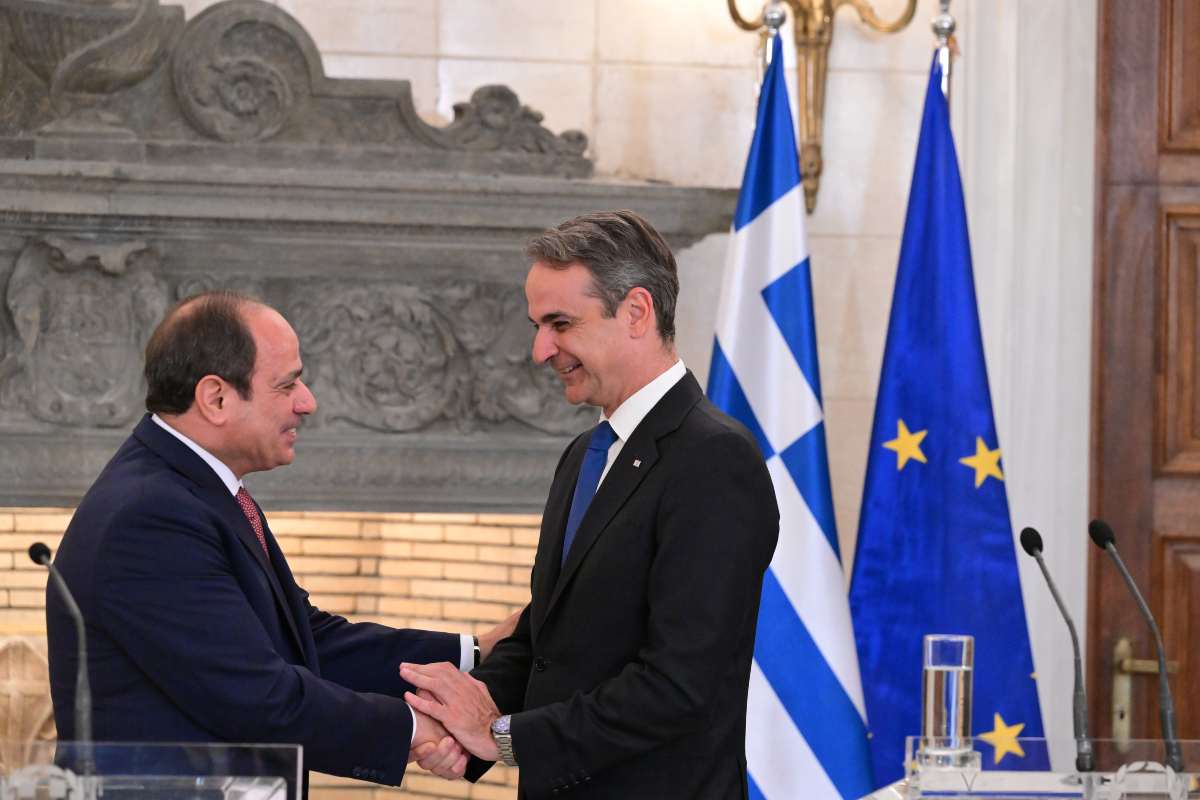
From the Thessaloniki International Fair and the domestic economy, Kyriakos Mitsotakis moves almost immediately onto the geopolitical chessboard of the Eastern Mediterranean.
On Tuesday, September 8, the Greek prime minister will travel to El Alamein for talks with Egyptian President Abdel Fattah el-Sisi at a moment when almost every major regional balance is shifting simultaneously.
Turkey. Libya. Maritime zones. Migration. Sinai. Energy. New defense alignments.
Behind all of them lies one increasingly important question for Athens:
How close can Sisi’s Egypt move toward Erdoğan’s Turkey without changing the strategic balance in the Eastern Mediterranean?
Athens does not fear Cairo–Ankara dialogue — it fears a strategic realignment
This is the lens through which the El Alamein meeting should be viewed.
Greece cannot — and does not seek to — prevent normalization between Egypt and Turkey.
Athens’ concern is different: whether diplomatic normalization could eventually evolve into a strategic convergencecapable of affecting the geopolitical architecture of the Eastern Mediterranean.
Ankara has clear reasons to pursue such a rapprochement.
Egypt possesses one of the region’s strongest armed forces, controls the Suez Canal, sits opposite Crete and Libya, and remains a pivotal player from the Eastern Mediterranean to the Red Sea.
For Turkey, bringing Cairo closer would represent far more than repairing a bilateral relationship.
It would alter the regional balance.
Erdoğan’s new regional opening
One factor Athens is closely watching is the emerging regional defense architecture involving Turkey and other major Muslim powers.
Ankara has been promoting closer defense coordination across the Middle East and has signaled that Egypt could become an increasingly important partner in broader regional arrangements.
This matters because Egypt is not simply another regional state.
If Cairo were eventually drawn into a security structure in which Turkey played a central role, a new strategic geometry could emerge stretching from the Eastern Mediterranean toward the Gulf.
There is currently no indication that Egypt is prepared to abandon its traditional policy of strategic autonomy or bind itself exclusively to Ankara.
Cairo maintains deep relations with Washington, Europe, the Gulf monarchies, Greece and Cyprus.
And that multiplicity of partnerships is precisely what makes Egypt so valuable.


The Greece–Egypt EEZ agreement is Athens’ strategic anchor
Greece nevertheless possesses one major advantage.
Athens and Cairo have already created a legal and geopolitical foundation through their 2020 partial EEZ delimitation agreement.
That agreement was more than a bilateral technical arrangement.
It constituted a strategic response to the Turkey–Libya maritime memorandum and established a framework based on internationally recognized principles of maritime delimitation.
For Greece, protecting that acquis is essential.
Athens wants to ensure that improved Turkey–Egypt relations do not create room for Ankara to reopen questions surrounding maritime zones or persuade Cairo to reconsider positions developed over years of Greek–Egyptian cooperation.
The Turkey–Libya memorandum remains the geopolitical fault line
Libya will inevitably be part of the conversation.
Greece continues to reject the Turkey–Libya maritime memorandum, arguing that it disregards the maritime rights generated by Greek islands and cannot create legitimate maritime boundaries between two states whose claimed zones are separated by Greek territory.
For Egypt, Libya is equally critical.
The countries share a long land border, and instability in eastern Libya is regarded in Cairo as a direct national-security concern.
This creates an important area of convergence between Greece and Egypt.
Both want stability in Libya.
Both are wary of arrangements that could allow another regional power to dominate the country.
And both have major interests in how Libya’s maritime and energy future is eventually settled.
Crete is effectively on the negotiating table
There is another reason the El Alamein meeting matters.
Greece is advancing hydrocarbon exploration and broader energy planning in maritime areas south of Crete, while simultaneously rejecting Libyan challenges to Greek jurisdiction.
That means Eastern Mediterranean energy geography is becoming inseparable from diplomacy.
EEZs, offshore exploration, electricity interconnections and strategic infrastructure are now parts of the same geopolitical puzzle.
For Athens, Egypt is one of the states capable of giving that architecture additional regional legitimacy and economic depth.
But Sisi has every reason to talk to Erdoğan
This is where the picture becomes more complicated.
The Egyptian president has no interest in choosing between Greece and Turkey.
Cairo wants both.
Restoring relations with Ankara offers Egypt access to trade, investment, regional diplomacy and potential coordination over Libya.
Greece offers something different: access to the European political system, energy partnerships, strategic continuity, defense cooperation and a relationship built on years of institutional coordination.
Sisi’s strategy is therefore not necessarily to replace Athens with Ankara.
It is to increase Egypt’s strategic value by maintaining productive relationships with both.
That is classic Egyptian balancing.
Athens’ real task is to make itself indispensable
Greece therefore faces a more sophisticated diplomatic challenge than simply maintaining “good relations” with Cairo.
It must make the Greek–Egyptian partnership deep enough that any rapprochement between Erdoğan and Sisi cannot alter the fundamentals of the regional balance.
That requires more than diplomatic declarations.
It means energy.
The Greece–Egypt electricity interconnection.
Investment.
Defense cooperation.
Shipping.
Migration.
Libya.
European policy.
And institutional coordination over maritime law.
The deeper those links become, the more difficult it is for any third country to displace Greece from Egypt’s strategic calculations.
Cyprus completes the triangle
Cyprus adds another important layer.
Any Greece–Egypt–Cyprus coordination surrounding the visit would send a clear message that bilateral normalization with Turkey does not erase the trilateral architecture built over the previous decade.
For Athens, the trilateral relationship has always been about more than diplomatic symbolism.
It creates a political platform joining three states with major interests in maritime law, energy development and regional stability.
Maintaining that structure while Egypt improves relations with Turkey would be an important diplomatic success.
Sinai is a different issue — but a sensitive test of trust
The future of Saint Catherine’s Monastery in Sinai is also expected to feature prominently.
This is not a hard-power issue comparable with Libya or EEZ delimitation.
But for Greece it carries exceptional religious, historical and political significance.
Athens wants a durable arrangement safeguarding the monastery’s character, rights and continued operation.
In diplomatic terms, the issue has become a test of the depth of mutual confidence between Athens and Cairo.
Mitsotakis arrives after sending a message to Erdoğan
The timing is also important.
Only days before the Egypt visit, Mitsotakis used his meeting with European Council President António Costa to place Turkey’s casus belli and the latest tensions in the Aegean within a broader European framework.
The Greek prime minister also linked the participation of third countries in European defense initiatives with respect for the security interests of EU member states.
Athens is therefore pursuing the same principle on several diplomatic levels:
European support against challenges to Greek sovereignty and sovereign rights, combined with regional partnerships that reinforce Greece’s position in the Eastern Mediterranean.
The sequence is significant:
Brussels – Ankara – Cairo – Eastern Mediterranean.
So how close can Sisi really get to Erdoğan?
The answer, at least for now, is: close enough for substantial cooperation, but considerably further away from a full strategic realignment.
Egypt has strong incentives to normalize relations with Turkey.
But it has equally strong incentives not to become part of a Turkey-centered regional bloc.
Cairo wants Washington.
It wants the European Union.
It wants Saudi Arabia and the UAE.
It wants Greece and Cyprus.
And it also wants a functioning relationship with Ankara.
That is not a contradiction.
It is multi-vector balancing.
The bigger picture: Athens wants to remain indispensable to Cairo
El Alamein should therefore not be interpreted as Mitsotakis asking Sisi to choose between Greece and Turkey.
That would be both unrealistic and strategically counterproductive.
Athens’ objective is subtler:
Egypt must be free to move closer to Turkey without ever finding it advantageous to move away from Greece.
The EEZ agreement, Cyprus, energy, Libya, European ties, defense cooperation and investment are the pillars supporting that calculation.
That is why the September 8 meeting carries substantially more weight than an ordinary bilateral visit.
Sisi is not being asked to choose Athens over Ankara.
The real contest for Greece is to ensure that, however far Cairo’s normalization with Ankara progresses, Athens remains strategically irreplaceable in Egypt’s Eastern Mediterranean equation.
Source: pagenews.gr