Ukraine’s €70 Billion Funding Gap: EU Turns to Canada and Britain as War Costs Soar
 ΧΡΟΝΟΣ ΑΝΑΓΝΩΣΗΣ 19 '
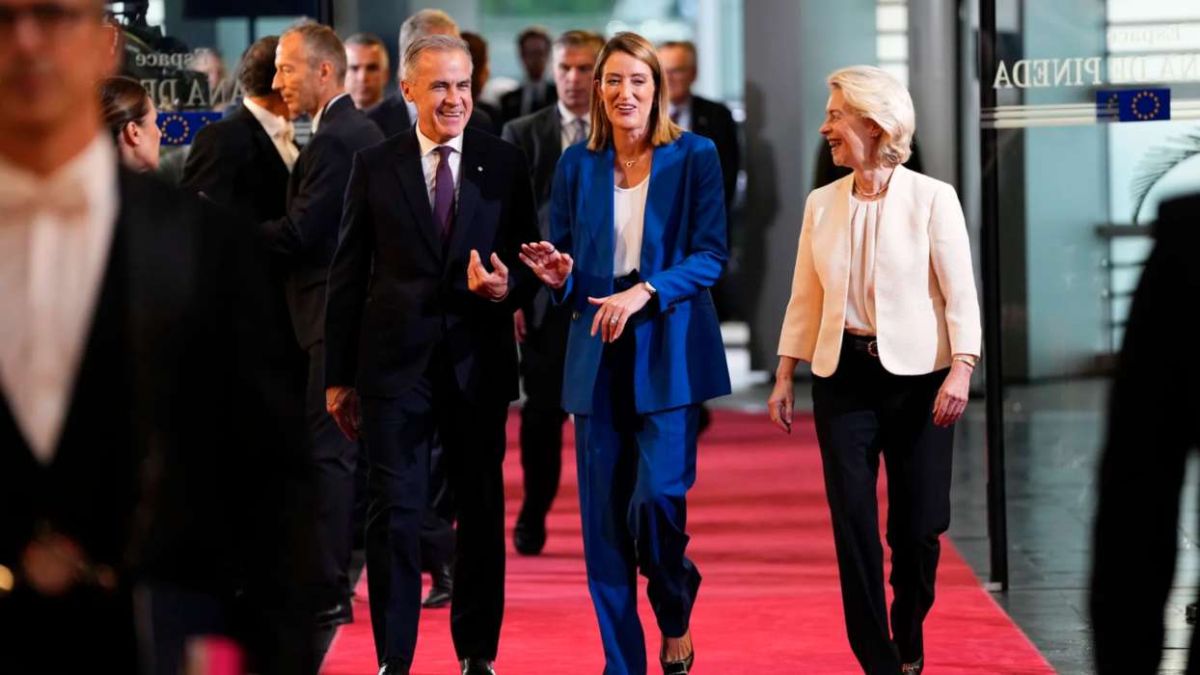
Πηγή Φωτογραφίας: AP Photo//Ukraine’s €70 Billion Funding Gap: EU Turns to Canada and Britain as War Costs Soar



The European Union is preparing a major diplomatic effort to secure additional financial support for Ukraine, turning to Canada, the United Kingdom and other international partners as the cost of sustaining Kyiv’s war effort continues to rise.
According to reporting by POLITICO, Brussels intends to press Ottawa and London for greater contributions as Ukraine faces a projected €70 billion funding gap in 2027.
The initiative comes as European governments confront growing pressure on their national budgets, rising defence expenditure and uncertainty over the future direction of US policy under President Donald Trump.
European officials increasingly acknowledge that the EU cannot indefinitely shoulder such a large proportion of Ukraine’s external financing without broader international participation.
The issue is expected to feature prominently in upcoming EU summits with Canada and Britain, where discussions on economic cooperation, defence partnerships and market access will provide a wider diplomatic framework.
For Brussels, the objective is not simply to secure additional money.
It is to establish a more sustainable international financing arrangement that allows Ukraine to maintain its defence capabilities, operate essential public services and withstand continued Russian military pressure.
Brussels Confronts a €70 Billion Challenge
Ukraine’s financial requirements are expected to remain substantial throughout 2027.
The projected €70 billion gap reflects the continuing pressure on the country’s public finances and defence budget.
Years of war have severely disrupted economic activity, damaged infrastructure and increased government spending.
Kyiv relies heavily on external financial assistance to maintain essential state functions, including public-sector salaries, healthcare, education and critical infrastructure.
Military requirements add another layer of pressure.
Ukraine needs continued access to air-defence systems, ammunition, drones and other equipment as Russian attacks persist.
Although the EU has already committed significant resources, the scale of Ukraine’s future needs exceeds the financing currently secured.
That imbalance is driving the European Commission’s renewed diplomatic campaign.
Brussels wants international partners to move beyond general expressions of solidarity and make concrete financial commitments with clear implementation schedules.
Von der Leyen Calls for Greater International Burden-Sharing
European Commission President Ursula von der Leyen has repeatedly emphasised the scale of Europe’s financial contribution to Ukraine.
According to figures presented by the Commission, the EU and its member states now account for approximately 80% of external assistance provided to Kyiv.
That concentration of responsibility is becoming increasingly difficult to sustain.
Von der Leyen has argued that Europe must continue leading the international response while encouraging other partners to assume a larger share of the burden.
The Commission’s position reflects a broader strategic concern.
If Ukraine’s financing depends too heavily on a limited number of governments, political developments or fiscal constraints in those countries could disrupt essential assistance.
Diversifying funding sources would reduce that vulnerability.
It would also provide Kyiv with greater certainty when planning defence procurement, reconstruction and public expenditure.
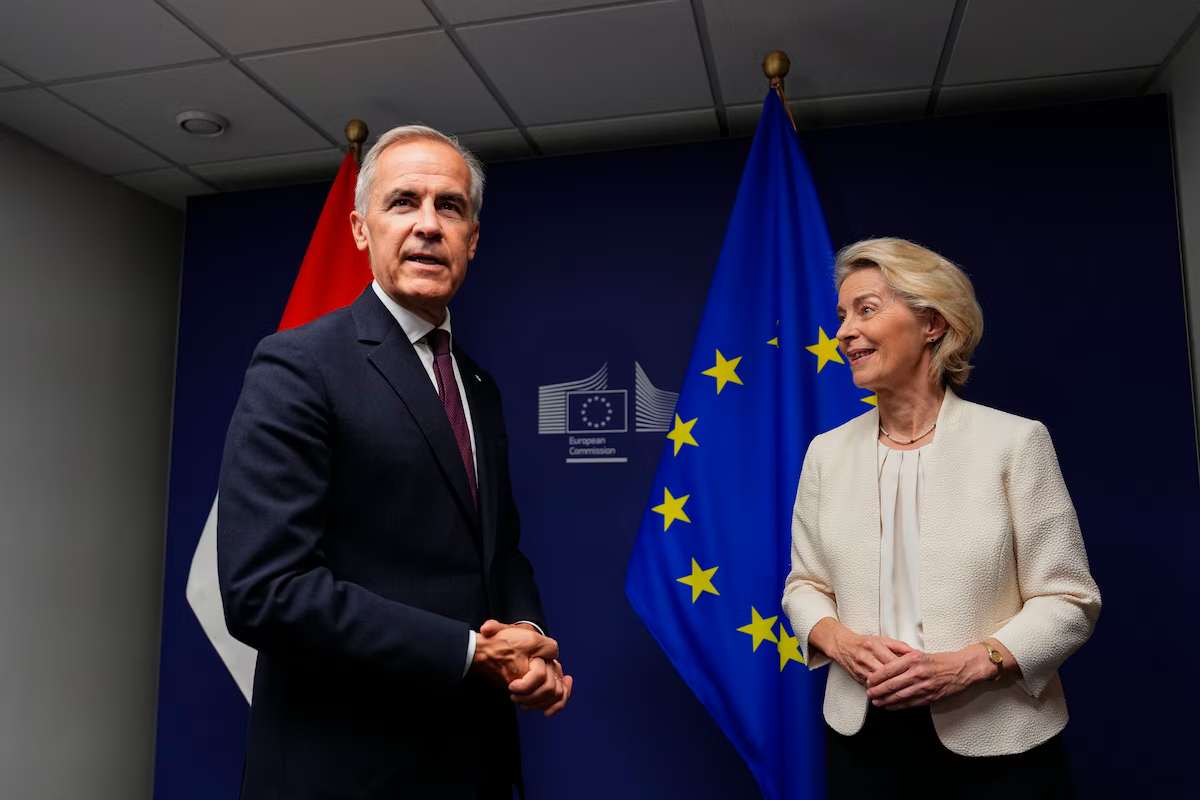
Two Crucial Summits: Canada in October, Britain in November
Brussels has identified two upcoming diplomatic meetings as important opportunities to advance its funding campaign.
The EU–Canada summit is scheduled for October 29–30, while the EU–UK summit is expected on November 20.
According to European officials and diplomats cited by POLITICO, Ukraine’s financial requirements will form part of the discussions.
Both meetings are expected to cover broader economic and security cooperation.
Canada is seeking deeper engagement with European defence initiatives, while Britain is pursuing a closer economic relationship with the EU.
Those parallel negotiations provide Brussels with opportunities to raise the issue of financial assistance at the highest political level.
However, European officials have indicated that they do not intend to establish an explicit arrangement exchanging access to European programmes for additional Ukraine funding.
The approach is designed to encourage political commitments rather than create a formal financial bargain.
No specific additional contribution has yet been agreed with either country.
Why the EU’s €90 Billion Loan Is Not Enough
The European Union has already established a major financing instrument to support Ukraine during 2026 and 2027.
The €90 billion Ukraine Support Loan is designed to address military and economic requirements over the two-year period.
The programme consists of two principal components.
Approximately €60 billion is allocated to defence-related expenditure, including military procurement and support for Ukraine’s defence industry.
The remaining €30 billion is intended for economic and budgetary assistance.
Financing is raised through EU borrowing, supported by guarantees linked to the European budget.
The repayment framework is connected to the prospect of future Russian war reparations.
Despite its considerable size, the programme was never intended to cover all of Ukraine’s financial requirements.
Brussels had anticipated substantial additional contributions from international partners.
The challenge is that some of those expected resources have not yet been fully secured.
Consequently, the European Commission is intensifying efforts to turn political commitments into dependable financing.
The Missing €45 Billion From International Partners
European financial planning has included expectations of approximately €45 billion in contributions from partners outside the EU.
Countries identified in those discussions include Canada, Japan, South Korea, Australia and Norway.
However, a significant portion of the anticipated assistance remains subject to further decisions or implementation.
For Ukraine, the distinction between a political pledge and an actual disbursement is crucial.
Governments cannot finance immediate expenditure using commitments that lack agreed amounts or payment schedules.
The uncertainty also complicates longer-term planning.
Defence contracts, infrastructure projects and budgetary commitments require predictable financing.
Brussels therefore wants international partners to clarify both the scale and timing of their support.
The objective is to prevent financing shortages from emerging during a period when Ukraine remains under intense military pressure.
Dombrovskis Pushes for a Broader Coalition of Donors
European Commissioner for the Economy Valdis Dombrovskis has raised Ukraine’s financial requirements during international meetings involving the International Monetary Fund, the G7 and the G20.
The Commission has also explored the issue with countries in the Gulf.
The diplomatic campaign reflects Brussels’ determination to expand the financing coalition beyond Europe’s traditional security partners.
Dombrovskis has emphasised the importance of wider burden-sharing as Ukraine continues to resist Russian aggression.
The message is directed at governments that support Ukraine politically but have contributed different levels of financial assistance.
European officials argue that the scale of the challenge requires a more coordinated international response.
They also want funding arrangements that can survive changes in domestic political priorities.
For Brussels, international burden-sharing is increasingly a question of strategic resilience.
Canada: A Major Ukraine Supporter Facing New European Requests
Canada has been one of Ukraine’s most consistent international supporters.
Under Prime Minister Mark Carney, Ottawa has continued to provide military, financial and humanitarian assistance.
Figures cited in the POLITICO report place Canadian military commitments at approximately €5.4 billion, alongside roughly €8.2 billion in direct financial support.
The Canadian government estimates its broader contribution at almost C$26 billion, including development and humanitarian assistance.
Ottawa maintains that its commitment to Ukraine remains strong.
Nevertheless, Brussels is seeking additional support for 2027.
European officials recognise Canada’s existing contribution but argue that Ukraine’s growing requirements demand further international mobilisation.
The upcoming EU–Canada summit will therefore take place against a backdrop of overlapping financial, security and economic priorities.
Canada’s Defence Industry Could Benefit From Closer EU Cooperation
The European Union is simultaneously exploring a deeper strategic partnership with Canada.
Von der Leyen has proposed a closer association between Ottawa and the EU, potentially establishing a new model of cooperation with a trusted international partner.
Canada is also preparing to participate in the European SAFE defence financing initiative.
The programme supports joint defence procurement and aims to strengthen Europe’s industrial capacity.
Canadian participation could provide its defence companies with improved access to European-funded procurement opportunities.
This creates an important diplomatic context.
Canada is interested in expanding its defence-industrial relationship with Europe.
Brussels, meanwhile, wants Ottawa to play a larger role in financing Ukraine.
Although the two issues are being discussed within the same broader relationship, no formal agreement has been announced linking additional Ukraine assistance to defence-market access.
The negotiations illustrate how European security policy is becoming increasingly intertwined with industrial and economic cooperation.
Britain Seeks a New Relationship With Brussels
The United Kingdom represents the second major focus of the EU’s diplomatic campaign.
Prime Minister Andy Burnham’s government is seeking closer relations with the European Union.
The November summit is expected to address trade, economic cooperation, youth mobility, agricultural products and the possible alignment of emissions-trading systems.
London also wants improved conditions for British companies operating in European markets.
The British government believes that aspects of the current post-Brexit relationship require further development.
Security cooperation provides another important area of shared interest.
Britain remains a significant European military power and a major supporter of Ukraine.
For Brussels, a closer relationship with London could strengthen both European defence capabilities and the international coalition supporting Kyiv.
The challenge is to advance those objectives while respecting the institutional and economic framework governing EU–UK relations.
Britain’s £25 Billion Commitment to Ukraine
The United Kingdom has already committed approximately £25 billion in assistance to Ukraine.
That support includes military equipment, training, economic assistance and other forms of cooperation.
London also participates in arrangements connected to the EU’s €90 billion financing programme.
Those arrangements allow Ukraine to use relevant European loan resources to purchase defence equipment from British suppliers, subject to the applicable conditions.
Britain has agreed to contribute proportionately to certain borrowing costs associated with its participation.
The framework supports closer cooperation between British and European defence industries.
However, Ukraine’s increasing financial requirements have prompted Brussels to seek further international contributions.
British officials have indicated that they have not received a formal request to provide additional Ukraine funding in exchange for preferential treatment of British businesses.
The distinction is significant.
The EU is seeking greater financial support, but there is no announced agreement linking that support directly to commercial concessions.
Brussels Rejects a Trump-Style Bargaining Strategy
European officials have sought to distinguish their approach from the transactional negotiating style associated with President Trump.
One senior European diplomat cited by POLITICO rejected the idea of explicitly exchanging economic privileges for financial contributions.
The Commission’s preferred approach is to encourage partners to increase their support while maintaining broader cooperative relationships.
That position does not mean economic and security negotiations are unrelated.
Both Canada and Britain have substantial interests in European industrial and defence initiatives.
But Brussels is seeking to avoid presenting Ukraine financing as a direct condition for market access.
The EU has not publicly established specific additional funding targets for Ottawa or London.
Nor has it announced a formal mechanism connecting new contributions to concessions under other negotiations.
The diplomatic effort remains focused on persuading partners to make larger commitments voluntarily.
The “Made in Europe” Debate Adds Economic Pressure
The EU’s proposed Industrial Accelerator Act introduces another important dimension.
The legislation is intended to strengthen European manufacturing by establishing preferences for certain products manufactured within Europe.
The measures could influence public procurement and industrial support programmes.
Britain wants to ensure that its companies are not placed at a disadvantage.
British manufacturers are deeply integrated into European supply chains, particularly in advanced industrial sectors.
London is therefore seeking arrangements that would preserve favourable access for its businesses.
The issue also matters for defence production.
Europe’s expanding military expenditure is creating significant opportunities for manufacturers of equipment, components and advanced technologies.
Closer cooperation with British and Canadian companies could strengthen industrial capacity.
At the same time, Brussels wants to ensure that European financing contributes to the development of its own strategic industries.
The resulting negotiations involve a delicate balance between industrial protection, international partnerships and defence readiness.
Japan Faces Questions Over Its Contribution
The European Commission is also seeking greater participation from Japan.
According to European officials, Tokyo’s financial contributions during 2026 have not fully matched Brussels’ expectations.
Japanese representatives, however, emphasise the scale of the assistance already provided.
Japan estimates its support for Ukraine at approximately $20 billion.
Tokyo has also indicated that further assistance could be considered in response to additional requests from Kyiv.
The discussion takes place alongside broader economic negotiations between Japan and the EU.
Japanese companies are closely watching European proposals that could favour locally manufactured products.
The possibility of tighter industrial preferences has raised concerns about future market access.
As with Canada and Britain, the Ukraine funding debate is therefore unfolding within a wider economic relationship.
No specific additional Japanese contribution has yet been finalised.
Australia, South Korea and Norway Remain Part of the Strategy
Brussels is pursuing a broader international financing effort involving Australia, South Korea and Norway.
Australia has already announced additional assistance for Ukraine and strengthened its security cooperation with Kyiv.
However, Australian officials have indicated that Canberra has not yet received a formal request for additional 2027 funding.
South Korea and Norway are also among the countries considered potential contributors to the wider international effort.
The objective is to distribute the financial burden among a larger group of partners.
Each country has different economic capabilities, security priorities and existing commitments.
Consequently, Brussels is not necessarily seeking identical contributions.
Instead, the Commission wants a financing arrangement that reflects the combined capacity of countries supporting Ukraine.
Such an approach could reduce the pressure on individual European governments while improving Kyiv’s financial predictability.
Trump’s Russia Policy Complicates Europe’s Calculations
The European funding campaign is taking place amid uncertainty over Washington’s future role.
The Trump administration is pursuing diplomatic contacts with Moscow in an effort to negotiate an end to the war.
Those contacts have raised questions among European governments about the direction of US policy.
Washington’s decisions on sanctions, military assistance and financial support could significantly affect Ukraine’s position.
European officials cannot assume that the United States will provide the same level of support in future years.
That uncertainty has strengthened arguments for a more independent European financing strategy.
Brussels wants Ukraine to have access to dependable resources regardless of changes in American political priorities.
The issue extends beyond immediate military requirements.
It concerns Europe’s capacity to sustain a long-term security commitment in its own neighbourhood.
Europe’s Contribution Exceeds €231 Billion
The European Union and its member states estimate their combined support for Ukraine at more than €231 billion since Russia launched its full-scale invasion.
That figure includes several categories of assistance.
Military equipment, direct budget support, financial guarantees, humanitarian measures and assistance for Ukrainians hosted in EU countries all form part of the overall calculation.
Revenue generated from immobilised Russian assets also contributes to the broader support framework.
Not all of these commitments represent direct cash transfers to the Ukrainian government.
Nevertheless, the total demonstrates the scale of Europe’s involvement.
European diplomats increasingly argue that the continent has assumed a substantial financial responsibility.
The Commission’s current campaign is intended to ensure that other international partners make contributions proportionate to their capabilities.
European Politics Could Make Future Funding More Difficult
The financing debate is becoming increasingly sensitive as European governments face domestic political pressures.
Higher defence spending, economic uncertainty and demands for investment in public services are placing competing claims on national budgets.
In France, political disagreements over assistance to Ukraine have become part of the wider debate ahead of the 2027 presidential election.
Other European countries are also confronting differing views on the appropriate scale and duration of support.
These domestic pressures could complicate future financing decisions.
For Brussels, the solution is to secure commitments that extend beyond individual budget cycles and short-term political developments.
A wider international coalition could provide greater continuity.
It could also help protect Ukraine’s financial stability from sudden shifts in political sentiment.
What the Funding Debate Means for Greece
As an EU member state, Greece is directly involved in the broader European financial and security framework supporting Ukraine.
Common borrowing instruments, EU budget guarantees and collective defence initiatives all have implications for national fiscal planning.
The growing cost of supporting Ukraine highlights the importance of distributing financial responsibilities among member states and international partners.
For Greece, the debate also intersects with European defence-industrial policy.
Expanded joint procurement programmes and closer cooperation with international partners could influence future defence investments and industrial opportunities.
At the same time, Athens must balance European commitments with domestic priorities, including infrastructure, public services and fiscal stability.
Additional contributions from countries outside the EU could help reduce some of the pressure on European budgets.
However, such contributions would not eliminate existing European obligations.
Ukraine’s Next Battle Is Also Financial
Ukraine’s ability to continue resisting Russia depends on more than military equipment.
The country must also maintain a functioning economy and public administration.
Hospitals, schools, energy networks and other essential services require sustained financing.
Without predictable external assistance, Kyiv would face difficult choices between immediate military needs and the operation of the state.
That is why the European Commission is treating the 2027 funding challenge as a strategic priority.
The effort to secure contributions from Canada, Britain, Japan and other partners reflects the recognition that financial resilience is an essential component of Ukraine’s defence.
For European governments, the challenge is to sustain support while preserving domestic economic stability.
For international partners, it is to determine how much responsibility they are prepared to assume.
The Next Diplomatic Test for Brussels
The upcoming summits with Canada and the United Kingdom will provide the first major opportunities to assess whether the EU’s strategy is producing results.
Brussels wants additional financial commitments, but neither Ottawa nor London has agreed to a specific new contribution.
Discussions with Japan and other potential partners are also continuing.
The outcome will influence Ukraine’s ability to plan for 2027.
It will also test the EU’s capacity to mobilise a broader coalition around one of its most important security priorities.
With a projected €70 billion funding gap looming, Brussels is attempting to transform international political solidarity into a more predictable financial commitment.
The stakes extend beyond Ukraine’s immediate budgetary needs.
They concern the future of European security, the durability of Western cooperation and the financial foundations of Kyiv’s continued resistance.
The central question is no longer simply how much Europe can contribute. It is how many international partners Brussels can persuade to share the burden — and whether their promises will become actual funding before Ukraine’s next financial crisis emerges.
Source: pagenews.gr
Διαβάστε όλες τις τελευταίες Ειδήσεις από την Ελλάδα και τον Κόσμο