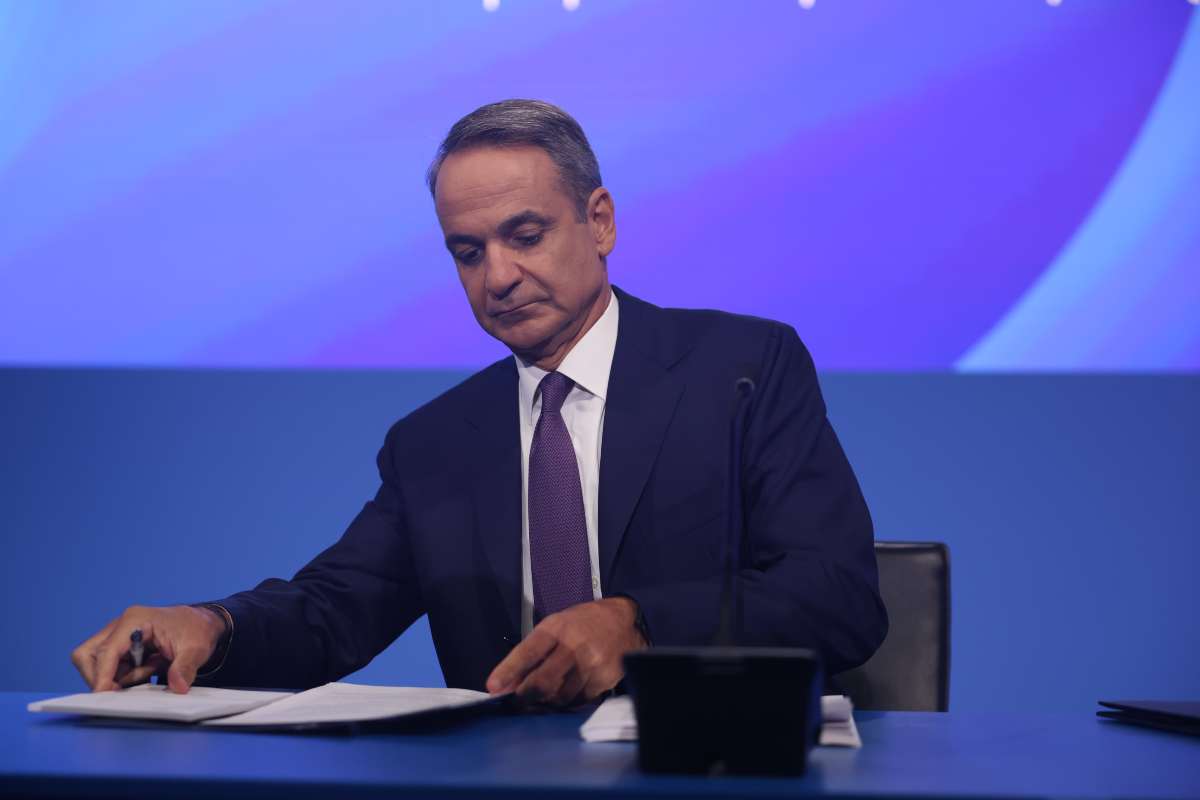
Prime Minister Kyriakos Mitsotakis used his press conference at the 90th Thessaloniki International Fair to move well beyond the economic package unveiled a day earlier.
His answers laid out three political red lines: against Turkish challenges to Greece’s defense and sovereign rights, against post-election scenarios that would sideline the party finishing first, and against Antonis Samaras on fundamental foreign-policy issues.
The broader message linked geopolitics with domestic politics: deterrence abroad, stability at home and a renewed push for a single-party majority in 2027.
“We Will Not Ask Anyone’s Permission” on Greece’s Defense
The strongest geopolitical message was clearly directed at Ankara.
Mitsotakis argued that Greece has significantly strengthened its deterrence capabilities in recent years and made clear that Athens will determine its own defense policy.
“Greece has strengthened its deterrent capability in recent years and obviously will not ask anyone’s permission about how it arms itself.”
The statement comes as Greece continues a major modernization of its Armed Forces and amid renewed friction with Turkey over the strategic balance in the Aegean and Eastern Mediterranean.
The underlying message is straightforward: dialogue with Ankara does not imply constraints on Greece’s defense planning.
For Athens, military modernization and diplomatic engagement are parallel tracks, not mutually exclusive choices.
The 12-Nautical-Mile Option Remains on the Table
Mitsotakis went further by reiterating Greece’s position on territorial waters.
Athens maintains that the principal dispute it recognizes with Turkey concerns the delimitation of maritime zones — the continental shelf and Exclusive Economic Zone — rather than the broader set of issues Ankara seeks to place on the negotiating table.
At the same time, the prime minister reaffirmed Greece’s position that it retains the sovereign right under international law to extend its territorial waters.
“Greece retains the inalienable right to extend its territorial waters to 12 nautical miles whenever and in whatever manner it considers the timing most appropriate.”
This is strategically significant.
Mitsotakis did not announce an imminent extension. He instead reinforced the principle that the option remains available and that the timing of any decision belongs to Athens.
That keeps one of the most sensitive instruments in Greek-Turkish relations firmly on Greece’s strategic agenda.


GSI: “Turkey Has No Legitimacy to Block the Project”
The Greece-Cyprus electricity interconnector was another major geopolitical component of the press conference.
Asked about the timetable for laying the cable, Mitsotakis said he expects procedures to restart within the coming months.
He then delivered another direct message to Ankara:
“Turkey has no legitimacy to obstruct the project. I believe it will not do so. We are also coordinating with France in order to address all possible scenarios.”
The reference to France is particularly important.
It places the Great Sea Interconnector not merely within the framework of an energy infrastructure project, but within the wider strategic relationship between Athens and Paris.
The project therefore sits at the intersection of energy security, maritime geopolitics and European strategic interests in the Eastern Mediterranean.
From Deterrence to the Ballot Box
Mitsotakis also linked the increasingly unstable international environment to Greece’s domestic political debate.
His objective remains clear: New Democracy will seek a parliamentary majority in the 2027 national election.
For the prime minister, the argument is no longer simply that a majority government is preferable for New Democracy. He is trying to frame political stability itself as a strategic national asset.
That logic is especially relevant as Greece prepares to assume the rotating Presidency of the Council of the European Union in the second half of 2027.
Investment, foreign policy, defense and Greece’s European role are increasingly being folded into the same political argument: a volatile international environment requires predictable government at home.
“Good Luck” With a Government of the Losers
Mitsotakis was particularly dismissive of scenarios under which opposition parties could combine after the election to form a government despite none of them finishing first.
“The first party forms the government, with the leader of the first party as prime minister,” he said.
Discussing what he described as a possible “government of the losers,” Mitsotakis added:
“Good luck, if that is what the country needs today.”
He also recalled the 2023 election, when similar discussions about alternative governing coalitions ultimately gave way to a New Democracy victory with roughly 41% of the vote.
His political objective is increasingly visible: turn the 2027 election not only into a judgment on the government’s economic record, but into a referendum on governability.
Samaras: The Door Is Effectively Closed
The sharpest internal New Democracy message concerned former prime minister Antonis Samaras.
Mitsotakis defended the decision to expel Samaras from the party and made clear that the dispute is no longer merely personal.
The dividing line, he argued, now touches the core of Greek foreign policy.
Mitsotakis said he could see no meaningful room for political understanding as long as Samaras continues to challenge central elements of the government’s foreign-policy strategy.
That is an important distinction.
A disagreement over tactics can potentially be repaired.
A disagreement over the strategic foundations of foreign policy is much harder to bridge.
The prime minister also expressed regret that relations had reached the point of expulsion, while noting that Samaras’s criticism had continued afterward.


Karamanlis Gets a Very Different Message
The tone toward former prime minister Kostas Karamanlis was markedly different.
“I have a good personal relationship with Mr. Karamanlis. I respect and honor him, just as I honor all the leaders of New Democracy and former prime ministers,” Mitsotakis said.
The contrast was difficult to miss.
With Karamanlis, Mitsotakis emphasized personal respect and continuity within the party.
With Samaras, he emphasized a political rupture rooted partly in foreign policy.
The message to New Democracy’s broader conservative electorate appears calibrated accordingly: the government is not seeking confrontation with the party’s former leaders as a group, but it will not change strategic direction to repair the Samaras relationship.

The Bigger Picture: Security Abroad, Stability at Home
Taken together, Mitsotakis’s answers reveal the political architecture with which he intends to approach 2027.
Toward Turkey, the message is that dialogue does not equal retreat. Greece will continue strengthening its Armed Forces, retains the 12-nautical-mile option and rejects attempts to broaden the bilateral agenda beyond the disputes Athens recognizes.
On the Great Sea Interconnector, Athens is signaling that Turkish objections will not determine whether a European energy project proceeds.
Inside New Democracy, Mitsotakis is drawing a firm boundary around his foreign-policy strategy, even if that means leaving the Samaras rupture unresolved.
And toward voters, he is beginning to construct a broader electoral choice: single-party stability or a period of coalition bargaining at a moment of heightened geopolitical uncertainty.
The 2026 Thessaloniki International Fair therefore ended with much more than an economic package.
It offered perhaps the clearest preview yet of the political and geopolitical argument Mitsotakis wants to take into the 2027 election:
a stronger Greece abroad, political stability at home, and no outside veto over the country’s defense and sovereign choices.
Source: pagenews.gr