Greece–Turkey Cable Dispute: “The Kasos Crisis Must Not Happen Again” – A Warning to Ankara
 ΧΡΟΝΟΣ ΑΝΑΓΝΩΣΗΣ 12 '

Πηγή Φωτογραφίας: eurokinissi//Greece–Turkey Cable Dispute: “The Kasos Crisis Must Not Happen Again” – A Warning to Ankara



“The Kasos crisis must not be repeated.” With this unequivocal warning, Professor of European Politics Konstantinos Lavdas addressed the latest developments surrounding the Greece–Cyprus electricity interconnector, while international affairs analyst Konstantinos Filis outlined the diplomatic negotiations and the next movements of the research vessel involved in the project.
At the centre of the debate is France’s diplomatic notification to Turkey, which has triggered questions about whether the communication constituted a routine precaution or an implicit acknowledgment of Ankara’s claims in the Eastern Mediterranean.
Both analysts rejected the interpretation that the French initiative represented a concession of Greek sovereign rights.
However, they stressed that the real diplomatic and strategic test would be whether the Great Sea Interconnector (GSI) could proceed without obstruction.
Their assessments come amid renewed attention to maritime jurisdiction, the Turkey–Libya maritime agreement and the increasingly important role of French and American interests in the Eastern Mediterranean.
Filis: “No Permission Was Requested from Turkey”
Konstantinos Filis, director of the Institute of International Affairs, explained that the French government had submitted a written notification to Ankara concerning the planned route of the research vessel.
He emphasised that the communication was informational and did not constitute a request for Turkish authorisation.
“There was indeed a written notification from the French side. This notification explicitly does not concern a request for permission from Turkey,” Filis stated.
According to his account, the relevant requests for maritime navigational notices, known as NAVTEX, were submitted to Greece and Cyprus.
Both countries subsequently issued their notices on the same Friday, a development Filis described as particularly significant.
Under different circumstances, Cyprus might have issued its own NAVTEX at a later stage, when the vessel approached the maritime areas under Cypriot jurisdiction.
Instead, the two countries acted simultaneously.
“That did not happen. The notices were issued simultaneously, in coordination between the two sides,” he explained.
Filis interpreted the move as evidence of close operational coordination between Athens and Nicosia.
He also stressed that the French communication to Turkey should not be confused with the legal and administrative procedures carried out by Greece and Cyprus.
Research Vessel Expected East of Karpathos
Filis provided details about the anticipated timetable for the next stage of the project.
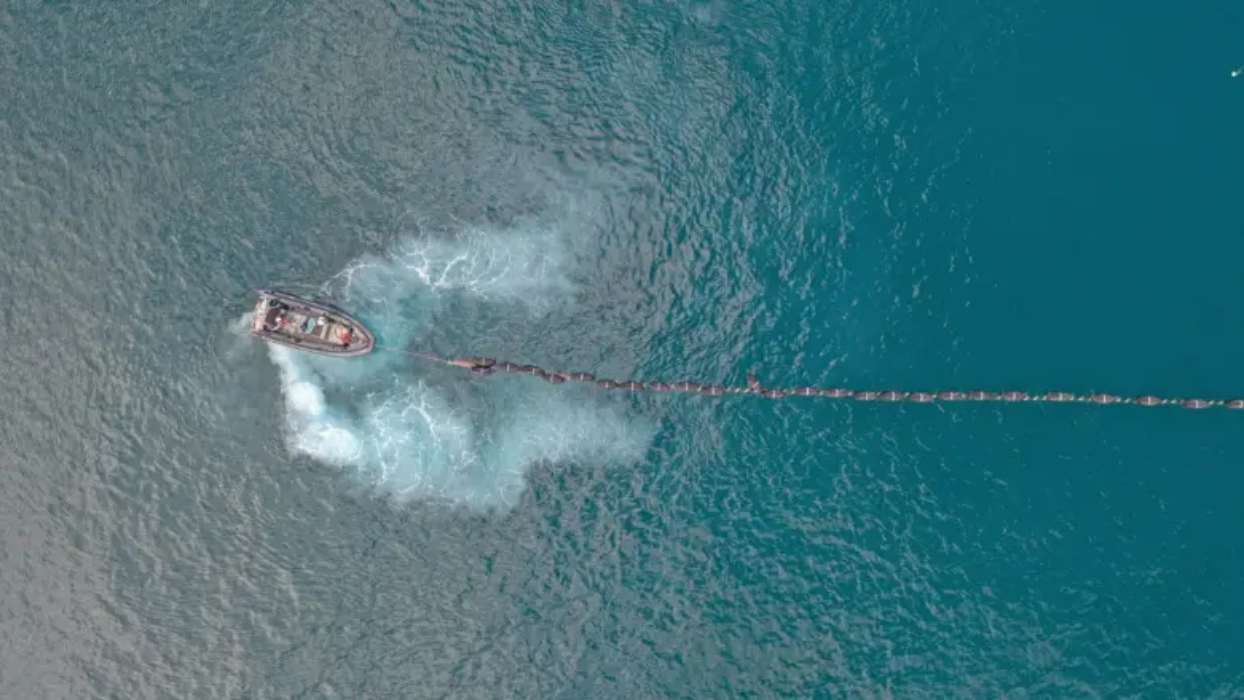
According to his information, the research vessel was in Heraklion, Crete, and was expected to move east of Karpathos around the middle of the week.
That area would serve as the starting point for the next phase of seabed surveys.
“The vessel will most likely be east of Karpathos around the middle of the week, where it will begin its seabed surveys,” he said.
Before departure, the vessel needed to complete the calibration of its equipment, a procedure that could also be carried out while underway.
Unfavourable weather conditions in the preceding days had reportedly delayed its departure from Heraklion.
The next phase is particularly sensitive because the vessel is expected to operate in maritime areas where Turkey has repeatedly asserted claims that Greece disputes.
Filis stressed that the operation would not be completed within a few days.
“This is a process that will last three to four months, depending on the weather,” he explained.
He also noted that the vessel would need to return from Cyprus as part of the survey process.
The extended timetable means that the project will remain exposed to possible diplomatic and operational challenges over several months.
Lavdas: “France Had No General Legal Obligation to Notify Turkey”
Professor Konstantinos Lavdas focused on the international-law implications of France’s decision.
He distinguished between diplomatic notification and the recognition of jurisdiction, arguing that the two should not be treated as equivalent.
“Under international law, there is no general obligation to provide notification for submarine cables,” Lavdas stated.
He emphasised the legal distinction between submarine electricity cables and underwater pipelines, while noting that the applicable rules also depend on the maritime area concerned.
In his assessment, France was not generally required to provide the particular notification.
Nevertheless, he argued that the decision could be understood in light of the commercial and insurance risks facing the companies involved.
“Companies face business and insurance risks. They make their decisions by taking those business and insurance risks into account,” he explained.
The ownership of the vessel, its charter arrangements and the commercial responsibilities of the participating companies all influence operational decisions.
Lavdas acknowledged that the French initiative was not necessarily ideal from a diplomatic perspective.
However, he rejected claims that it amounted to a Greek retreat.
“It is not ideal, but it does not mean a concession. It does not mean that we recognise anything. These interpretations are exaggerations,” he said.
His argument draws a distinction between the political desirability of notifying Ankara and any legal consequences that might be attributed to the communication.
“The Kasos Crisis Must Not Be Repeated”
The discussion turned to the possibility that Turkey might attempt to challenge the vessel’s operations as it moves farther east.
Lavdas made clear that this was a separate issue from the French diplomatic notification.
“That is another question. An entirely different question,” he said.
He then delivered his central warning:
“It is obvious that the Kasos crisis must not be repeated.”
The reference concerned the tensions around Kasos in 2024, when Turkish reactions to maritime research activities generated significant diplomatic and operational concern.
Lavdas argued that Greece must avoid another situation in which the implementation of a strategic infrastructure project becomes vulnerable to external pressure.
He nevertheless expressed confidence that the current developments were unlikely to escalate into direct military confrontation.
“We may see vessels present. We may see drones. I do not believe we are heading towards a military incident. I do not have that impression at all,” he stated.
The professor also warned against expecting a single diplomatic arrangement to resolve the broader Greek–Turkish dispute.
In his assessment, Ankara’s overlapping maritime claims and the complexity of the bilateral relationship mean that tensions could reappear even if the immediate project proceeds.
Filis: “The Understanding Covers the Entire Route”
Filis offered a more detailed assessment of the reported diplomatic understanding surrounding the vessel’s activities.
He argued that the arrangement was not limited to a particular geographical section.
“Whatever agreement has been reached is not sectional. It is not the case that a new agreement will be required every time the vessel changes area. It is an understanding covering its entire route,” he said.
According to Filis, the vessel’s movement towards Cyprus and its subsequent return should therefore be viewed as parts of the same operation.
He suggested that Turkey might still seek to register its objections through radio communications.
For example, Turkish authorities could contact the vessel and claim that it was operating over what Ankara considers its continental shelf.
Such communications have occurred during previous maritime disputes.
However, Filis distinguished between verbal challenges and physical interference.
He considered it possible that Turkey would limit its reaction to warnings rather than actively obstructing the vessel.
At the same time, he warned against a repetition of the events near Kasos in 2024, which he described as a serious setback.
The practical challenge, in his view, is to ensure that diplomatic disagreements do not prevent the completion of the seabed surveys.
Trump–Erdogan Contacts and the American Factor
The analysts were also questioned about reports suggesting possible American involvement in efforts to prevent a new confrontation.
Filis expressed scepticism about claims of a specific new US intervention concerning the cable.
He argued that Washington had already communicated its broader position on regional energy and strategic projects through earlier diplomatic contacts.
During the programme, the presenters referred to a reported telephone conversation between US President Donald Trump and Turkish President Recep Tayyip Erdogan on Saturday.
According to the information discussed on air, it was their third conversation within a week.
However, the participants explicitly cautioned against assuming that the telephone call was connected to the electricity interconnector.
No evidence was presented establishing such a link.
The discussion also raised the possibility of contact between Greek Foreign Minister Giorgos Gerapetritis and Turkish Foreign Minister Hakan Fidan.
The analysts did not confirm whether a specific telephone conversation had taken place between the two ministers concerning the latest developments.
The exchanges nevertheless highlighted the broader geopolitical importance of the project and the attention paid to American diplomatic relations with both Greece and Turkey.
GSI and ExxonMobil: Two Projects Challenging Ankara’s Regional Strategy
One of the most significant geopolitical arguments came from Filis, who linked the Great Sea Interconnector to energy exploration activities south of Crete involving the American energy company ExxonMobil.
He argued that the two projects have implications extending far beyond their immediate commercial objectives.
The GSI involves European support and French participation in a strategically important electricity connection between Greece and Cyprus.
Meanwhile, American involvement in energy exploration south of Crete introduces another major international dimension into the region’s energy landscape.
According to Filis, the parallel advancement of these projects challenges Turkey’s efforts to position itself as an indispensable actor in the Eastern Mediterranean.
Ankara has repeatedly promoted the view that regional energy arrangements cannot succeed without taking Turkish interests into account.
Filis suggested that the development of major projects involving French and American interests could weaken that argument in practice.
“These are two projects, one American and one French, involving Americans and French companies, which effectively challenge Turkey’s claim to be the key country in the Eastern Mediterranean,” he argued.
He also connected the developments to the wider controversy over the Turkey–Libya maritime memorandum, which Greece rejects as inconsistent with its maritime rights.
In his assessment, the implementation of international energy projects can carry diplomatic significance beyond formal statements and legal arguments.
“Maximalism Can Lead to Paralysis and Defeatism”
Filis concluded by warning against a foreign-policy approach that treats every diplomatic compromise or precaution as a national defeat.
He argued that excessive demands can sometimes prevent progress on strategically valuable projects.
“Very often, maximalism leads to paralysis and defeatism,” he said.
For the analyst, the central objective is to ensure that Greece and Cyprus can proceed with their energy infrastructure plans while maintaining their legal positions and avoiding unnecessary escalation.
He stressed that the progress of the GSI and the planned energy exploration activities south of Crete should be understood as practical developments with wider geopolitical consequences.
The projects, he argued, demonstrate that international energy initiatives can advance in the Eastern Mediterranean despite Ankara’s objections.
His final assessment was that their implementation would send a meaningful message to Turkey about the limits of its regional claims.
Source: pagenews.gr
Διαβάστε όλες τις τελευταίες Ειδήσεις από την Ελλάδα και τον Κόσμο