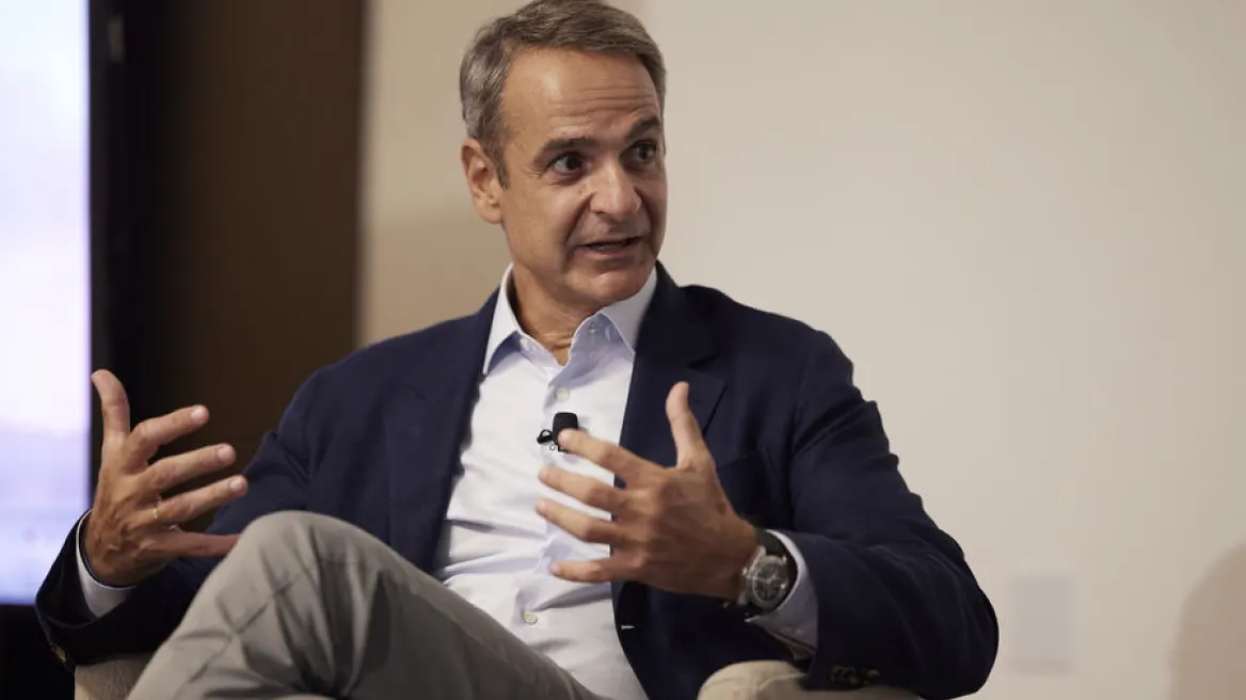
Greece is seeking to place itself at the intersection of maritime power, artificial intelligence, space technology and environmental policy, with Prime Minister Kyriakos Mitsotakis using his presence in New York to unveil a series of concrete commitments under the new OceanEye Global Alliance.
Speaking at the alliance’s inaugural event alongside European Commission President Ursula von der Leyen and Canadian Prime Minister Mark Carney, Mitsotakis stressed Greece’s particular responsibility as one of the world’s leading shipping nations and the EU country with the longest coastline.
“The ocean is vital to our planet, our climate and our economies. We are one of the leading shipping nations in the world. We have the longest coastline of any EU country. Therefore, protecting our seas is both a responsibility and a strategic priority, and we certainly take that responsibility seriously,” Mitsotakis said.


“30% of Our Territorial Waters Well Before 2030”
The Greek prime minister placed particular emphasis on the two large marine national parks recently created by Greece — one in the Ionian Sea and another in the Southern Cyclades.
He then set out a clear target:
“We will protect 30% of our territorial waters well before the 2030 target.”
But Mitsotakis argued that designating protected areas is only part of the equation.
Effective protection, he said, increasingly depends on data: understanding what is happening beneath the surface, observing changes in real time and turning scientific information into policy.
“We can only protect what we measure and what we truly understand,” he said.
That principle underpins the three commitments Greece brought to OceanEye.
First Commitment: Mercator Ocean International
The first concerns Mercator Ocean International.
Mitsotakis said Greece has already signed the convention establishing Mercator Ocean International as an intergovernmental organization and committed his government to seeking its swift ratification by the Greek Parliament.
“We encourage other countries to do the same,” he said.
The move strengthens Greece’s involvement in an international architecture designed to improve ocean observation, forecasting and scientific cooperation.


Second Commitment: Greek AI Power for the Oceans
The second commitment may be the most technologically significant.
Athens is offering part of its expanding computing and artificial intelligence capabilities to process the enormous volumes of data generated by global ocean observation.
Mitsotakis specifically linked the initiative to Greece’s new EU-funded AI infrastructure.
“We have significant new computing infrastructure — EU-funded, dear Ursula — in the AI factories in Greece. We can provide additional computing power to process a truly massive amount of ocean data and contribute to the ‘Digital Twin of the Ocean.’”
The concept is ambitious: combine observations, satellite information, oceanographic measurements and advanced computational models to create increasingly sophisticated digital representations of the world’s oceans.
These models could eventually allow scientists and policymakers not only to observe changes but also to simulate how marine ecosystems may respond to climate change, pollution and human activity.
For Greece, the project also offers an opportunity to extend its emerging AI infrastructure beyond generative AI and commercial applications into climate science, maritime policy and environmental monitoring.


Third Commitment: Eyes on the Eastern Mediterranean
Greece’s third commitment has a clear geographical dimension.
Mitsotakis said Athens would increase its contribution to ocean observation and data collection by using national space assets, in-situ observation systems and Greece’s substantial operational presence in the Eastern Mediterranean.
He described the region as a “hotspot for climate change.”
“We can provide valuable data and enhance maritime domain awareness,” the prime minister said.
The commitment brings together several areas that are increasingly converging: satellite observation, oceanographic data, climate monitoring and maritime situational awareness.
For a country whose economy, security and global commercial presence are closely connected to the sea, that convergence carries strategic as well as environmental significance.
Mapping the Aegean and Ionian Marine Habitats
Athens is also committing to map marine habitats within Greece’s Natura 2000 network and inside the two new national marine parks in the Aegean and Ionian seas.
The objective is to create a more detailed scientific picture of the ecosystems that Greece has pledged to protect.
The approach reflects the broader philosophy Mitsotakis outlined in New York: marine protection should increasingly be based on measurable, continuously updated information rather than simply drawing boundaries on a map.
Greece will therefore work with OceanEye, Mercator Ocean International, the Intergovernmental Oceanographic Commission, the European Commission and other partners to deepen scientific knowledge of the oceans.
Mitsotakis–Carney: AI, Space and Energy
The OceanEye launch also provided the backdrop for a bilateral meeting between Mitsotakis and Canadian Prime Minister Mark Carney during the High-Level Week of the 81st UN General Assembly.
According to the Greek government briefing, the two leaders exchanged views on bilateral and European issues.
Particular attention was given to strengthening Canada–European Union cooperation in three strategic areas:
artificial intelligence, space and energy.
Those are not accidental choices.
AI and space technologies are becoming increasingly important to economic competitiveness and security, while energy has acquired an even greater geopolitical dimension amid instability in global markets and supply routes.


Greece’s 2027 EU Presidency Enters the Equation
The two prime ministers also discussed cooperation in the context of Greece’s Presidency of the Council of the European Union in the second half of 2027.
That gives the New York talks a longer political horizon.
Athens is looking beyond its current bilateral relationship with Ottawa toward the role it can play in shaping EU–Canada cooperation when Greece assumes the rotating presidency.
AI, space and energy could therefore become part of a broader Greek agenda for transatlantic cooperation in 2027.
From Shipping Power to AI-Powered Maritime Policy
The wider significance of Mitsotakis’ OceanEye intervention lies in the combination of policy areas that were once treated separately.
Shipping.
Ocean protection.
Artificial intelligence.
Satellite observation.
Computing power.
Climate policy.
And the Eastern Mediterranean.
Greece is seeking to use both its maritime geography and its global shipping footprint to build a role in the emerging European and international ecosystem of ocean data and digital monitoring.
The prime minister encapsulated that strategy in one sentence:
“We can only protect what we measure and what we truly understand.”
The message from New York is therefore broader than environmental protection alone.
Athens wants to bring together the sea, AI, space and the Eastern Mediterranean — turning Greece’s traditional maritime strength into a platform for the next generation of European ocean policy.
Source: pagenews.gr