Berlin Blocks von der Leyen’s Canada Plan: EU Divisions Deepen 48 Hours Before Montreal Summit
 ΧΡΟΝΟΣ ΑΝΑΓΝΩΣΗΣ 18 '
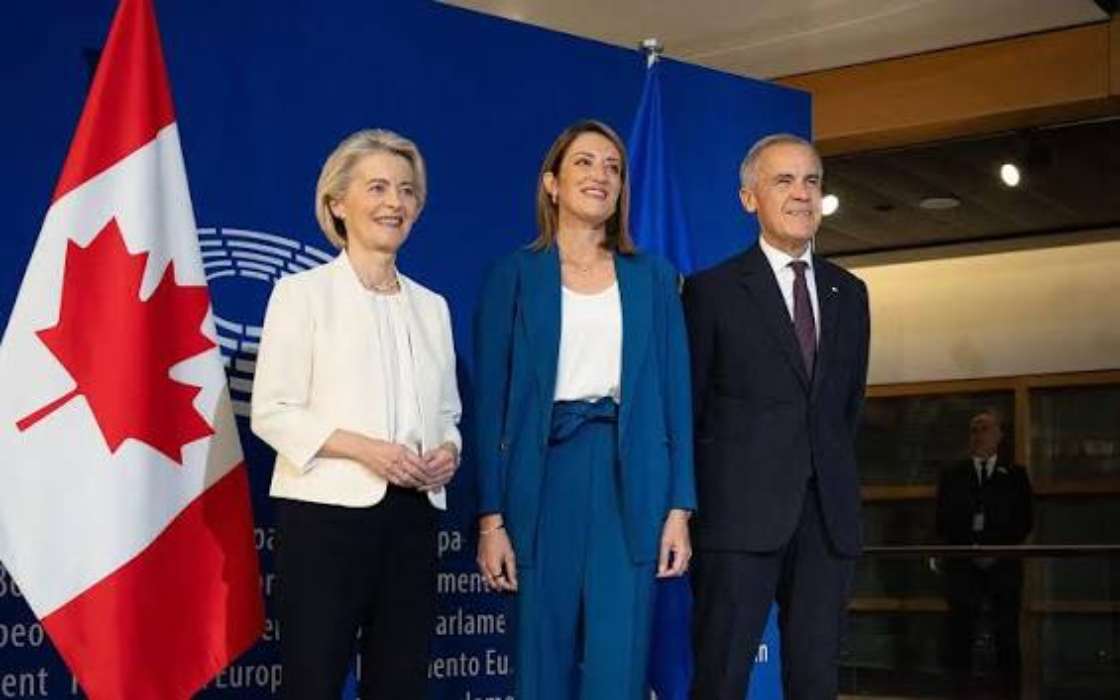
Πηγή Φωτογραφίας: AP Photo//Berlin Blocks von der Leyen’s Canada Plan: EU Divisions Deepen 48 Hours Before Montreal Summit



The European Union is facing a last-minute diplomatic confrontation over its proposed new relationship with Canada, just 48 hours before a major summit intended to demonstrate closer strategic cooperation between Brussels and Ottawa.
Germany and at least three other EU countries have blocked efforts to approve language describing Canada as a potential “associate member” of the European Union, according to POLITICO.
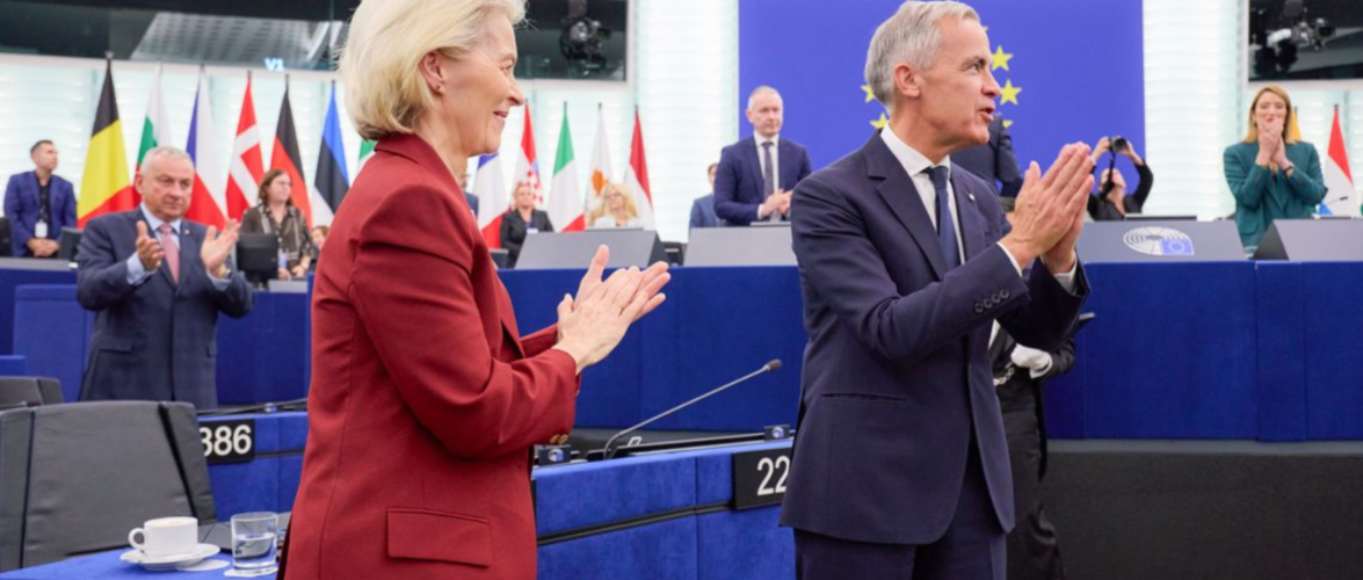
The disagreement has disrupted preparations for the EU–Canada summit scheduled for October 29–30 in Montreal, where European Commission President Ursula von der Leyen, European Council President António Costa and Canadian Prime Minister Mark Carney are expected to discuss a far-reaching partnership.
At the heart of the dispute is a deceptively simple question: Can the EU create a new category of membership for a country outside Europe without first defining what that status would actually mean?
For von der Leyen, the proposal represents an ambitious attempt to strengthen ties with a trusted democratic partner at a time of growing geopolitical uncertainty.
For Germany and other skeptical governments, however, the terminology raises institutional and legal questions that cannot be resolved through a political declaration alone.
The disagreement is particularly sensitive because the EU and Canada broadly agree on the need for closer cooperation.
What divides European capitals is not necessarily the strategic objective, but the institutional framework through which it should be pursued.
Diplomatic Deadlock: Four Countries Break the Silence
The latest attempt to resolve the dispute failed on Tuesday, October 27.
EU ambassadors had discussed a draft joint declaration on Monday, hoping to finalize the text ahead of the Montreal summit.
However, disagreements persisted over references to Canada’s proposed associate membership.
The revised document was subsequently submitted to the EU’s silence procedure, a diplomatic mechanism under which a text is considered approved unless a participating government raises an objection before a specified deadline.
That deadline expired at midday Tuesday.
Germany and at least three other countries broke the silence procedure, according to two EU diplomats cited by POLITICO.
Their objections prevented the draft from being approved.
The matter is now expected to return to EU ambassadors on Wednesday, October 28, leaving negotiators with little time to reach a compromise before the summit begins.
The development underscores the depth of the disagreement.
What had initially appeared to be a debate over diplomatic terminology has become a broader test of whether the EU can agree on a new framework for its relationship with Canada.
Why Germany Is Leading the Opposition
Berlin has emerged as the most prominent opponent of the proposed designation.
Germany wants the phrase associate member removed from the summit declaration altogether.
Its objections reflect concerns about introducing a new institutional category without clearly defining its legal consequences.
The EU treaties do not establish an existing status known as associate membership.
Nor do they specify what rights, obligations or institutional privileges such a status would entail.
For skeptical governments, this creates a fundamental problem.
A political declaration describing Canada as a prospective associate member could generate expectations that the EU has not yet agreed to fulfill.
Germany is therefore pushing for a more cautious approach: deepen practical cooperation first, and define any new institutional arrangements through the appropriate procedures.
The resistance extends beyond Berlin.
Earlier reporting by POLITICO indicated that France, Italy, Belgium and several other EU countries had expressed reservations about the proposal.
The precise identities of all governments that objected during Tuesday’s silence procedure have not been publicly confirmed.
Nevertheless, the latest intervention demonstrates that Germany has sufficient support to prevent the current wording from moving forward.
Von der Leyen’s Proposal Catches European Capitals Off Guard
The controversy began on September 16, when Ursula von der Leyen introduced the idea of a new strategic relationship with Canada during her State of the Union address.
The Commission president proposed establishing an “Alliance for the Future”, potentially leading to Canada becoming the EU’s first associate member.

Addressing Mark Carney, she declared:
“I would like us to work together to open the door for Canada to become the first associate member of the European Union.”
The proposal attracted considerable international attention.
It suggested that Brussels was considering a new model of cooperation with like-minded countries beyond the European continent.
But the initiative also surprised several EU governments.
According to earlier POLITICO reporting, diplomats complained that von der Leyen had introduced the concept publicly without sufficient prior consultation with national capitals.
That procedural concern has become part of the wider disagreement.
The Commission can propose new initiatives and help shape the EU’s external relations.
However, significant institutional changes and international agreements require the participation of member states through the relevant EU decision-making procedures.
For some governments, the controversy is therefore as much about institutional authority as it is about Canada.
Carney: “What Matters Is the Substance”
Canadian Prime Minister Mark Carney has welcomed the prospect of closer cooperation with the European Union.
However, he has been careful not to make the associate-member label a condition of the relationship.
Speaking at the European Parliament in September, Carney expressed support for the broader ambition.
“We welcome that ambition,” he said.
He then emphasized that the terminology itself was a European matter.
“President von der Leyen used both terms: Alliance for the Future and associate membership. The precise label is a matter for Europe,” he explained.
His central message was straightforward:
“What matters is the substance.”
Carney has also made clear that Canada is not seeking full EU membership.
“Canada is not in a position to become, nor is it seeking to become, a full member of the European Union. So this is a different framework,” he said.
That distinction could provide room for compromise.
Ottawa’s principal interest lies in securing deeper economic, technological and security cooperation.
Whether the arrangement is described as associate membership, a strategic alliance or an enhanced partnership may ultimately matter less to Canada than the practical commitments it delivers.
What Would EU Associate Membership Actually Mean?
The central difficulty is that associate membership is not an established category under the EU treaties.
There is no standard accession procedure for granting such a designation to a third country.
Nor is there a predefined package of rights and obligations.
Any new arrangement would therefore need to be negotiated and legally structured.
Crucially, associate membership should not be confused with full membership.
Canada would not automatically receive voting rights in the European Council, representation in the European Commission or seats in the European Parliament.
Canadian citizens would not automatically acquire the free-movement rights associated with EU citizenship.
Full EU membership is governed by Article 49 of the Treaty on European Union, which provides for applications by European states.
Canada does not satisfy that geographical requirement.
A different form of association could potentially be developed through existing EU legal instruments.
Article 217 of the Treaty on the Functioning of the European Union, for example, allows the EU to conclude association agreements with third countries.
However, such an arrangement would require detailed negotiations and the relevant approval procedures.
It could not simply be created through the adoption of a new political label.
This legal uncertainty explains much of the resistance among EU governments.
Brussels Wants More Than Another Trade Agreement
Despite the disagreement over terminology, the European Commission has outlined an ambitious vision for relations with Canada.
The proposed partnership would extend beyond conventional trade cooperation.
It could involve closer integration in defense, technology, energy security, critical minerals and industrial supply chains.
Canada offers several strategic advantages.
It is a major producer of natural resources, possesses significant reserves of critical minerals and maintains close political and security ties with European countries.
For the EU, strengthening these links could help reduce vulnerabilities in strategically important supply chains.
For Canada, closer cooperation with Europe offers an opportunity to diversify its international economic relationships.
The country remains heavily dependent on the United States as an export destination.
That dependence has become an increasingly important political issue amid uncertainty surrounding Washington’s trade policies.
A deeper relationship with the EU would therefore serve both economic and geopolitical objectives.
Trump’s Shadow Looms Over Montreal
The proposed EU–Canada partnership cannot be separated from the policies of US President Donald Trump.
Washington’s increasingly confrontational approach to international trade has encouraged several American allies to reconsider their economic dependencies.
Canada is particularly exposed.
Approximately 71.7 percent of Canadian goods exports in 2025 were destined for the United States, according to figures cited in the debate surrounding the proposed partnership.
That concentration leaves the Canadian economy vulnerable to changes in US tariffs and trade restrictions.
Carney’s government has consequently placed greater emphasis on diversifying Canada’s commercial relationships.
Europe represents an attractive alternative because of its market size, institutional stability and established economic ties with Ottawa.
But closer EU–Canada cooperation could also provoke tensions with Washington.
Trump has previously warned of serious tariff consequences if he concludes that a new European-Canadian arrangement undermines American interests.
For Brussels and Ottawa, the challenge is to strengthen their strategic partnership without triggering another damaging confrontation with the United States.
The Montreal summit therefore carries implications extending well beyond the EU’s internal debate over associate membership.
The CETA Paradox: A New Status Before the Old Agreement Is Fully Ratified
The EU and Canada already have a substantial framework for economic cooperation.
The Comprehensive Economic and Trade Agreement (CETA) has been provisionally applied since 2017.
It has eliminated tariffs on the overwhelming majority of goods traded between the two sides and created mechanisms for closer commercial cooperation.
However, the agreement has not yet been fully ratified by every EU member state.
Ten countries have still not completed their national ratification procedures.
That creates an awkward institutional contrast.
The EU is considering a potentially unprecedented new relationship with Canada while its existing trade agreement has yet to complete the full ratification process.
For skeptical governments, this raises a practical question.
Would it be more effective to consolidate existing commitments before introducing a new category of association?
Supporters of a more ambitious partnership argue that the geopolitical environment has changed sufficiently to justify moving beyond traditional trade arrangements.
Opponents of the associate-member label maintain that institutional clarity should precede political symbolism.
The dispute reflects a familiar tension within the EU: the desire to act strategically and quickly while preserving the legal and political consensus required among member states.
Defense, Energy and the Arctic: The Real Strategic Agenda
The Montreal summit has a much broader agenda than the dispute over membership terminology.
European and Canadian leaders are expected to discuss trade, energy, defense, research, education and security.
One increasingly important area is the Arctic.
Climate change, emerging shipping routes and competition for natural resources have transformed the region into a significant geopolitical arena.
Canada is a central Arctic power.
The EU has a growing interest in the region’s energy resources, critical minerals, environmental challenges and security implications.
Closer cooperation could strengthen both sides’ ability to respond to geopolitical developments in the High North.
Defense cooperation is another priority.
European governments are seeking to expand industrial capacity and improve the resilience of their defense supply chains.
Canada possesses advanced industrial capabilities and longstanding security relationships with European NATO allies.
Closer participation by Canadian companies in European defense initiatives could create opportunities for joint production and technological development.
Energy and critical minerals are similarly important.
Europe is seeking more diversified sources of strategic resources, while Canada wants to expand access to international markets.
These interests provide a substantial foundation for cooperation, regardless of the eventual institutional label.
Von der Leyen, Costa and Kallas Head to Montreal
Despite the unresolved dispute, senior EU leaders are preparing to travel to Canada.
The European delegation is expected to include Commission President Ursula von der Leyen, European Council President António Costa and EU foreign policy chief Kaja Kallas.
Ten European commissioners are also expected to participate.
The size and seniority of the delegation demonstrate the importance Brussels attaches to the relationship.
However, they also increase the political pressure to produce a meaningful summit outcome.
A meeting designed to demonstrate strategic unity risks being overshadowed by disagreements among EU member states.
European negotiators are therefore working to find wording acceptable to all governments.
Wednesday’s discussions among ambassadors will be crucial.
The objective is to prevent the dispute over associate membership from undermining broader agreements on trade, defense and economic cooperation.
Costa: “We Want the Closest Possible Relationship”
European Council President António Costa has adopted a more pragmatic position on the controversy.
In an earlier interview with POLITICO, he emphasized the importance of strengthening cooperation rather than focusing exclusively on terminology.
“The concept essentially means that we want to do more and act as much as possible together with Canada,” he explained.
Costa’s approach suggests that the EU could pursue a substantial strategic partnership without immediately establishing a new institutional category.
Such a compromise might allow the Commission to preserve the broader ambition of its initiative while addressing concerns raised by national governments.
The summit declaration could focus on concrete areas of cooperation and leave the question of associate membership for future negotiations.
However, no final agreement on this approach has been announced.
The outcome remains dependent on the positions of the member states.
The Institutional Dispute Behind the Diplomatic Crisis
The controversy highlights a broader question about how the European Union makes strategic decisions.
The Commission is expected to propose ambitious policies and help strengthen the EU’s international influence.
At the same time, member states retain significant authority over major institutional arrangements and international commitments.
When the Commission introduces a politically significant proposal before sufficient consensus has emerged, disagreements can arise even among governments that support the underlying objective.
That appears to be the case with Canada.
The resistance to the associate-member label does not necessarily represent opposition to closer relations with Ottawa.
Instead, it reflects concerns about how new forms of partnership should be designed and approved.
The issue therefore has an internal political dimension.
It illustrates the difficulty of reconciling the EU’s ambition to become a more influential geopolitical actor with the institutional procedures through which its member states exercise authority.
Three Scenarios Before the Summit
The negotiations could develop in several directions.
Scenario One: The Associate-Member Label Is Removed
The EU could approve a declaration referring to an enhanced strategic partnership or an Alliance for the Future without mentioning associate membership.
This would address Germany’s central objection and could allow the summit to proceed with a common position.
Scenario Two: A Compromise Leaves the Door Open
The declaration could refer to exploring new forms of association at a later stage, once their legal and institutional implications have been clarified.
Such an approach would preserve von der Leyen’s political ambition without creating an immediate commitment.
Scenario Three: The Deadlock Continues
If governments remain divided, negotiators could adopt less ambitious language or leave certain elements unresolved until the summit itself.
That would risk weakening the political impact of the meeting.
None of these scenarios has been confirmed as the final outcome.
The next round of negotiations will determine whether the EU can reach a consensus before leaders gather in Montreal.
A New Geopolitical Alignment Is Taking Shape
The EU–Canada initiative reflects a broader restructuring of international economic and political relationships.
The European Union is seeking to strengthen partnerships with countries that share its strategic interests.
Canada is attempting to reduce its economic vulnerability by developing stronger links beyond the United States.
Both face challenges involving supply-chain security, energy diversification, technological competition and defense cooperation.
A closer relationship could support these objectives without necessarily creating a formal alternative to existing transatlantic institutions.
Nevertheless, the initiative carries geopolitical significance.
It suggests that traditional American allies are increasingly interested in developing additional frameworks for cooperation that do not depend exclusively on Washington.
The proposed associate-member status represents the most ambitious political expression of that trend.
The current dispute, however, demonstrates that strategic ambition does not automatically translate into institutional agreement.
The Real Test for Brussels
The Montreal summit was intended to mark a significant step forward in EU–Canada relations.
Instead, its final preparations have exposed divisions within the European Union over the institutional framework of that partnership.
Von der Leyen wants to establish a new model of strategic cooperation.
Germany and other governments insist that the legal and political implications must be defined before a new membership designation is adopted.
Carney, meanwhile, has made clear that Canada is primarily interested in the substance of the relationship rather than its formal title.
The result is a diplomatic paradox: Europe agrees that it wants Canada closer, but cannot agree on what to call that relationship.
Wednesday’s negotiations will determine whether the EU can present a united position when its leaders arrive in Montreal.
More broadly, the episode will test Brussels’ ability to transform geopolitical ambitions into practical agreements without becoming trapped in its own institutional divisions.
In an increasingly fragmented international order, the EU and Canada have strong reasons to cooperate.
The question now is whether European governments can agree on the framework before the opportunity is overshadowed by another internal dispute.
Source: pagenews.gr
Διαβάστε όλες τις τελευταίες Ειδήσεις από την Ελλάδα και τον Κόσμο