Canada Turns to Erdogan as US Ties Fray: Defense Deals, Nuclear Ambitions and Cyprus Tensions
 ΧΡΟΝΟΣ ΑΝΑΓΝΩΣΗΣ 11 '
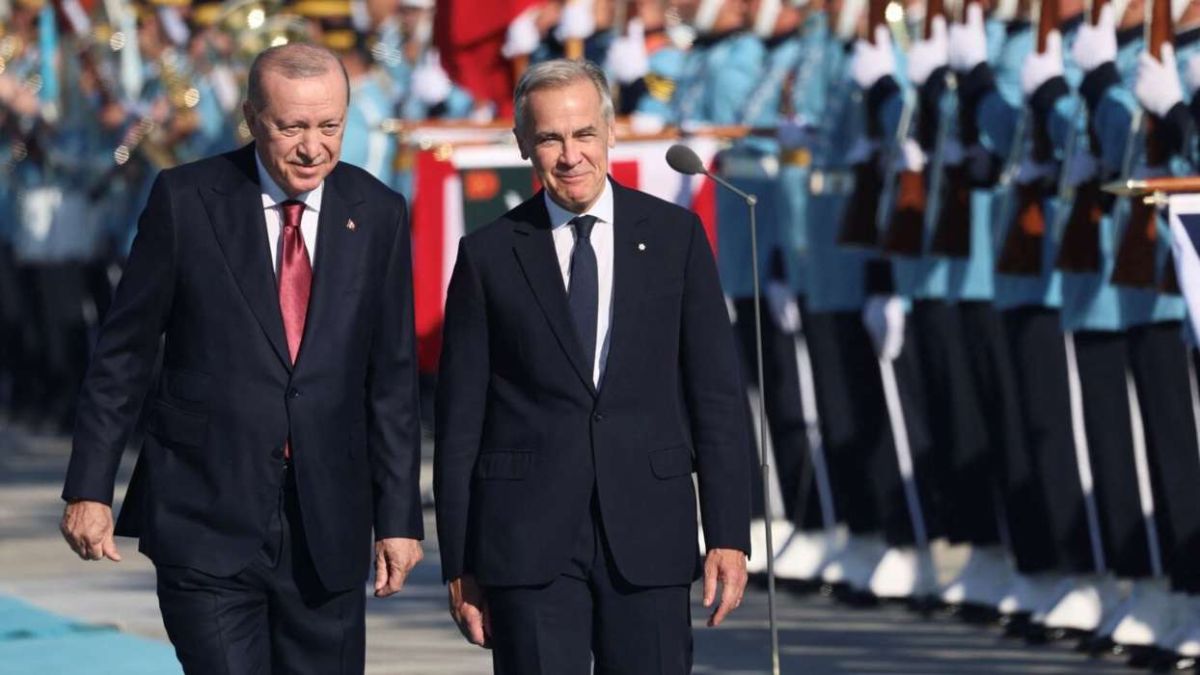
Πηγή Φωτογραφίας: Turkish President Recep Tayyip Erdogan, left, welcomes Canadian Prime Minister Mark Carney during a ceremony at the Presidential Complex during his visit to Turkey, in Ankara, on Oct. 22, 2026. — Adem Altan/ AFP via Getty Images



Turkey is seeking to transform growing tensions between Washington and Ottawa into a strategic opportunity, positioning itself as an increasingly important partner for Canada in defense technology, energy, aviation and investment.
Canadian Prime Minister Mark Carney’s October 22, 2026, visit to Ankara marked a significant development in bilateral relations.
According to Al-Monitor, Carney became the first Canadian prime minister to make a dedicated bilateral visit to Turkey. Previous Canadian leaders had traveled to the country for international meetings and multilateral events.
The Canadian delegation included Energy Minister Tim Hodgson and Foreign Minister Anita Anand, reflecting the broad economic and strategic agenda behind the visit.
Following discussions with Turkish President Recep Tayyip Erdogan, the two leaders announced a strategic partnership intended to expand cooperation across several major sectors.
But the implications extend well beyond bilateral trade.
For Turkey, closer ties with Canada could strengthen its defense-industrial capabilities, expand its international investment network and reinforce its diplomatic influence.
For Canada, the partnership offers an opportunity to diversify economic and technological relationships amid growing friction with the United States.
And for Greece and Cyprus, the developing relationship raises questions about the wider regional consequences of Turkey’s expanding strategic partnerships.
A strategic partnership with ambitions beyond trade
The Ankara summit produced a three-year framework for expanding bilateral trade, mutual investment and cooperation in defense, energy and mining.
Officials also signed three memoranda of understanding covering defense industry cooperation, aviation and energy.
These agreements could provide a foundation for future industrial projects, technological partnerships and access to additional export markets.
However, memoranda of understanding do not automatically constitute binding procurement contracts or finalized investment commitments.
Their practical significance will depend on subsequent negotiations, regulatory approvals, financing arrangements and specific implementation agreements.
That distinction is especially important in sensitive sectors such as defense and nuclear technology.
The summit nevertheless demonstrates a shared intention to move the relationship beyond conventional diplomacy.
Ankara and Ottawa are exploring a broader partnership combining industrial capacity, technological expertise and long-term economic interests.
From $3 billion to $10 billion: The economic ambition
The two governments have established an ambitious trade agenda.
According to Al-Monitor, Canada and Turkey aim to increase bilateral trade from approximately $3 billion to $5 billion within five years, with a longer-term target of $10 billion.
These figures represent policy objectives rather than guaranteed outcomes.
Achieving them would require significant growth in commercial exchanges, investment and market access.
Turkey offers Canada access to a substantial industrial economy and a strategically positioned market connecting Europe, the Middle East and Asia.
Canada, meanwhile, offers Turkey advanced technological expertise, investment opportunities and access to a developed North American economy.
The two countries have also agreed to begin free trade agreement negotiations in Ankara in November.
Those discussions will provide an early indication of whether the political rapprochement can produce a deeper economic relationship.
A successful trade framework could reduce barriers, encourage investment and support long-term industrial cooperation.
But the outcome will depend on the negotiating positions of both governments.
Defense technology: The most sensitive dimension
Defense cooperation is among the most strategically significant aspects of the new partnership.
Turkey has invested heavily in expanding its domestic defense industry, including unmanned systems, aerospace technology, electronics and military manufacturing.
Canada possesses advanced industrial and technological capabilities that could complement selected Turkish defense programs.
Potential cooperation could involve joint research, industrial partnerships, production arrangements or technology development.
However, defense exports and transfers of sensitive technology remain subject to national regulations, licensing requirements and international commitments.
A political agreement does not automatically authorize unrestricted transfers of military equipment or technology.
The practical implications will therefore depend on the specific projects that emerge.
For NATO partners, the details will matter.
Cooperation in civilian aviation or industrial research would have different strategic implications from agreements involving military electronics or advanced defense systems.
Until concrete projects are announced, the scope of the partnership should not be overstated.
Nuclear energy enters the strategic equation
Energy cooperation introduces another potentially long-term dimension.
Turkey has been seeking to diversify its energy mix and strengthen its electricity generation capacity.
Canada possesses extensive expertise in nuclear technology, uranium resources and the broader nuclear energy industry.
A closer relationship in this field could create opportunities for technical cooperation, investment and the development of energy infrastructure.
Nuclear projects typically involve long investment cycles, specialized expertise, complex regulatory requirements and sustained government involvement.
As a result, cooperation in this sector can create strategic relationships extending over decades.
However, the available announcements do not establish that Canada and Turkey have signed a final agreement to build a particular nuclear reactor.
The difference between exploring cooperation and committing to a specific nuclear project remains essential.
For now, the nuclear dimension represents a potentially important area of future collaboration.
Why tensions with Washington matter
The diplomatic opening comes against the backdrop of strained relations between Canada and the United States.
For Ottawa, diversifying economic relationships can help reduce dependence on a single major market and expand access to international investment opportunities.
Turkey sees an opportunity to position itself as an alternative industrial and strategic partner.
The relationship is not necessarily a replacement for Canada’s longstanding ties with Washington.
Canada remains deeply integrated into North American economic and security structures.
Instead, the Ankara initiative can be understood as part of a broader effort to expand Ottawa’s international options.
For Erdogan, the opportunity is equally significant.
A deeper relationship with Canada would demonstrate Turkey’s ability to attract cooperation from major Western economies while pursuing an increasingly autonomous foreign policy.
This approach reflects Ankara’s wider effort to strengthen its bargaining position through diversified international partnerships.
Cyprus: The geopolitical issue behind the economic diplomacy
The developing Canada–Turkey relationship also intersects with renewed attention to the Cyprus question.
A report published by Hellas Journal on October 26 describes Turkish initiatives connected to Antalya and an invitation extended to the Turkish Cypriot leadership.
The publication presents these developments as part of a broader effort by Ankara to promote the international standing of the Turkish Cypriot administration in the northern part of the island.
That interpretation should be distinguished from independently verified diplomatic developments.
The underlying dispute, however, is well established.
The Republic of Cyprus is the internationally recognized state on the island.
The self-declared Turkish Republic of Northern Cyprus is recognized only by Turkey.
United Nations Security Council resolutions provide an important legal and diplomatic framework concerning the status of the secessionist entity.
Consequently, initiatives that appear to seek international recognition or political upgrading of the northern administration attract opposition from Nicosia.
The relevant question is whether Turkey’s expanding international partnerships could provide additional diplomatic opportunities to promote its positions on Cyprus.
There is no evidence in the material provided that Canada has changed its position on the international recognition of the Republic of Cyprus or agreed to recognize the Turkish Cypriot administration.
The new strategic partnership should therefore not be interpreted as an automatic Canadian endorsement of Ankara’s Cyprus policy.
Erdogan’s wider strategy: Defense, energy and diplomatic leverage
Turkey’s approach to Canada fits within a broader foreign policy pattern.
Ankara has sought to combine its membership in NATO with an increasingly independent international agenda.
Defense exports, industrial partnerships and energy projects have become important tools of Turkish diplomacy.
These relationships can create long-term economic connections while also increasing Turkey’s strategic relevance.
Defense cooperation may deepen industrial interdependence.
Energy projects can establish partnerships lasting decades.
Trade agreements can encourage investment and provide new channels of diplomatic engagement.
Taken together, these instruments can expand Turkey’s international influence without requiring formal political alignment on every regional issue.
The Canada initiative illustrates how Ankara is attempting to use economic and technological cooperation to broaden its diplomatic reach.
What the rapprochement means for Greece
For Athens, the emerging partnership deserves close diplomatic attention.
Canada is an important NATO ally and maintains longstanding political and social ties with Greece.
Any substantial expansion of Canadian-Turkish defense cooperation would therefore be relevant to the wider strategic environment.
The key questions concern the specific technologies involved, the scope of potential joint production and the conditions governing defense exports.
At the same time, Greece and Cyprus retain diplomatic channels through which they can communicate their positions on sovereignty, international law and regional security.
Economic cooperation between Canada and Turkey does not, by itself, constitute an action against Greece or Cyprus.
However, the strategic content of future agreements could have implications for the regional balance of capabilities.
The distinction between commercial cooperation and military-industrial cooperation is therefore important.
The Eastern Mediterranean dimension
The Eastern Mediterranean remains an area of overlapping strategic interests.
Greece, Cyprus and Israel have developed cooperation in energy, security and regional diplomacy.
Turkey maintains its own maritime claims and regional priorities, which have generated serious disputes with Athens and Nicosia.
Canada’s expanding relationship with Ankara introduces another international actor into this wider diplomatic environment.
It does not automatically alter the legal status of maritime disputes or the Cyprus question.
But it may increase the importance of monitoring Turkey’s international defense and energy partnerships.
For Greece and Cyprus, the challenge is to assess developments on the basis of concrete agreements rather than political symbolism alone.
November: The first practical test
The planned opening of free trade negotiations in Ankara in November will be an early test of the new relationship.
The central question is whether the commitments announced during Carney’s visit can be translated into detailed agreements, investment projects and measurable commercial results.
In defense and energy, attention will turn to the identification of specific companies, technologies and industrial programs.
In trade, the focus will be on market access, regulatory issues and the prospects for a broader bilateral agreement.
The political framework has been announced.
Its long-term strategic significance will depend on implementation.
A changing geopolitical landscape
Carney’s visit reflects a wider international trend: governments are increasingly seeking to diversify economic, technological and strategic partnerships amid uncertainty in established relationships.
For Canada, Turkey offers another avenue for commercial and industrial cooperation.
For Turkey, Canada represents access to advanced expertise, investment and new international markets.
For Greece and Cyprus, the development requires careful assessment of its defense and diplomatic implications.
The central geopolitical question is not simply whether bilateral trade reaches $10 billion. It is whether Canada and Turkey establish a lasting strategic relationship capable of influencing defense cooperation, energy investment and regional diplomacy.
The answer will emerge through the agreements and projects that follow the Ankara summit.
Source: pagenews.gr
Διαβάστε όλες τις τελευταίες Ειδήσεις από την Ελλάδα και τον Κόσμο