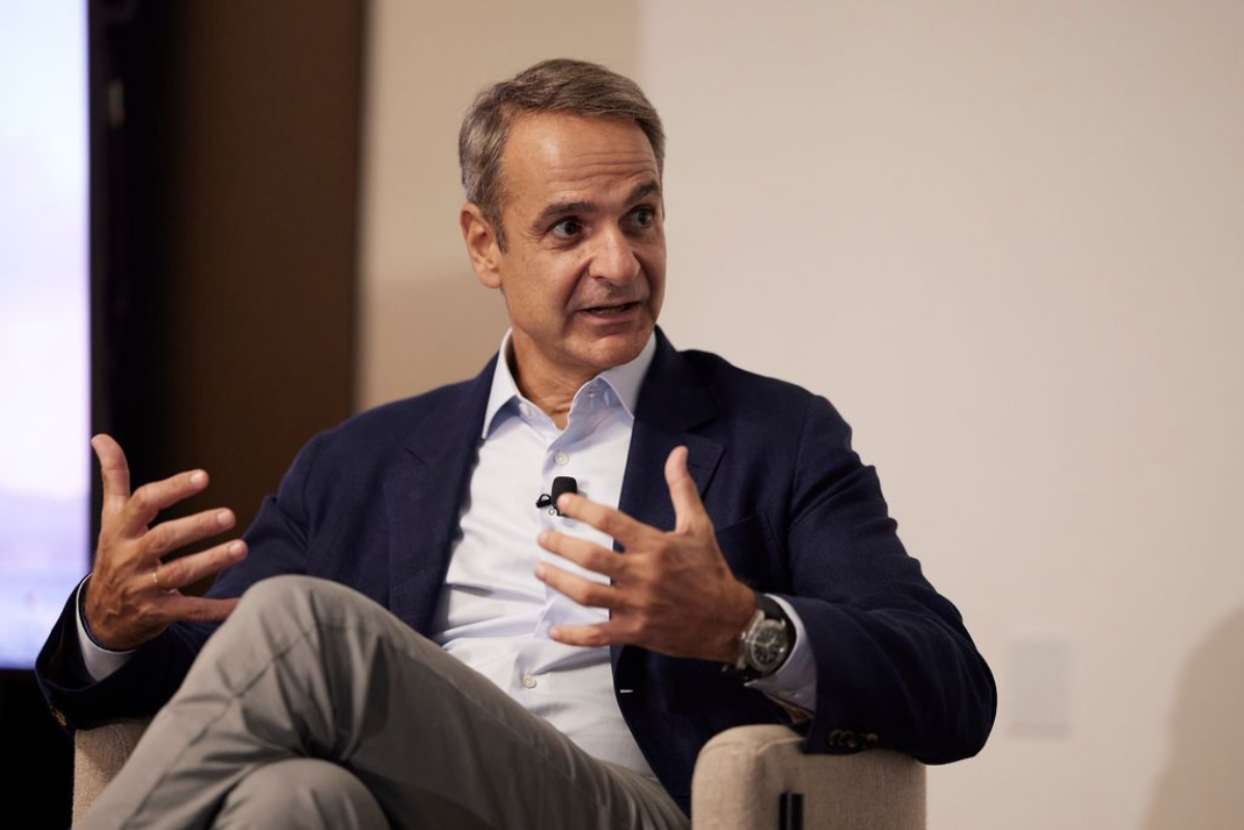
Kyriakos Mitsotakis has made a new and carefully targeted intervention in the decades-long dispute over the Parthenon Sculptures, this time addressing the British public directly through an article in The Guardian.
And he has chosen a powerful British cultural reference to make his case: the Bayeux Tapestry.
The arrival in Britain of the celebrated medieval masterpiece for the first time in almost 1,000 years provides the Greek prime minister with an opportunity to pose a straightforward question.
If no one would seriously consider cutting the surviving Bayeux Tapestry in two, displaying one half in Britain and the other in France, why should the division of the Parthenon be regarded as acceptable?
The Bayeux argument
Mitsotakis argues that the Bayeux Tapestry and the Parthenon Sculptures share a fundamental characteristic: both were conceived to be seen and understood as unified works.
In the case of the Parthenon, however, the relationship goes even further.
The Sculptures were not created as an independent collection of artworks. They were carved as integral architectural elements of the monument itself.
“No one would seriously contemplate cutting the surviving Bayeux Tapestry in half and displaying one part in London and the other in Bayeux,” is the central comparison underpinning the Greek prime minister’s argument.
Yet, Mitsotakis argues, this is effectively what happened to the Parthenon.
A single masterpiece was divided, with its surviving elements now principally split between London and Athens.


A clear “no” to a loan
This is also where the most politically significant part of Mitsotakis’s intervention emerges.
The Greek prime minister makes clear that Athens cannot accept an arrangement requiring Greece to recognise the British Museum’s ownership of the Sculptures.
Nor, he argues, can Greece accept a formula under which it would effectively “borrow” parts of its own monument.
“Greece cannot accept any arrangement that would require it to recognise the British Museum’s ownership of the Sculptures, nor a scheme that would mean ‘borrowing’ parts of our own monument,” Mitsotakis writes.
The statement publicly defines one of Athens’ fundamental red lines as discussions continue over the legal and institutional formula that could eventually allow the Sculptures to be displayed in Athens.
Why the Bayeux “loan model” does not work for Athens
The comparison has particular significance because the British Museum has pointed to the Bayeux Tapestry agreement as an example of international cultural cooperation that could potentially offer lessons for the Parthenon.
Mitsotakis rejects that comparison.
France has loaned the Bayeux Tapestry as a single work and it will return to France as a single work.
The Parthenon represents the opposite situation.
Integral parts of one monument were removed and dispersed.
Athens therefore argues that the objective cannot simply be a temporary loan.
The objective is permanent reunification.
The Acropolis Museum at the heart of the Greek case
Mitsotakis also returns to one of the central pillars of the Greek argument: Athens now has a museum specifically designed to allow the surviving Sculptures to be presented as parts of a single monument.
At the Acropolis Museum, the surviving pieces could be displayed together while maintaining a direct visual relationship with the Parthenon itself.
For Athens, therefore, reunification is not simply a dispute about which country should possess individual antiquities.
It is about restoring what Greece describes as the physical, aesthetic and conceptual integrity of a divided monument.
Mitsotakis takes the argument directly to the British public
The intervention is not addressed solely to the trustees or management of the British Museum.
It is aimed directly at British public opinion.
Mitsotakis points to polling indicating majority support for the return of the Sculptures to Greece and highlights a finding that 72% agreed the Sculptures are better understood as part of a single whole with the Parthenon.
The political strategy is clear: to move the debate beyond the framework of a bilateral Greek-British dispute and turn it into a broader question about cultural coherence and the presentation of world heritage.
A broader deal with Britain
Athens is also careful not to frame reunification as an arrangement in which Britain simply loses and Greece wins.
Mitsotakis proposes that the return of the Sculptures could become the foundation of a much broader and lasting cultural partnership between Greece and the United Kingdom.
That partnership could encompass major exhibitions, museum exchanges, scientific research, conservation projects and cooperation between Greek and British institutions.
“Together, we could shape a new model of cultural cooperation,” is the message Mitsotakis sends through The Guardian.
In this formulation, the reunification of the Parthenon Sculptures would mark the beginning rather than the end of a new cultural relationship between Athens and London.
“Greece remains ready”
The conclusion of Mitsotakis’s intervention is explicitly political.
He connects the Parthenon with the emergence of democracy and argues that restoring the unity of a monument so closely associated with democratic history would carry particular symbolic weight at a time when democratic principles are being tested around the world.
His message to Britain is concise:
“Greece remains ready.”
What is required now, he argues, is the political will and courage to take the decisive step — reunifying the Sculptures and transforming a dispute stretching back more than two centuries into an act of cultural friendship.
The political significance
The timing of the intervention matters.
Mitsotakis is once again taking the issue to the highest political level while publicly defining the boundaries of the Greek negotiating position.
No recognition of British Museum ownership.
No formula under which Greece simply “borrows” the Parthenon Sculptures.
Instead, Athens is seeking a framework leading to their permanent reunification while simultaneously creating a broader cultural partnership with Britain.
The strength of the intervention lies in the simplicity of the analogy chosen for a British audience.
The Bayeux Tapestry is valued precisely because its surviving narrative can be experienced as a whole.
The Greek prime minister is asking Britain to apply the same principle to another globally recognised masterpiece.
The question he leaves hanging over the debate is therefore difficult to miss:
If Britain would never cut the Bayeux Tapestry in half, why should the Parthenon remain divided?
Source: pagenews.gr