Mitsotakis–Amal Clooney: Parthenon Sculptures Back on the Table as Athens Steps Up Cultural Diplomacy
 ΧΡΟΝΟΣ ΑΝΑΓΝΩΣΗΣ 4 '
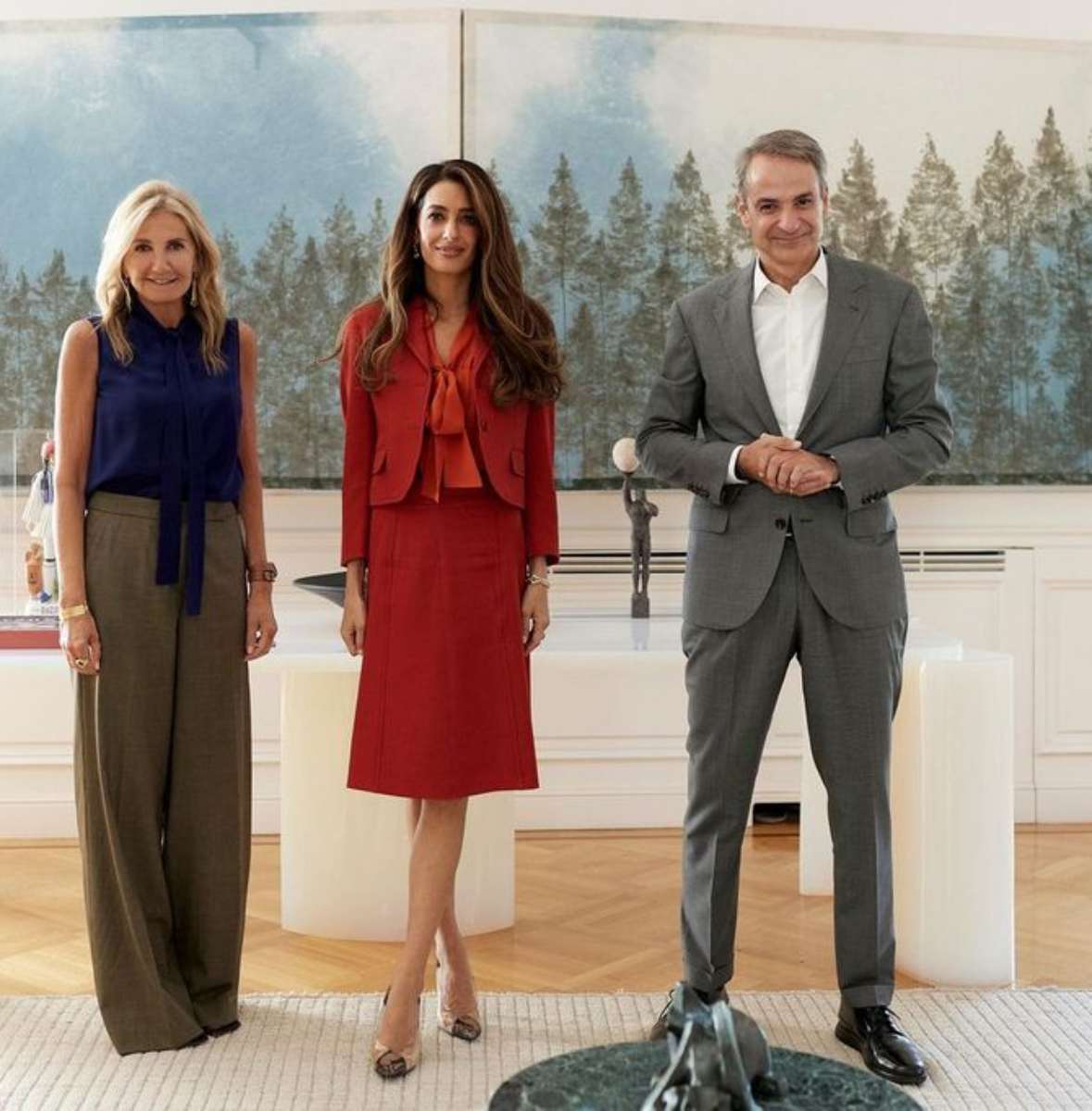
Πηγή Φωτογραφίας: Greek Prime Minister Office--Papamitsos//Mitsotakis–Amal Clooney: Parthenon Sculptures Back on the Table as Athens Steps Up Cultural Diplomacy



The Parthenon Sculptures are back at the forefront of Greek cultural diplomacy — this time with a figure who knows both the international and legal dimensions of the case particularly well: Amal Clooney.
Prime Minister Kyriakos Mitsotakis, accompanied by his wife Mareva Grabowski-Mitsotakis, met the prominent human rights lawyer at Maximos Mansion during her visit to Athens for UNESCO’s annual Goodwill Ambassadors meeting.
Their talks covered culture and cultural diplomacy, with particular attention given to the reunification of the Parthenon Sculptures in Athens.
And Clooney’s presence is far from merely ceremonial.
Amal Clooney Knows the Parthenon File
Amal Clooney has been extensively involved with the Greek case in the past.
In 2014, she travelled to Athens when the Greek government was examining the legal avenues available in its campaign for the Sculptures. Constantine Tassoulas — then Culture Minister and now President of the Hellenic Republic — had sought advice from the London law firm where Clooney worked on the legal aspects of Greece’s claim.
More than a decade later, Clooney is once again in the Greek capital, with the Parthenon Sculptures returning to the agenda of her high-level meetings.

From Tassoulas to Maximos Mansion
Clooney also met President Constantine Tassoulas at the Presidential Mansion, bringing together two figures whose paths had already crossed over the Parthenon issue in 2014.
The timing gives the visit additional political symbolism.
Within the same day, a lawyer internationally associated with the legal dimension of the Parthenon campaign is holding talks with Greece’s highest political and institutional leadership, while UNESCO is simultaneously at the centre of events in Athens.
This does not mean that a new legal initiative is necessarily underway.
It does, however, demonstrate that Athens continues to keep the issue active across several fronts — political, diplomatic, cultural and international.
Mitsotakis’ Message: Reunification, Not Simply “Return”
The choice of the word “reunification” is politically significant.
Greece’s argument is not simply that individual works of art should be moved from one museum to another. Athens maintains that the Sculptures are integral parts of a single monument whose surviving elements are currently divided between Athens and London.
That distinction has increasingly become central to Greece’s international messaging.
Rather than presenting the dispute solely as a bilateral disagreement with Britain, Athens has sought to frame it as a wider question concerning the integrity of a world-famous monument and the principles governing cultural heritage.
UNESCO Adds Weight to the Moment
Clooney is in Greece for UNESCO’s annual gathering of Goodwill Ambassadors, placing her visit within a much broader cultural and diplomatic setting.
The programme also brings together international personalities and institutional representatives around discussions on culture, heritage and emerging global challenges.
Against that backdrop, the Parthenon issue acquires additional visibility.
Athens, the Acropolis, UNESCO and one of the most internationally recognisable lawyers previously involved in the case create a powerful combination of symbolism and diplomatic messaging.
The Parthenon Sculptures as Greek Soft Power
There is also a wider strategic dimension.
For Greece, the Parthenon Sculptures have evolved into one of the country’s strongest instruments of cultural soft power.
Successive Greek governments have worked to internationalise the argument, shifting the debate beyond the traditional Greece–Britain confrontation and towards questions of monument integrity, cultural heritage and the responsibilities of major museums in the 21st century.
Amal Clooney’s visit does not, by itself, resolve the decades-long dispute.
But it brings an internationally prominent figure who has already been directly connected with the Greek case back into the conversation.
And the political image emerging from Athens is powerful: Tassoulas, Mitsotakis, UNESCO and Amal Clooney — with Greek culture at the centre and the reunification of the Parthenon Sculptures once again high on Athens’ diplomatic agenda.
Source: pagenews.gr
Διαβάστε όλες τις τελευταίες Ειδήσεις από την Ελλάδα και τον Κόσμο