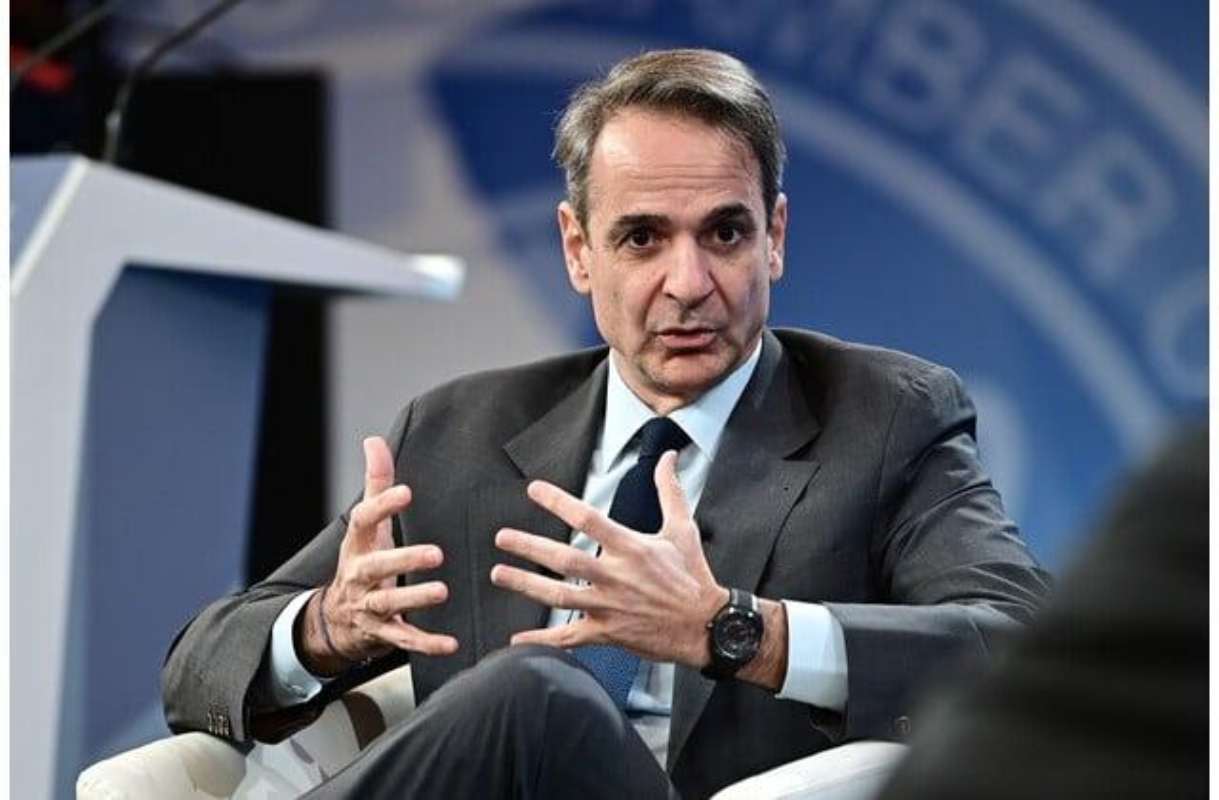
Prime Minister Kyriakos Mitsotakis has sent a message with two audiences in mind — Turkey and the broader international community — following his visit to the United States.
Dialogue with Ankara, but without compromising Greece’s positions.
And, above all, without unilateral actions that Athens considers incompatible with international law.
In his weekly Sunday review, Mitsotakis directly linked Greek-Turkish relations to the broader environment of instability in the Middle East and the Eastern Mediterranean.
“Condemned by geography to live next to each other”
On Turkey, Mitsotakis used a particularly striking phrase:
“With Turkey, it is necessary to maintain open channels of communication and dialogue based on international law and good-neighborly relations.”
He added:
“After all, we are condemned by geography to live next to each other.”
The message is that Athens does not intend to abandon its policy of communication with Ankara, even when serious disagreements persist.
But the Greek prime minister immediately drew the line.
“Meaningful dialogue cannot coexist with unilateral actions”
The sharper part of Mitsotakis’ message followed:
“Meaningful dialogue, however, cannot coexist with unilateral actions that violate international legality.”
The statement carries particular weight at a time when disputes involving the Eastern Mediterranean, maritime zones, energy exploration and cross-border energy interconnections remain unresolved.
The Greek government’s position, reiterated by Mitsotakis, is that the dispute between Greece and Turkey must be addressed institutionally and on the basis of international law.


“The only institutional framework”
Mitsotakis also referred back to his address before the United Nations General Assembly:
“The only institutional framework for resolving our dispute is international law.”
That sentence encapsulates the strategy Athens is seeking to project:
open communication,
avoidance of uncontrolled escalation,
but continued adherence to Greece’s legal positions.
“A bridge-builder, not a troublemaker”
The second message in the prime minister’s post goes beyond Greek-Turkish relations.
“This is exactly what we want Greece to be: a bridge-builder, not a troublemaker.”
He continued:
“A country that is present, reliable and useful in managing the major challenges of tomorrow.”
The government is thus placing Greek-Turkish relations within a broader vision of Greece’s role at the crossroads of Europe, the Middle East and North Africa.
October and the UN Security Council
The timing gives the message additional significance.
Greece assumes the presidency of the United Nations Security Council in October, a role the government wants to use to strengthen the country’s international presence.
“At a time when rules and international agreements are being tested, Greece insists on international law, multilateralism and dialogue.”
This also reflects Athens’ effort to frame its positions on Greek-Turkish disputes not simply as bilateral political claims, but as questions to be addressed through established international rules.
The difficult test will come at sea
Behind the diplomatic language, however, remain the areas where the Greek-Turkish relationship will ultimately be tested.
Maritime zones.
Energy exploration.
Electricity interconnections.
The Eastern Mediterranean.
And Turkey’s relationship with Libya.
It is there that it will become clear whether a policy of open channels can coexist with the deep disagreements between Athens and Ankara.
Mitsotakis, however, sums up his approach in two phrases:
“A bridge-builder, not a troublemaker.”
But at the same time:
dialogue without unilateral actions and without compromising on international law.
Source: pagenews.gr