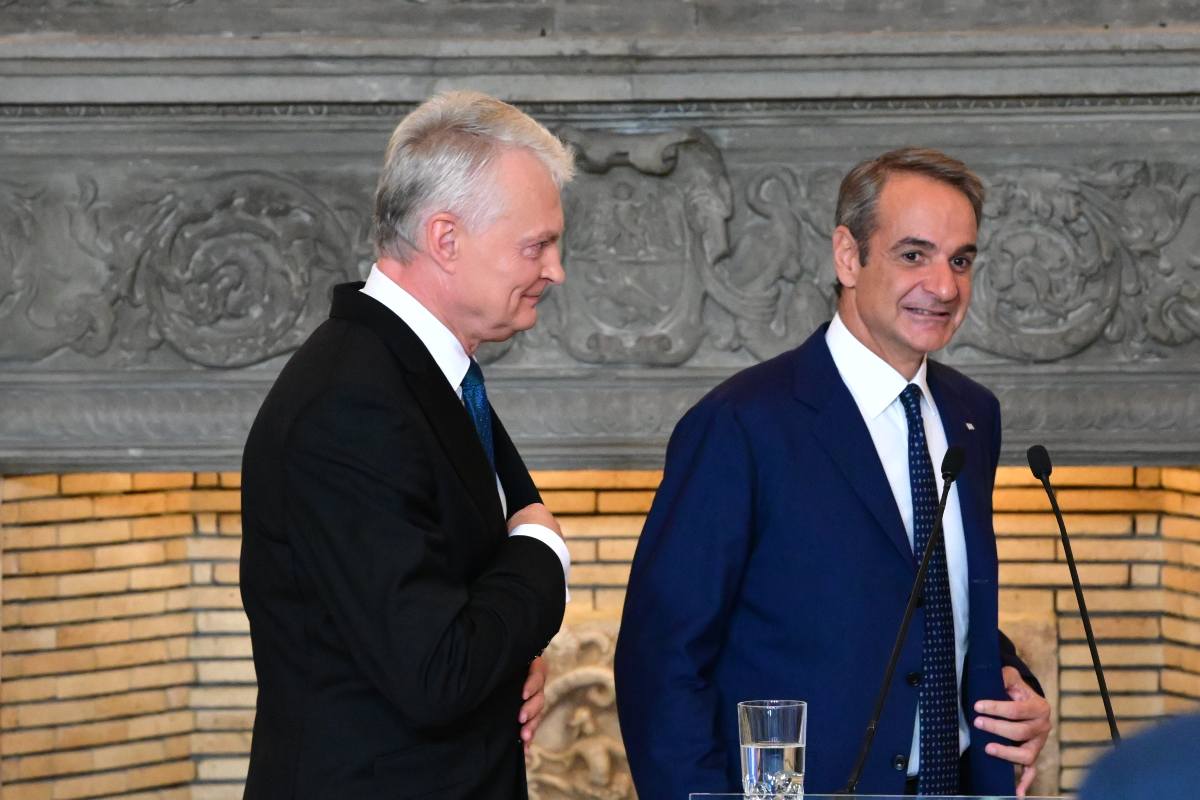
Greek Prime Minister Kyriakos Mitsotakis has placed European defense, Turkey and the energy crisis at the center of Athens’ agenda, following his meeting at the Maximos Mansion with Lithuanian President Gitanas Nausėda.
His message had two distinct fronts.
On European defense, Mitsotakis reiterated that third countries cannot gain unconditional access to EU-funded defense initiatives. On the economic front, he called for greater but carefully calibrated European fiscal flexibility to help governments respond to the energy crisis.
Although Turkey was not explicitly named in the specific statement on third countries, the remarks came against the backdrop of discussions over Ankara’s potential participation in the EU’s SAFE defense instrument.
“Their participation in programs supported by European funds cannot be without conditions,” Mitsotakis said.
“Therefore, for anyone to join SAFE or similar European security arrangements, they must first respect the security interests of member states, without asterisks.”


The Message to Ankara Behind SAFE
The statement reinforces a position Athens has already expressed regarding Turkey and European defense cooperation.
Greece supports efforts to strengthen Europe’s defense capabilities, but argues that cooperation with third countries cannot come at the expense of the security interests of an EU member state.
Mitsotakis has previously stated that third-country participation in SAFE must not undermine the security and defense interests of EU members.
The issue carries particular significance for Greek-Turkish relations, as Athens links Ankara’s access to European defense mechanisms with safeguards concerning the security interests of Greece and other member states.
The wider question is therefore no longer simply about access to European funding.
It concerns who can participate in Europe’s emerging defense architecture, and under what political and security conditions.
Mitsotakis: “We Need Measured European Flexibility”
The second major message was directed at Brussels.
With the renewed energy shock putting pressure on households and businesses, Mitsotakis called for greater flexibility under Europe’s fiscal framework.
“We need measured European flexibility so that states can support households and businesses by utilizing additional fiscal space,” the prime minister said.
Athens is effectively asking the European Union to allow temporary and targeted interventions designed to cushion the impact of higher energy costs without undermining fiscal stability.
Mitsotakis said he had already sent a letter to the President of the European Commission calling for an immediate and ambitious European response.
“I believe that if my proposal is accepted, we will address a common problem with a common and timely response,” he said.
Extra VAT Revenue Could Be Returned to Society
One of the most significant economic elements of Mitsotakis’ remarks concerned additional tax revenues generated by energy-driven inflation.
The prime minister raised the possibility that VAT revenues exceeding the government’s original projections because of higher energy prices could be used to finance temporary and targeted support measures.
“If the Greek government, for example, has additional revenues over and above what it had projected from value-added tax, exclusively because of inflation stemming from energy, potentially, in accounting terms, these additional revenues could be used for targeted and temporary measures to support society,” Mitsotakis said.
He stressed that such an approach would not, in his view, necessarily jeopardize Greece’s fiscal stability.
The obstacle lies primarily in the European fiscal rules governing how such additional revenues can be used.


“Fiscal Stability Is Non-Negotiable”
At the same time, Mitsotakis sought to make clear that Athens does not intend to respond to the energy shock through uncontrolled public spending.
Referring to the turbulence in international bond markets, the prime minister said Greece would not risk the fiscal credibility it has rebuilt.
“Under no circumstances would our country jeopardize the major achievement of restoring market confidence in the government’s determination to remain firmly on the path of fiscal balance,” he said.
And he added:
“This is non-negotiable for our country.”
The Greek position therefore rests on a delicate balance: more European room for targeted support, but no departure from fiscal discipline.
Additional Support for Greek Fishermen
Mitsotakis also singled out Greek fishermen as one of the groups facing particular pressure.
He said the government is examining ways to provide them with additional financial assistance.
“We know, for example, that we have a problem with our fishermen. We are working on how to address it and how to provide them with additional financial assistance,” he said.
However, he also acknowledged the limits of the government’s ability to intervene.
“We all know that the possibilities are finite.”
Greece and Lithuania Look Ahead to 2027
The meeting with Nausėda also focused on the wider European agenda and Greece’s Presidency of the Council of the European Union in the second half of 2027.
Mitsotakis described 2027 as a potentially “very critical year” and said Greece and Lithuania are aligned on almost all major European priorities.
“I am pleased that we are aligned on almost all the key priorities. We sit next to each other at the European Council, something that facilitates the development of a personal relationship,” the Greek prime minister said.
Nausėda, for his part, said the talks focused on the upcoming Presidency, bilateral relations and the two countries’ common European future.
Athens’ Two Red Lines: Security and Fiscal Credibility
The prime minister’s statements ultimately connect two of Europe’s most pressing challenges: security and economic resilience.
On defense, Athens argues that EU-funded cooperation with third countries must come with clear conditions and cannot override the security interests of member states — a position with direct implications for the debate over Turkey’s participation in SAFE.
On the economy, Greece is asking Brussels for additional room to respond to the energy shock, while insisting that any measures must be targeted, temporary and compatible with fiscal stability.
From Turkey and SAFE to energy prices, bond markets and additional support for households and businesses, Athens is seeking a stronger European response — but one governed by clear rules on both security and public finances.
Source: pagenews.gr