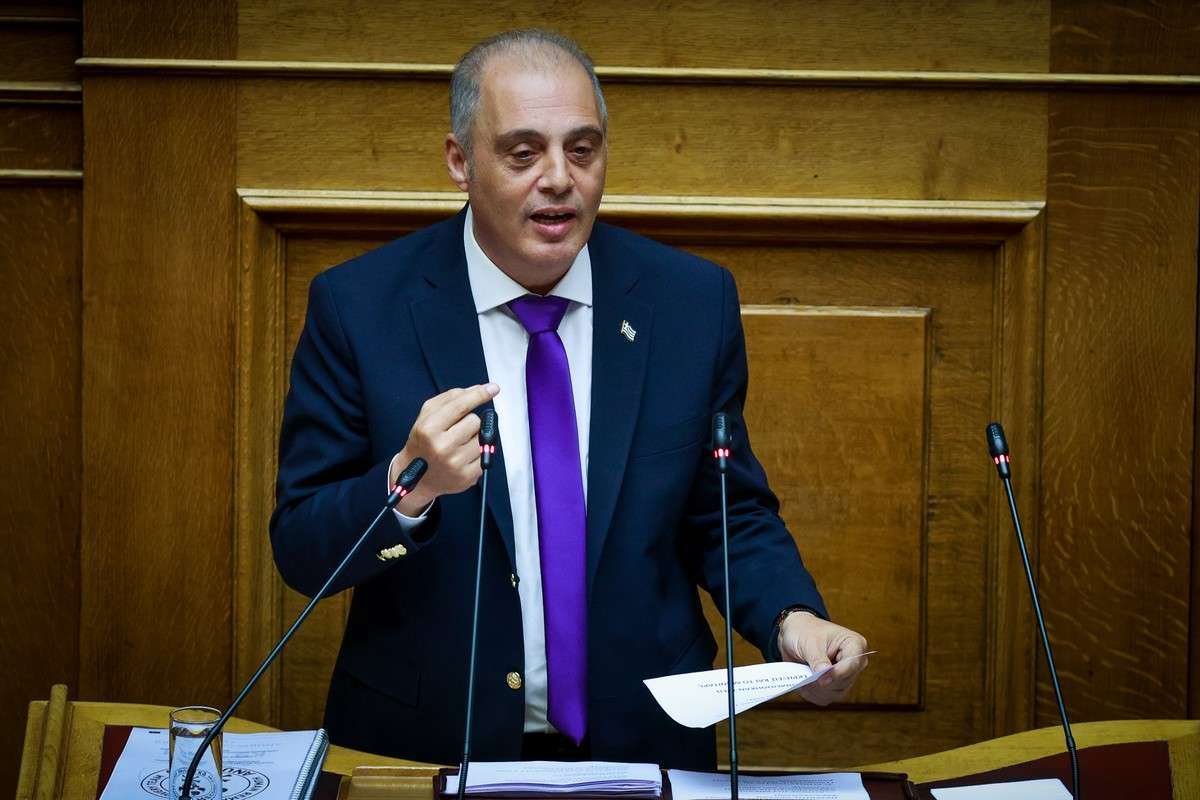
Greek Solution President Kyriakos Velopoulos delivered a wide-ranging and confrontational interview on ANT1 television, challenging the Greek government over foreign policy, energy security and economic management while directing criticism at several opposition leaders.
The departure of Kimberly Guilfoyle from her position as US ambassador to Greece dominated the opening discussion, with Velopoulos arguing that the diplomatic development should be examined within the broader struggle for control of energy routes across Southeastern Europe and the Eastern Mediterranean.
He claimed that powerful economic and geopolitical interests were competing behind the scenes and warned that Greece must protect its strategic position through the Vertical Gas Corridor.
The opposition leader also questioned the government’s economic record, criticized high energy prices and proposed state-operated fuel stations and retail outlets as emergency measures to address inflation.
“Those Celebrating Guilfoyle’s Departure Are Either Fools or Pro-Turkish”
Velopoulos opened his intervention with a particularly sharp assessment of the controversy surrounding Guilfoyle.
“When buffaloes fight, the frogs get trampled,” he said, invoking a familiar proverb to describe how smaller countries can suffer when powerful international interests clash.
He then accused those celebrating the ambassador’s departure of either failing to understand Greece’s interests or favoring Turkey.
His central argument was that the issue should not be reduced to Guilfoyle’s public appearances or personal lifestyle.
Instead, he urged attention to the energy projects she had supported and their potential implications for Greece’s geopolitical position.
Velopoulos argued that the controversy could weaken the country’s standing at a time when competing infrastructure projects are reshaping regional energy markets.
Guilfoyle, Tom Barrack and the Battle Over Energy Routes
According to Velopoulos, the diplomatic developments reflect a broader contest between two competing energy strategies.
He associated Guilfoyle with support for the Vertical Gas Corridor, a project designed to strengthen the movement of natural gas through Greece toward Southeastern and Central Europe.
He contrasted this with a potential energy route linking Qatar to Turkey through other Middle Eastern countries, which he associated with US diplomat Tom Barrack.
These assertions represent Velopoulos’s political interpretation. The interview did not establish that the two American officials were acting on behalf of opposing commercial interests.
Nevertheless, he insisted that the underlying stakes were far greater than domestic political disagreements.
“We are talking about enormous sums of money,” he emphasized, referring to multibillion-euro energy infrastructure projects.
For Velopoulos, the central issue was whether Greece would consolidate its position as a regional energy gateway or see competing routes strengthen Turkey’s strategic influence.


Questions Over an Anonymous Letter and the Wall Street Journal
The Greek Solution leader also referred to an anonymous letter allegedly sent to Bulgaria’s Energy Ministry, claiming that it subsequently became part of reporting by The Wall Street Journal.
He raised questions about how the document circulated and suggested that the circumstances surrounding the controversy deserved closer scrutiny.
However, the interview did not provide independent evidence linking the Greek government to the alleged leak.
The ANT1 presenters pointed out that Health Minister Adonis Georgiadis had rejected any suggestion of Greek government responsibility for Guilfoyle’s departure, noting that decisions concerning American ambassadors belong to Washington.
Velopoulos maintained that Athens should nevertheless examine the potential geopolitical consequences.
“I Want Turkey Isolated Economically and Geopolitically”
Velopoulos’s strongest strategic statement concerned Turkey.
“What matters to me is that Turkey is isolated economically and geopolitically,” he declared.
He argued that strengthening the Vertical Gas Corridor would reduce Ankara’s ability to dominate energy transportation routes serving European markets.
Conversely, he warned that additional pipelines through Turkey could deepen Europe’s dependence on Turkish infrastructure.
He specifically referred to TurkStream, which carries Russian natural gas, arguing that Turkey’s position could become even stronger if additional energy corridors passed through its territory.
Despite his broader criticism of the Mitsotakis administration, Velopoulos acknowledged the strategic importance of the Vertical Corridor.
This was one of the interview’s notable distinctions: he strongly challenged the government while supporting the continuation of an energy project that Athens itself considers strategically important.
Velopoulos Targets Tsipras Over the Greece–Cyprus Electricity Interconnector
Former Prime Minister Alexis Tsipras also came under attack.
Velopoulos criticized what he described as confusion over the electricity interconnection project between Greece and Cyprus.
He insisted that the project was not merely a technical infrastructure initiative but an investment with substantial geopolitical significance.
The interconnector is intended to connect electricity systems across the Eastern Mediterranean, although its development has faced political, financial and regional challenges.
Velopoulos linked the project to Turkey’s objections and the broader struggle over energy infrastructure in the region.
The interview did not reproduce the full statement by Tsipras that Velopoulos was challenging. His accusation of misunderstanding must therefore be treated as an attributed political claim rather than an independently established error.
Russian Oil and Ukraine: “I Want Greek People to Have Cheap Energy”
Turning to the war in Ukraine, Velopoulos reiterated his opposition to Greece’s involvement in the conflict.
He argued that European energy restrictions and the broader confrontation with Russia had contributed to higher fuel prices.
He also suggested that Greece should consider opportunities to secure cheaper energy supplies, including Russian oil where legally permissible.
“I want Greek people to have cheap energy,” he said.
Velopoulos linked his position to recent US moves concerning Russian diesel supplies, arguing that Greece should prioritize affordable fuel for households and businesses.
The ANT1 presenters challenged him by emphasizing that Russia had invaded Ukraine and that sanctions were part of a collective European response.
Velopoulos responded by drawing a comparison with Turkey’s 1974 invasion of Cyprus and the continuing occupation of territory in the Republic of Cyprus.
“Why Don’t You Impose Sanctions on Turkey Over Cyprus?”
The Cyprus question became another major point of confrontation.
Velopoulos accused Greece and its European partners of applying inconsistent standards when responding to violations of international law.
“Why don’t you impose sanctions on Turkey for its invasion of Cyprus?” he asked.
He argued that Greece should make greater use of its influence within the European Union to pressure Ankara, particularly concerning European funding.
The exchange highlighted two different approaches: the EU’s collective sanctions policy following Russia’s invasion of Ukraine, and Velopoulos’s demand for stronger measures against Turkey over Cyprus.
Although the two situations involve different historical and institutional circumstances, the Greek Solution leader argued that the principle of defending sovereignty should be applied consistently.
Allegations of Threats Against MEP Emmanouil Fragkos
Velopoulos also raised a serious allegation concerning Greek Solution Member of the European Parliament Emmanouil Fragkos.
He claimed that Turkish media reports had included threatening language against the MEP following his interventions calling for restrictions on European funding to Turkey.
Velopoulos accused Greek television networks of failing to give the alleged threats sufficient attention.
The precise wording, origin and credibility of the reported threats require independent verification.
He used the episode to argue that Greek Solution representatives receive unequal treatment in national political coverage.
“The Greek Economy Is Doing Worse Than Badly”
The interview then shifted to the domestic economy, where Velopoulos sharply challenged the government’s account of economic performance.
He disputed claims that Greece’s improving financial position was translating into meaningful relief for businesses and households.
“The economy is not doing well,” he argued.
The opposition leader cited his business experience and accused leading political figures of relying too heavily on advisers rather than understanding conditions in the marketplace.
He also questioned the government’s debt-management decisions.
Velopoulos referred to borrowing costs of approximately 4.45% and criticized the repayment of older debt carrying lower interest rates.
These figures require examination in their specific financial context. Individual bond yields, borrowing maturities and debt repayment arrangements cannot, by themselves, establish the government’s overall financing position.
The €95 Million Industry Package and the Crisis Facing Small Bakeries
Velopoulos criticized the government’s €95 million package aimed at helping Greek industry cope with elevated energy costs.
He argued that the amount was insufficient to address the pressures facing manufacturers.
“It is not enough,” he repeatedly insisted.
He emphasized that rising electricity and operating costs also affect smaller businesses, particularly bakeries and other local producers.
According to Velopoulos, support measures should not focus exclusively on large industrial companies.
He argued that smaller enterprises require additional protection if the government wants to prevent further price increases for consumers.
His remarks highlighted the debate over how public resources should be distributed between major manufacturers and smaller businesses facing the same energy crisis.
Government-Run Fuel Stations: Velopoulos’s Proposal Against Inflation
One of the interview’s most concrete policy proposals involved the establishment of government-operated fuel stations and outlets selling essential consumer goods.
Velopoulos pointed to prices at military fuel stations, claiming that diesel was available at approximately €1.91 per liter compared with around €2.15 in the wider market.
He argued that the difference demonstrated the potential for state intervention during an exceptional cost-of-living crisis.
His proposal would also cover essential goods such as pasta and other staple foods.
According to Velopoulos, publicly operated outlets could provide consumers with lower-cost alternatives and place competitive pressure on private retailers.
However, such a system would require a detailed legal and financial framework, since military fuel stations operate under different conditions from the open retail market.
Velopoulos Challenges Opinion Polls: “New Democracy Is Around 22%”
The Greek Solution leader also questioned the credibility of published opinion polls.
He argued that New Democracy’s actual electoral support was lower than many surveys suggested and estimated it at approximately 22%.
That figure was presented as his personal assessment rather than a publicly documented polling result accompanied by methodological details.
Velopoulos also alleged that financial relationships between polling companies and public institutions could create conflicts of interest.
The interview did not establish that such relationships had resulted in manipulated polling results.
Asked about Greek Solution’s own level of support, he declined to provide a precise figure.
Instead, he referred to his regular visits to street markets and his direct contact with voters.
“I am not a prophet or a god,” he said, acknowledging that he could not know the party’s eventual electoral result.
“We Want to Govern”: His Message to Mitsotakis, Tsipras and Androulakis
In the closing section of the interview, Velopoulos sought to portray Greek Solution as a party with ambitions extending beyond protest politics.
“We want to govern,” he declared.
He insisted that his party had a political program and a plan for the country.
Velopoulos also criticized smaller political formations that, in his view, direct more attention toward Greek Solution than toward the governing party.
He identified Kyriakos Mitsotakis, Alexis Tsipras and Nikos Androulakis as his principal political opponents.
The interview ultimately brought together two strands of his opposition strategy: sharp criticism of the government’s economic record and an emphasis on energy security as a central component of Greek foreign policy.
From the Vertical Gas Corridor and relations with Turkey to Russian energy supplies and government intervention in retail markets, Velopoulos presented a series of positions that would require detailed policy planning and scrutiny if translated into government action.
His appearance on ANT1 demonstrated how energy prices, geopolitical competition and the cost of living are becoming increasingly interconnected themes in Greece’s political debate.
Source: pagenews.gr