The climate crisis is not waiting for wars to end, energy markets to stabilize or governments to resolve their economic disputes.
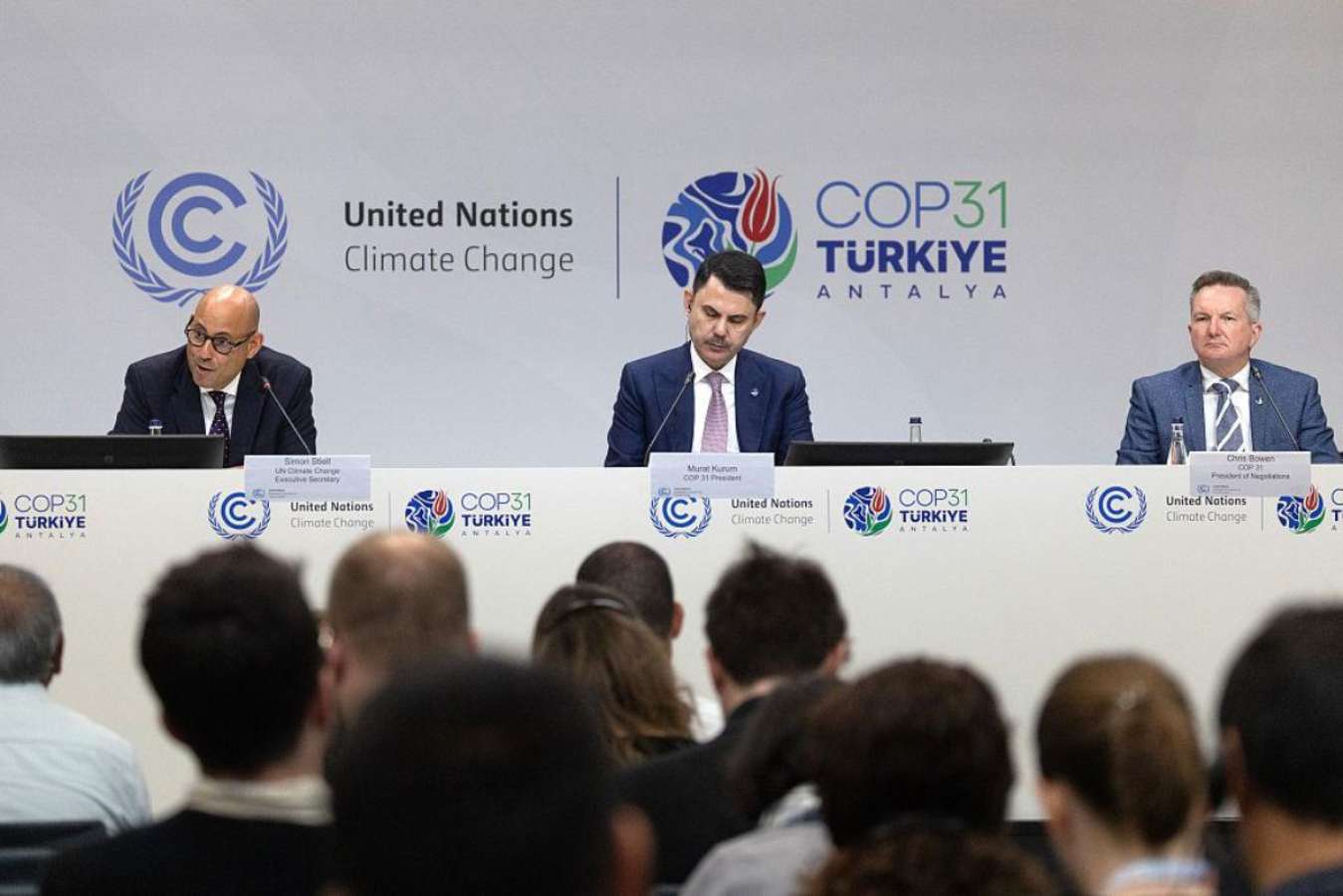
That is the central contradiction emerging from the 31st United Nations Climate Change Conference (COP31) in Antalya, Türkiye, where mounting scientific warnings are colliding with a fragmented geopolitical landscape.
While governments continue to acknowledge the urgency of reducing greenhouse gas emissions, international conflicts, rising energy costs and national security concerns are complicating the transition away from fossil fuels.
The absence of an official United States delegation, alongside limited participation by several major economies at the highest political level, has intensified questions about the strength of global climate leadership.
The challenge is no longer simply to announce ambitious targets. It is to demonstrate that governments can deliver on the commitments they have already made.
Guterres Warns: The Climate Crisis Is Outpacing Global Action
United Nations Secretary-General António Guterres delivered one of the summit’s starkest warnings, arguing that the international response is failing to keep pace with the accelerating climate emergency.
“The hard truth is that the climate crisis is outpacing us,” he said, according to remarks reported from the conference.
Guterres also warned of a trajectory toward “mutually assured destruction” unless governments substantially accelerate efforts to reduce emissions.
His intervention follows growing concerns that the world is on course to exceed the 1.5°C warming threshold established as a central ambition of the Paris Agreement.
The critical question, according to the UN chief, is how far temperatures will rise beyond that threshold, how long the overshoot will last and how quickly the world can return to safer levels.
Exceeding 1.5°C does not mean climate action becomes irrelevant.
On the contrary, every fraction of a degree matters in limiting the severity of heatwaves, floods, droughts and other extreme weather events.
The consequences are already visible across continents, with increasingly destructive disasters causing loss of life, infrastructure damage and mounting economic costs.


Lula: Weapons and Tariffs Are Replacing Climate Action
Brazilian President Luiz Inácio Lula da Silva used the summit to criticize the retreat of climate policy from the international political agenda.
“We have begun talking more about weapons and tariffs than about the survival of future generations,” Lula said, according to remarks attributed to him at COP31.
His intervention reflected concerns that the diplomatic momentum generated by COP30, hosted by Brazil in 2025, has weakened.
Major economies are increasingly prioritizing defense, industrial competitiveness, trade protection and energy security.
Lula warned that climate cooperation risks becoming a casualty of geopolitical rivalry.
“The planet cannot remain at the mercy of hegemonic rivalries,” he argued.
Brazil is seeking to maintain international attention on three priorities: transitioning away from fossil fuels, expanding climate finance for developing countries and reversing deforestation.
A central element of the financial debate is the ambition to mobilize $1.3 trillion annually by 2035 for climate action in developing economies.
Yet the gap between those ambitions and the funding currently available remains substantial.
The Iran War Reshapes the Global Energy Debate
The military confrontation involving the United States, Israel and Iran has added another layer of uncertainty to international climate negotiations.
Disruptions affecting Middle Eastern oil supplies and volatility in global energy markets have increased pressure on governments to secure affordable and reliable energy.
For some countries, that means renewed interest in domestic oil and gas production.
For others, the same instability strengthens the argument for accelerating investment in renewable energy.
Guterres emphasized that roughly three-quarters of humanity live in countries that import fossil fuels.
These economies are exposed to price shocks often triggered by events far beyond their borders.
The transition toward cleaner energy is therefore not solely an environmental issue.
It is increasingly connected to economic resilience, national security and reducing dependence on geopolitically vulnerable supply chains.
The challenge is that short-term energy security measures do not always align with long-term climate objectives.
Türkiye’s Climate Contradiction: Hosting COP31 While Discovering New Oil
The summit’s host country illustrates the competing pressures confronting governments.
At the opening of COP31, Turkish President Recep Tayyip Erdoğan announced the discovery of two new oil deposits.
The announcement highlighted the tension between climate commitments and the pursuit of greater domestic energy production.
Türkiye has established a target of achieving net-zero emissions by 2053.
It also plans to increase its combined installed wind and solar capacity to 175 gigawatts by 2040.
An expansion of renewable energy could help reduce the country’s substantial dependence on imported fossil fuels.
Nevertheless, continued investment in oil production demonstrates that the energy transition remains uneven.
Governments are attempting to balance decarbonization with energy affordability, industrial development and strategic independence.
Britain’s Rosebank Dilemma Tests Its Climate Commitments
The United Kingdom faces a similar debate over the future of the Rosebank oil field in the North Sea.
Prime Minister Andy Burnham’s government is confronting competing demands over whether additional oil development should be approved.
Supporters of new production argue that domestic energy resources can contribute to supply security, investment and employment.
Climate campaigners maintain that expanding fossil fuel extraction risks undermining long-term emissions commitments.
The decision has become a test of how Britain balances its climate ambitions against economic and energy-security pressures.
The debate also reflects a wider European challenge.
Governments are seeking to decarbonize their economies while maintaining affordable electricity, protecting industrial competitiveness and reducing dependence on imported energy.
The 35% Electrification Target: A Climate Solution With a Critical Gap
One of the initiatives under discussion at COP31 is a proposal to increase electricity’s share of global final energy consumption.
Türkiye has proposed raising that share to 35% by 2035, compared with slightly more than 20% today.
Electrification can reduce direct fossil fuel consumption in transport, buildings and industry.
Electric vehicles, heat pumps and electrified industrial processes can improve energy efficiency and lower emissions.
However, the proposal raises a fundamental question.
Where will the additional electricity come from?
If increased demand is met primarily through coal- or gas-fired power generation, the climate benefits will be reduced.
Successful electrification therefore requires parallel investment in renewable generation, modern electricity grids, energy storage and other low-emission technologies.
The debate illustrates why numerical targets alone are insufficient.
Governments must also establish credible strategies for delivering the infrastructure necessary to achieve them.
Türkiye Says Its Energy Transition Requires $300 Billion
Climate finance remains one of the most difficult issues facing the negotiations.
Turkish Finance Minister Mehmet Şimşek has estimated that the country requires approximately $300 billion to transform its energy system and reduce emissions.
The scale of the investment exceeds what public finances alone can provide.
An expanded role for multilateral development banks, international financial institutions and private investors will therefore be essential.
Türkiye’s dependence on imported fossil fuels adds an economic dimension to the transition.
The country has reportedly spent approximately $600 billion on oil and gas imports over the past decade.
Investments in domestic clean-energy infrastructure could help reduce that exposure over time.
For Ankara, the energy transition is consequently linked not only to climate commitments but also to economic stability and long-term strategic autonomy.


Guterres Calls for Taxes on Fossil Fuel Windfall Profits
The UN Secretary-General also renewed calls for a more equitable distribution of the financial burden of climate change.
According to figures presented in the summit reporting, nine major oil and gas companies generated approximately $95 billion in combined profits during a single quarter.
By comparison, the international fund designed to address climate-related loss and damage has received approximately $600 million.
The contrast highlights the imbalance between the financial resources generated by the fossil fuel industry and those available to vulnerable countries facing severe climate impacts.
Guterres called on governments to consider taxing extraordinary fossil fuel profits and directing the proceeds toward climate assistance.
The proposal forms part of a broader debate over who should finance adaptation, disaster recovery and the transition toward low-carbon economies.
Developing countries argue that wealthier nations, which account for a substantial share of historical emissions, must assume greater financial responsibility.
A New Coalition Seeks to Unlock Clean-Energy Investment
A more concrete development at COP31 was the presentation of the Electrify Now Finance Coalition.
The initiative brings together governments, development banks and private financial institutions to accelerate investment in clean electrification across developing economies.
Its objective is to address obstacles such as high borrowing costs, limited access to long-term finance and investment risks.
The financing imbalance is particularly pronounced in Africa.
According to figures presented during the conference, approximately 90% of global energy-transition investment is concentrated in developed economies and China, while Africa receives only around 2%.
Five investment plans were also announced through the Climate Investment Funds’ AMPLIFi program.
With an initial allocation of $94 million, the initiative aims to mobilize more than $1.2 billion in private investment.
The projects focus on clean electricity generation, power grids and energy storage.
The underlying strategy is to use limited public resources to reduce investment risks and attract larger amounts of private capital.
Its success will depend on whether announced commitments translate into completed projects and measurable improvements in energy access.
Türkiye and Saudi Arabia Expand Renewable-Energy Cooperation
The energy transition is also creating new geopolitical and commercial partnerships.
During COP31, Türkiye and Saudi Arabia announced an agreement covering the second phase of renewable-energy investments with a combined capacity of 3 gigawatts.
The projects include wind farms, electricity transmission infrastructure and energy-storage systems.
They form part of a broader bilateral initiative involving 5 gigawatts of renewable-energy capacity, with the participation of Saudi developer ACWA Power.
The initial phase includes 2 gigawatts of solar projects in the Turkish provinces of Sivas and Karaman.
The agreement illustrates how major oil-producing economies are expanding their presence in renewable-energy markets.
However, investment in clean energy does not automatically mean that fossil fuel production is being reduced.
The two activities can expand simultaneously, complicating assessments of the overall climate impact.
Weather Monitoring Systems Face Funding Threats
The head of the World Meteorological Organization (WMO), Celeste Saulo, raised concerns about another consequence of shifting government priorities.
Growing military expenditure and fiscal pressures are threatening funding for essential weather and climate observation systems.
According to the concerns outlined at the summit, meteorological and climate-monitoring infrastructure valued at approximately $10 billion faces financial risks.
These systems are critical for forecasting storms, heatwaves, floods and droughts.
They also support early-warning services that can protect communities and reduce economic losses.
The WMO estimates that developing countries require approximately $150 million annually to strengthen observation capabilities.
Meanwhile, the global climate-observation system needs around $500 million per year to sustain its operations.
Cuts to these systems could weaken the international community’s ability to anticipate and respond to increasingly severe climate-related disasters.
The concern extends to scientific research, including the resources needed to complete future assessments by the Intergovernmental Panel on Climate Change.
Artificial Intelligence Adds a New Challenge to Electricity Demand
The rapid expansion of artificial intelligence is emerging as another major issue for energy policymakers.
According to analysis attributed to BloombergNEF, electricity consumption by data centers could quadruple by 2035.
Under that scenario, data centers could account for approximately 7% of global electricity consumption.
The growth of AI infrastructure is increasing pressure on electricity grids and generation capacity.
In some markets, long delays in connecting new data centers to power networks are encouraging developers to invest in dedicated electricity generation.
These facilities may rely on natural gas, potentially increasing emissions even as renewable-energy capacity expands.
Governments therefore face a dual challenge.
They must support digital innovation while ensuring that the additional electricity demand is increasingly supplied by low-emission sources.
The issue also raises questions about grid investment, energy efficiency and the environmental footprint of the global technology industry.
Major Leaders Are Missing as Climate Diplomacy Loses Political Momentum
The limited participation of senior political leaders is one of the defining features of COP31.
The United States is absent from the official proceedings for a second consecutive year.
France, Germany, Italy, Japan and Canada are not represented at the highest political level, according to the summit reporting.
China is participating through Vice President Han Zheng, while European Commission President Ursula von der Leyen is expected to represent the European Union’s political leadership.
The absence of heads of government does not necessarily indicate that their countries have abandoned climate policy.
However, it raises questions about the priority assigned to climate diplomacy at a time when defense, trade and technological competition dominate international discussions.
Mohamed Adow, director of Power Shift Africa, has argued that the world’s largest economies should take greater responsibility for addressing the climate crisis.
Political leadership is especially important when negotiations involve financial commitments and policy decisions that go beyond the authority of technical delegations.
Eleven Years After Paris, the Real Test Is Implementation
Former French Foreign Minister Laurent Fabius, who presided over the landmark Paris climate conference in 2015, has emphasized the importance of implementing existing commitments.
Eleven years after the Paris Agreement, the international community possesses extensive scientific evidence, established climate objectives and a growing range of financial instruments.
What remains difficult is translating those commitments into consistent national policies.
COP31 must confront several interconnected challenges: financing the energy transition in developing countries, reducing dependence on fossil fuels, strengthening energy security and protecting vulnerable populations.
The underlying issue is political as much as environmental.
Governments must determine whether they regard the climate transition primarily as an additional economic burden during a period of geopolitical instability or as a long-term investment in resilience, security and prosperity.
The climate crisis is accelerating, while the international response remains constrained by geopolitical rivalries, competing economic priorities and uneven access to finance.
That is the defining challenge of COP31.
The world does not simply need another set of promises about the future.
It needs evidence that governments are prepared to act in the present.
Source: pagenews.gr