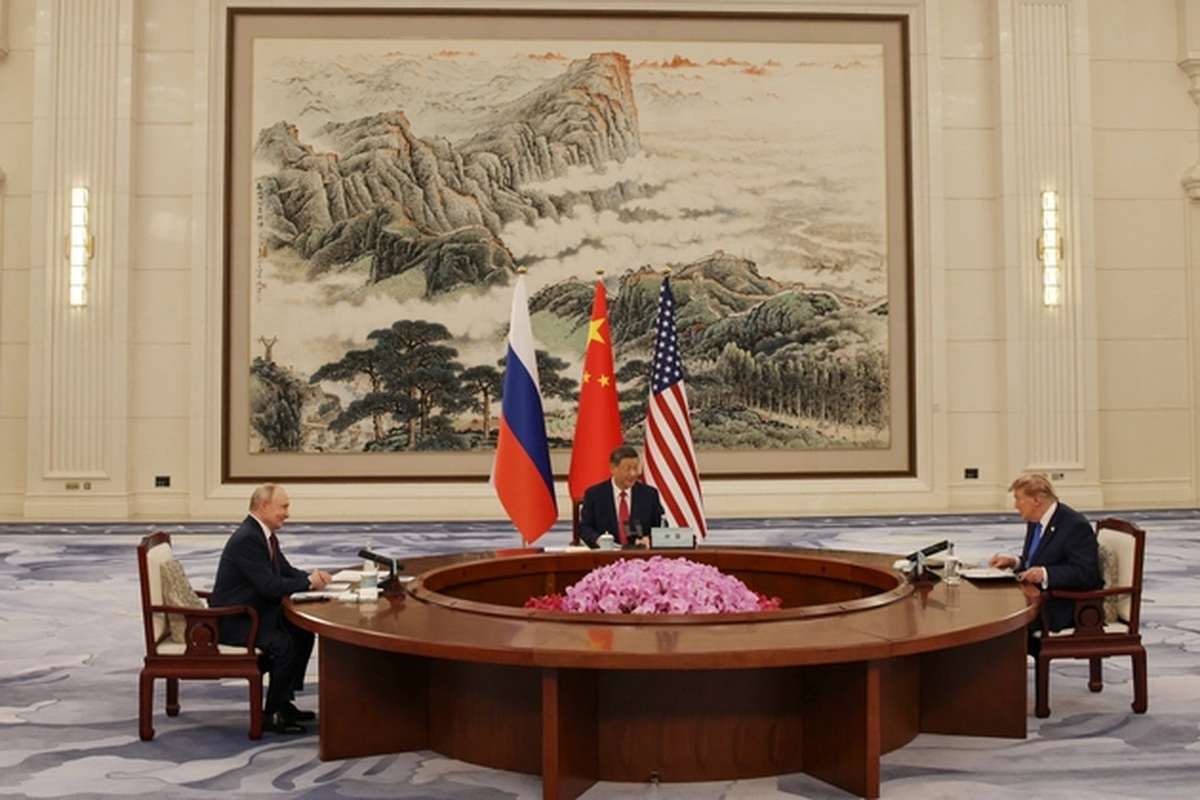
US President Donald Trump, Russian President Vladimir Putin and Chinese leader Xi Jinping delivered a joint rebuke to the International Criminal Court (ICC) on Thursday, November 19, during a trilateral summit in Shenzhen, China.
According to POLITICO, the three leaders issued a four-point “declaration toward peace” that included an explicit warning against what they described as the court’s excessive exercise of jurisdiction.
The declaration stated that the ICC “must not abuse [its] jurisdiction.”
The statement carries particular significance given Washington’s recent sanctions against the Hague-based institution and the arrest warrant issued against Putin in 2023 over alleged war crimes involving the unlawful deportation and transfer of Ukrainian children.
The meeting lasted one hour and 20 minutes, with the declaration initially published by Chinese state media before being circulated by Russian news outlets.
At the time of POLITICO’s report, no official American version of the joint statement had been released.
The summit brought together three leaders whose governments have long expressed reservations about the authority of international judicial institutions.
Yet the declaration’s significance extends beyond the ICC itself, raising questions about the relationship between major powers, international accountability and the institutions established to enforce international law.
Trump Targets the ICC: A “Rogue Globalist Organization”
Donald Trump went beyond the language of the joint declaration during the public portion of the summit.
He described the International Criminal Court as a “rogue globalist organization” that had exceeded its authority.
His remarks reflected the administration’s increasingly confrontational approach toward the court.
On October 9, Washington imposed sweeping sanctions against the ICC, following previous declarations that the administration intended to dismantle the institution “brick by brick.”
The United States has historically objected to the court exercising jurisdiction over American nationals without Washington’s consent.
The Trump administration has intensified that opposition, arguing that the institution’s actions can interfere with national sovereignty.
The joint statement with Russia and China places these American objections within a broader diplomatic context.
Although the three governments have different legal and geopolitical interests, they have now publicly endorsed a common warning concerning the court’s authority.
The declaration does not establish a formal alliance against the ICC or change its legal mandate.
It does, however, represent a notable convergence in their public positions toward the institution.


Putin’s Arrest Warrant Gives the Declaration Added Significance
For Vladimir Putin, the confrontation with the International Criminal Court is not merely theoretical.
In March 2023, the ICC issued an arrest warrant against the Russian president over allegations relating to the unlawful deportation and transfer of children from occupied Ukrainian territories to Russia.
Moscow rejects the court’s jurisdiction and disputes the allegations.
Nevertheless, the warrant remains legally significant, particularly when Putin travels to countries that are parties to the Rome Statute, the treaty establishing the ICC.
The court does not possess its own police force and relies on states to cooperate in executing arrest warrants.
The Shenzhen declaration does not invalidate or suspend the warrant against Putin.
Nor does it alter the obligations of states under the Rome Statute.
However, the participation of the Russian president in a joint statement criticising the court underscores the political tensions surrounding international criminal accountability.
The declaration comes as the ICC continues to face pressure from governments that dispute aspects of its jurisdiction or challenge its authority over particular cases.
A Four-Point Declaration With Few Concrete Commitments
Beyond the criticism of the International Criminal Court, the three leaders outlined several broad areas of potential cooperation.
According to the declaration reported by POLITICO, the United States, Russia and China expressed support for discussions on reforming the United Nations, increasing production of refined petroleum products and reducing nuclear risks.
However, the statement offered few details about how those objectives would be implemented.
No comprehensive timetable was announced.
There were no clearly defined mechanisms for monitoring progress, and the leaders did not present a detailed roadmap for translating their commitments into binding agreements.
The limited scope of the declaration is particularly striking given the international attention surrounding the summit.
The three countries hold enormous economic, military and diplomatic influence.
All are permanent members of the United Nations Security Council, and their decisions can have significant consequences for global security.
Yet their joint statement remained largely confined to general principles.
The summit demonstrated an ability to agree on selected international issues without resolving the broader disagreements separating the three powers.
Nuclear Weapons: Agreement to Talk, but No Disarmament Roadmap
Nuclear security featured prominently in the declaration.
Trump, Putin and Xi reaffirmed the principle that “a nuclear war cannot be won and must never be fought.”
The formulation has appeared in previous international statements and reflects a longstanding principle of nuclear risk reduction.
The three leaders also committed themselves to continuing dialogue on nuclear security.
However, they did not announce numerical targets for reducing their nuclear arsenals.
Nor did they establish a negotiating timetable, verification arrangements or a new arms-control framework.
The absence of concrete commitments limits the immediate practical significance of the announcement.
The United States and Russia possess the world’s largest nuclear arsenals, while China has been expanding its nuclear capabilities.
Discussions involving all three countries could become important for future arms-control arrangements.
But the Shenzhen statement did not establish a formal trilateral disarmament process.
For now, it represents a commitment to continued communication rather than a substantive nuclear arms-reduction agreement.
Energy Cooperation: A Shared Interest in Refined Petroleum Production
The declaration also addressed energy production.
The three countries expressed their intention to increase the production of refined petroleum products.
The announcement comes amid considerable uncertainty in international energy markets, driven by geopolitical tensions, supply disruptions and changing patterns of global demand.
Energy is strategically important to all three countries, although their economic interests differ.
The United States is a major producer and exporter of oil, natural gas and refined petroleum products.
Russia relies heavily on energy exports as a source of revenue and international economic influence.
China is one of the world’s largest energy consumers and plays a major role in global refining and industrial demand.
The declaration did not specify production targets, investment commitments or a timetable for implementation.
It also did not establish a detailed framework for coordinating the three countries’ energy policies.
As a result, the statement should be understood as a broad political commitment rather than a completed trilateral energy agreement.
The Most Striking Omission: No Mention of Ukraine
Perhaps the most significant feature of the Shenzhen declaration is what it does not say.
Russia’s war in Ukraine is entirely absent from the four-point statement.
Trump had indicated at the beginning of the summit that the conflict would be discussed during the private portion of the meeting.
However, the final declaration contained no reference to the fighting, a ceasefire or a potential peace settlement.
It offered no framework for negotiations between Moscow and Kyiv.
Nor did it outline any commitments regarding Ukraine’s sovereignty, territorial integrity or security arrangements.
The omission is particularly notable given that Putin remains subject to an ICC arrest warrant connected to the conflict.
It also raises questions about whether the three leaders reached any understanding during their private discussions.
Based on the information made public, no agreement concerning Ukraine was announced.
The absence of the war from a declaration explicitly presented as a statement “toward peace” highlights the limitations of the summit’s diplomatic outcome.
What the Joint Position Means for International Justice
The International Criminal Court was established to investigate and prosecute individuals accused of the most serious international crimes.
Its jurisdiction covers genocide, crimes against humanity, war crimes and, under specific conditions, the crime of aggression.
The court operates under the Rome Statute, which defines its jurisdiction and the circumstances in which investigations and prosecutions may proceed.
The United States, Russia and China are not parties to the Rome Statute.
However, that does not automatically exclude their nationals from the court’s jurisdiction in every circumstance.
The ICC may exercise jurisdiction when the relevant legal requirements are met, including certain situations involving crimes committed on the territory of a state that has accepted its jurisdiction.
The institution also depends on cooperation from governments to execute arrest warrants and enforce judicial decisions.
The joint statement by Trump, Putin and Xi does not alter these legal principles.
Nevertheless, it illustrates the political difficulties faced by international judicial institutions when major powers challenge their authority.
Supporters of the ICC argue that international criminal accountability is essential to addressing serious violations of international law.
Governments critical of the court have raised objections concerning sovereignty, jurisdiction and the institution’s exercise of authority.
The Shenzhen declaration brings these longstanding disputes into renewed international focus.


A Broader Question: Can Major Powers Reshape Global Institutions?
The declaration’s reference to United Nations reform adds another dimension to the summit.
The United States, Russia and China already occupy permanent seats on the UN Security Council, giving them considerable influence over international peace and security decisions.
All three possess veto power.
Their stated support for reform therefore raises questions about what changes they might seek and whether they share a common vision of the international system.
The declaration did not identify specific institutional reforms.
It also did not explain how the three governments intend to reconcile their competing geopolitical interests.
Those differences remain substantial, particularly regarding the war in Ukraine, strategic competition in Asia and the future of international security arrangements.
Nevertheless, the joint statement demonstrates that Washington, Moscow and Beijing can find areas of diplomatic convergence even amid broader tensions.
The criticism of the ICC is the clearest example from this summit.
Whether that convergence develops into sustained cooperation on international institutions remains uncertain.
The Shenzhen Summit: Symbolic Convergence, Limited Results
The meeting between Trump, Putin and Xi produced a joint declaration but few measurable commitments.
On the International Criminal Court, the three leaders issued a direct warning about the exercise of jurisdiction.
On nuclear weapons, they reaffirmed the need to avoid nuclear war and continue dialogue.
On energy, they expressed support for increased production of refined petroleum products.
On UN reform, they outlined a general commitment without specifying proposals.
And on Ukraine, despite Trump’s indication that the issue would be discussed, the final statement remained silent.
The central contradiction of the Shenzhen summit is clear: Trump, Putin and Xi found common language to challenge the International Criminal Court, but presented no shared plan for ending Russia’s war in Ukraine.
The declaration may have diplomatic significance as a public expression of agreement among three major powers.
Its practical consequences, however, will depend on whether the governments follow their statements with specific policies, negotiations or institutional initiatives.
For now, the most concrete outcome is their joint criticism of the Hague-based court.
The broader question is whether this meeting marks the beginning of sustained cooperation on selected international issues or remains a limited diplomatic gesture.
At Shenzhen, the three leaders agreed on a warning to international justice. They did not announce a comparable agreement on how to achieve peace in Ukraine.
Source: pagenews.gr