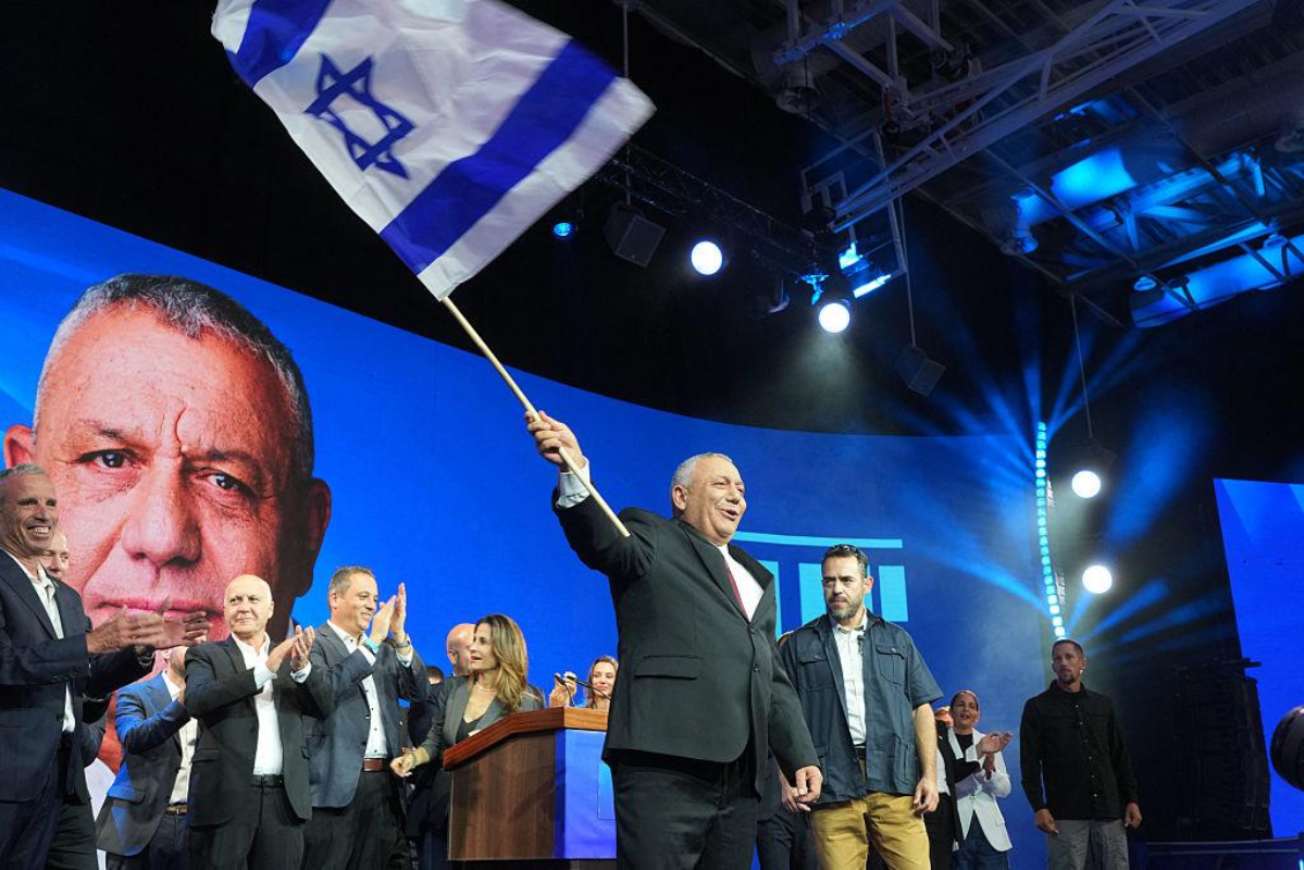
Israel’s political crisis is entering a decisive phase as Gadi Eisenkot, the former Israel Defense Forces chief of staff and leader of the Yashar party, signals that he is prepared to establish a government even if negotiations for a broad parliamentary coalition fail.
In an extensive public statement, Eisenkot outlined three possible routes to power, warned against prolonged coalition negotiations and launched a sharp attack on Prime Minister Benjamin Netanyahu.
At the center of the confrontation are negotiations with ultra-Orthodox parties, the possibility of a unity arrangement involving Likud, and a politically explosive third option: a minority government that could depend on parliamentary support from Arab parties.
The dispute is unfolding against the backdrop of tensions with Iran, disagreements over military conscription and growing concerns about political intimidation.
For Eisenkot, the question is no longer simply who will lead Israel’s next government. It is whether the country’s political institutions can produce a functioning administration without another election.
“I intend to establish a national emergency government”
Eisenkot has made clear that he will not allow coalition negotiations to continue indefinitely.
In his statement, he declared:
“If the sincere efforts I am making to form a broad government do not bear fruit, I intend to establish a national emergency government — a government that I will seek to expand, either before or after its inauguration.”
The declaration represents a direct warning to potential coalition partners.
Eisenkot’s preference remains a broad-based government capable of maintaining political stability and addressing Israel’s security challenges.
But he is also prepared to pursue a narrower arrangement if negotiations fail.
The most controversial element is the possibility of securing parliamentary backing from Arab parties without formally bringing them into the government.
Although Eisenkot does not explicitly identify those parties in his statement, the prospect of support from Ra’am and the Joint List has become central to the political debate.


Three routes to power — and three major obstacles
Eisenkot acknowledges that forming a government requires serious negotiations and difficult compromises.
“There are three main paths to forming a new government, and I approach each of them with a deep sense of responsibility and a sincere desire to succeed,” he said.
His options can be summarized as follows:
- A coalition with ultra-Orthodox parties, requiring an agreement on military conscription and exemptions for members of the Haredi community.
- A broader unity government involving Likud, despite significant disagreements over political leadership and policy.
- A national emergency government, potentially operating as a minority administration with external parliamentary support from Arab parties.
Each scenario presents substantial difficulties.
The ultra-Orthodox parties are reluctant to accept far-reaching changes to military exemptions.
Negotiations with Likud remain divided by questions of leadership and political trust.
And an Arab-backed minority government could face opposition from parties that otherwise support replacing Netanyahu.
Eisenkot’s challenge is to convert a shared desire for political change into a workable parliamentary arrangement.
The Arab vote: Netanyahu’s red line and Eisenkot’s warning
The role of Arab political parties has emerged as one of the most contentious issues in Israel’s coalition negotiations.
Netanyahu has repeatedly portrayed Arab political representatives as supporters of terrorism, arguing that a government dependent on their votes would pose a danger to national security.
Eisenkot has challenged that rhetoric, warning that broad attacks on Arab political participation risk intensifying divisions within Israeli society.
“The distance from a violent campaign of delegitimization against 21% of the population — labeling them ‘supporters of terrorism’ — to actual physical violence may prove very short. The warning signs are clear,” he said.
The reference to 21% concerns Israel’s Arab population.
Eisenkot argues that political disagreements with particular parties should not become a justification for delegitimizing an entire community.
His remarks do not constitute a formal coalition agreement with Arab parties.
They do, however, mark a clear disagreement with Netanyahu’s approach to their participation in parliamentary politics.
The Lieberman problem: Can an anti-Netanyahu coalition hold together?
Eisenkot has identified four parties as the potential foundation of his government: Yashar, Beyahad, the Democrats and Yisrael Beiteinu.
All oppose Netanyahu’s continued leadership.
Yet their agreement on that objective does not eliminate major differences over coalition strategy.
Avigdor Lieberman, leader of Yisrael Beiteinu, has pledged to oppose a minority government dependent on Arab parties.
That position creates a serious obstacle to Eisenkot’s third option.
The former military chief appears determined to test whether lawmakers will maintain such commitments when confronted with a concrete choice between a new government and another election.
“Every member of the Knesset will be called upon to follow their conscience and decide: will a new government be formed, or are they prepared to drag the State of Israel and its citizens into another round of elections, with Netanyahu remaining as caretaker prime minister?” Eisenkot asked.
The statement places responsibility directly on individual lawmakers.
Rather than waiting for every disagreement to be resolved, Eisenkot is signaling that he may bring a proposed government before parliament and require legislators to take a public position.
Ultra-Orthodox parties and the military draft dispute
The first route to a new government involves negotiations with ultra-Orthodox political parties.
The central obstacle is military conscription.
Ultra-Orthodox parties have traditionally sought exemptions from compulsory service for members of their communities, particularly religious students.
Other political forces argue that the burden of military service must be distributed more equally across Israeli society.
The issue has become especially sensitive amid the continuing operational demands placed on the Israel Defense Forces.
Eisenkot insists that his negotiations do not involve abandoning his principles.
“This is not an attempt to ‘square the circle,’ nor is it a case of ‘lowering the flag’ on military service,” he said.
Instead, he argues that an agreement must be based on a principled framework addressing Israel’s military manpower requirements.
Whether the ultra-Orthodox parties are prepared to accept such an arrangement remains uncertain.
Likud negotiations: “A significant gap” remains
The second option is a broader unity government involving Likud.
Eisenkot says he is continuing to explore that possibility, although he acknowledges that the negotiations have encountered serious obstacles.
“Regarding negotiations with Likud, we are making sincere and genuine efforts. Unfortunately, however, a significant gap remains between their rhetoric and their actual position, as well as their practical willingness to act,” he said.
Nevertheless, Eisenkot is not closing the door.
“I intend to give this path another chance. We must try to persuade Likud members to rise to the occasion.”
The remarks suggest that Eisenkot hopes individual Likud lawmakers may be willing to support a new political arrangement.
They also reveal the difficulty of establishing a unity government while the question of Netanyahu’s continued leadership remains unresolved.
Iran becomes a central issue in the struggle for power
The political confrontation is taking place as Israel faces continuing security challenges involving Iran.
Netanyahu has emphasized the Iranian threat in his calls for a national unity government under his leadership.
He has also argued that a minority administration dependent on Arab parties would be unable to respond effectively to major national security threats.
Eisenkot disputes the way military considerations are being introduced into the coalition debate.
“The fact that operational interests and timetables are being mixed with political interests and agendas — and that this has become accepted as normal — is unacceptable,” he declared.
His criticism focuses on the relationship between military decision-making and political interests.
It does not necessarily mean that Eisenkot dismisses the Iranian threat.
Rather, he argues that decisions involving national security should not be shaped by the immediate political interests of those in power.
That distinction is especially important in a country where security policy frequently dominates electoral and coalition debates.
“Desecrating the memory of the fallen”: A deeply personal accusation
One of the most emotionally charged passages in Eisenkot’s statement concerns the families of Israelis killed in military service.
He accused elements of Netanyahu’s political camp of targeting bereaved families with abusive messages.
“Sending hateful messages to grieving families, or making comments such as ‘your son would be ashamed of you,’ crosses the boundaries of decency, humanity and respect,” Eisenkot said.
He called on Netanyahu to condemn such behavior.
The allegations highlight the intensity of Israel’s political polarization.
For families who have lost relatives in military service, participation in political debate can expose them to particularly painful attacks.
Eisenkot argues that disagreements over government formation must not become a pretext for targeting the families of fallen soldiers.
The allegations should be distinguished from independently established findings about who organized or encouraged the reported harassment.
Parliamentary gains: Committees, the Knesset speaker and judicial reform
Eisenkot also pointed to parliamentary developments that he presents as evidence of progress by the political forces seeking to replace Netanyahu.
According to his statement, the emerging coalition has gained control of parliamentary committees, elected a new Knesset speaker and advanced legislation intended to reverse elements of Netanyahu’s judicial overhaul.
These developments demonstrate that parties with different ideological positions can cooperate on specific parliamentary objectives.
However, cooperation on individual votes does not automatically translate into agreement on forming a government.
The distinction is central to Eisenkot’s challenge.
A parliamentary bloc may be able to oppose particular government measures without agreeing on a common prime minister, defense policy or coalition program.
The next stage will determine whether those temporary alliances can become a durable governing arrangement.
Political rhetoric and fears of further violence
Eisenkot has also warned that increasingly hostile rhetoric could contribute to wider social tensions.
His criticism follows reported incidents of violence in northern Israel, including an attack on a mosque and an incident involving a Jewish driver and Arab Israelis.
Arab community leaders have blamed the deteriorating political climate and the language directed at their representatives.
Such allegations require careful examination.
The occurrence of violent incidents does not, by itself, establish that particular political statements directly caused them.
Nevertheless, the controversy illustrates the concerns surrounding the treatment of Arab citizens and their political representatives during a highly polarized period.
Eisenkot’s argument is that political leaders have a responsibility to avoid rhetoric that could intensify hostility between communities.
“I have no intention of wasting time”
Eisenkot concluded his statement by emphasizing that negotiations must produce a result.
“I intend to continue fighting for meaningful progress along every available path to forming a government — a government as broad as possible,” he said.
He then delivered a warning:
“All parties must understand that I have no intention of delaying or wasting time.”
And he added:
“They must understand that, at the appropriate moment, I will present to the Knesset, for its approval, a new and capable government under my leadership.”
The statement suggests that Eisenkot may seek parliamentary approval even if some potential coalition partners remain unwilling to commit in advance.
The outcome will depend on whether enough lawmakers are prepared to support the proposed administration when the question is formally put before them.
December 6: A deadline that could reshape Israeli politics
According to reporting by the Jerusalem Post, Eisenkot’s mandate to form a government expires on December 6, 2026.
His party is reportedly considering bringing a minority government before the Knesset ahead of that deadline.
Under the arrangement described in the reporting, Arab parties could provide external parliamentary support without receiving cabinet positions or representation on the security cabinet.
Such an arrangement would seek to separate support for establishing a government from direct participation in its executive decisions.
But it would not eliminate the political opposition of lawmakers who reject dependence on Arab parties.
The deadline increases pressure on Eisenkot, Likud, the ultra-Orthodox parties and the wider anti-Netanyahu bloc.
A government, another election or a prolonged political standoff?
Israel’s political uncertainty now revolves around several interconnected questions.
Can Eisenkot reach an agreement with ultra-Orthodox parties on military service?
Will Likud lawmakers accept a unity arrangement?
Can an anti-Netanyahu coalition overcome disagreements over Arab parliamentary support?
And will national security concerns involving Iran make compromise easier or more difficult?
Eisenkot has made clear that he does not intend to abandon the effort.
“What is at stake is the future of Israel… I do not intend to retreat, nor will I ignore the gravity of this moment. You have my word,” he concluded.
Three possible routes remain open, but each faces substantial political obstacles.
The next phase will depend on whether Eisenkot can transform parliamentary cooperation into a governing majority — or whether Israel will face another election.
Source: pagenews.gr