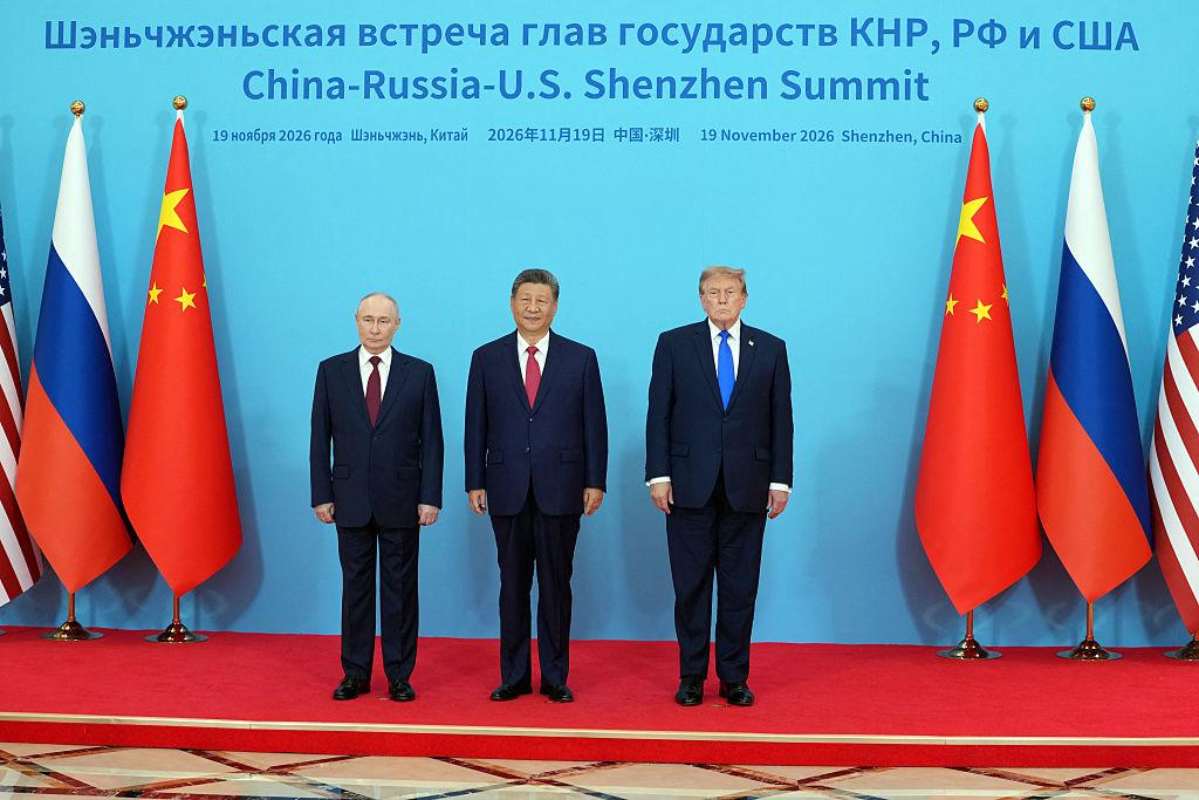
No historic agreement needed to be signed. The war in Ukraine did not have to end. Washington and Beijing did not have to resolve their bitter trade disputes.
For Xi Jinping, the most important outcome of his meeting with Donald Trump and Vladimir Putin was already visible in the images from Shenzhen: the American president had travelled to China to attend a trilateral summit hosted by Washington’s most formidable strategic rival.
That is the real significance behind the much-discussed “Yalta 2.0” moment.
Beijing is seeking to demonstrate that American power, however considerable, is no longer sufficient to dictate the terms of international diplomacy on its own.
China no longer wants merely a seat at the table. It wants a say in setting the rules.
The Detail That Revealed More Than the Joint Statement
China’s leadership welcomed Trump with considerable ceremony, while Putin received a different diplomatic reception.
That distinction did not necessarily signal any weakening of Beijing’s relationship with Moscow. Rather, it reflected a fundamental reality: China’s partnership with Russia is already firmly established, while its relationship with Washington requires constant negotiation.
Xi understands that the United States remains China’s principal economic and strategic competitor.
That makes diplomatic engagement with Trump potentially more consequential than another public demonstration of solidarity with Putin.
Beijing wants to keep Moscow close without closing the door to Washington.
This balancing act has become central to China’s foreign policy.
Russia provides Beijing with an important strategic partner, energy resources and a counterweight to Western influence. The United States, however, remains indispensable to the global economic and technological system in which China operates.
Xi’s challenge is to preserve both relationships without surrendering China’s strategic autonomy.


Trump Wanted Results. Xi Invested in the Process.
The American administration approached the summit with a series of concrete priorities: nuclear weapons, trade disputes, energy security and international conflicts.
Beijing had an additional objective.
It wanted to establish China as an indispensable participant in any major international settlement.
The distinction matters.
Trump frequently approaches diplomacy through the pursuit of negotiated agreements and visible results. Xi also invests in the longer-term transformation of international power structures.
Even a summit that produces few binding commitments can serve Beijing’s interests if it reinforces the perception that major global decisions cannot be made without China.
That does not mean Washington has accepted Chinese leadership.
It means that diplomatic engagement and strategic competition are increasingly taking place simultaneously.
For Xi, the meeting itself was part of the message.
The Real Battle Is Not Only in Ukraine. It Is Being Fought Over Microchips.
Behind the handshakes, the world’s two largest economies remain locked in a struggle for technological supremacy.
American restrictions on advanced semiconductors, access to artificial intelligence technologies and control over critical supply chains continue to shape the confrontation between Washington and Beijing.
China, meanwhile, possesses significant leverage through its dominant position in rare-earth processing and industrial supply chains on which Western manufacturers depend.
This exposes one of the summit’s central contradictions.
The United States and China can discuss global stability while simultaneously trying to constrain each other’s technological power.
The struggle for international influence is no longer confined to military bases, territorial disputes or diplomatic alliances.
It extends into data centres, semiconductor production, energy infrastructure, artificial intelligence and access to strategic minerals.
For Beijing, technological independence is closely connected to national security and economic resilience.
For Washington, preventing China from gaining decisive advantages in critical technologies remains a central strategic objective.
The summit may have offered an opportunity for dialogue, but it did not eliminate these competing priorities.
Putin Was in the Picture, but the Bigger Contest Is Between Washington and Beijing
For Vladimir Putin, appearing alongside the American and Chinese presidents carried substantial diplomatic significance.
After years of Western sanctions and attempts to isolate Moscow following its invasion of Ukraine, the Russian leader was able to present himself once again as a participant in discussions among the world’s major powers.
Yet the economic realities remain markedly different.
Russia possesses an enormous nuclear arsenal, extensive energy resources and significant military capabilities.
It does not, however, operate on the same economic or technological scale as the United States and China.
Beijing has strong reasons to maintain Russia as a strategic partner without automatically assuming the costs of Moscow’s decisions.
That creates a relationship defined by cooperation but also by unequal economic weight.
Putin sought recognition. Trump pursued negotiations. Xi was positioned to engage with both.
The summit illustrated how China can benefit diplomatically from maintaining channels with competing powers, even when their interests diverge.
“Yalta 2.0” May Not Be an Agreement. But It Is a Warning.
The most consequential aspect of a possible new era of great-power diplomacy is not necessarily the prospect of a secret agreement to divide the world into spheres of influence.
It is the gradual normalisation of the idea that the most powerful states can discuss international crises without the full participation of the countries directly affected.
Ukraine and Taiwan, in particular, have strong reasons to examine what such diplomatic arrangements could mean for their security and political autonomy.
The comparison with the 1945 Yalta Conference is therefore both powerful and imperfect.
The original Yalta meeting took place during a world war, when the victorious Allied powers were negotiating the postwar settlement.
Today’s international system is considerably more complex.
India, Japan, the European Union and other influential actors possess economic, diplomatic and strategic capabilities that cannot simply be disregarded.
Nor does a trilateral meeting automatically establish a new international order.
Nevertheless, the symbolism matters.
If great-power consultations increasingly take place through exclusive arrangements, smaller and medium-sized countries may face growing concerns about their ability to influence decisions affecting their future.
Xi’s Biggest Challenge Is Not the Photograph. It Is What Comes Next.
Beijing portrayed the Shenzhen summit as a historic diplomatic moment.
But the commitments announced were limited, and the meeting did not produce a comprehensive framework for resolving the disputes dividing the three powers.
The war in Ukraine continues. Nuclear disagreements remain unresolved. The economic and technological rivalry between Washington and Beijing has not disappeared.
The next test will be whether broad declarations can be translated into specific decisions.
Xi also faces a domestic challenge.
China’s economy continues to contend with pressures in its property sector, weak consumer confidence, demographic difficulties and employment concerns.
International diplomatic visibility does not automatically translate into stronger economic growth.
For the Chinese leadership, stable relations with Washington remain particularly important because another escalation in trade restrictions could place additional pressure on an already challenging economic environment.
The question, therefore, is not whether Xi secured an impressive photograph with Trump and Putin.
It is whether he can turn that image into lasting diplomatic, economic and strategic influence.
The answer will not emerge from a summit hall.
It will be determined by future trade negotiations, decisions over advanced technology, developments in Ukraine and the responses of other countries to the ambitions of the three powers.
For now, the Shenzhen meeting has highlighted a fundamental shift in the international debate.
China is no longer content simply to challenge the rules of an American-led order from the outside.
It increasingly wants to participate in writing whatever comes next.
And perhaps that is the most important meaning of Xi Jinping’s “Yalta 2.0” moment: Beijing is not waiting for the world order to change. It is actively seeking to shape the terms of that change.
Πηγή: pagenews.gr