Merz and Macron Bring Out the ‘Nuclear Option’: The Plan That Could Shut China Out of the EU Market
 ΧΡΟΝΟΣ ΑΝΑΓΝΩΣΗΣ 8 '
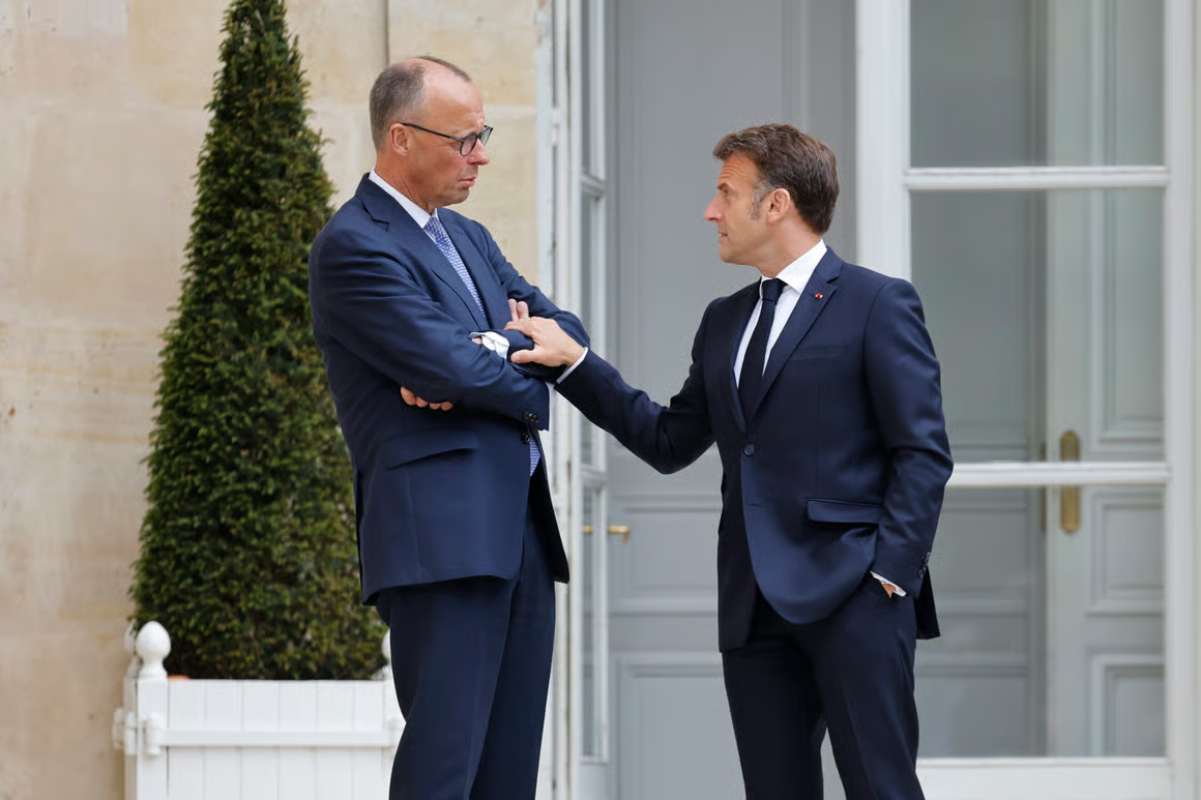
Πηγή Φωτογραφίας: Friedrich Merz, left, and Emmanuel Macron have promised to set up a joint Franco-German defence and security council. Photograph: Ludovic Marin/AP



Europe is preparing to rewrite the rules of trade warfare.
Emmanuel Macron and Friedrich Merz want the European Union to acquire an economic weapon powerful enough, in extreme circumstances, to shut third countries out of the Single Market.
The proposal could have enormous geo-economic consequences. Access to a market of roughly 450 million consumers is one of Europe’s most powerful bargaining chips, and Paris and Berlin now want Brussels to be prepared to use it.
The Franco-German initiative does not explicitly name China.
But there is little doubt about the country at the centre of the debate.
Chinese industrial overcapacity, state subsidies, electric vehicles, critical raw materials and export restrictions have turned the relationship between Brussels and Beijing into one of the defining geo-economic confrontations of the decade.
And this time, the most significant development is coming from Berlin.
Germany appears ready to play hardball.
The Letter to von der Leyen
The French president and German chancellor sent a joint letter to European Commission President Ursula von der Leyen calling for a stronger EU arsenal against economic coercion, market-distorting practices and major global economic imbalances.
At the heart of their proposal is a powerful new mechanism that could be deployed when Europe’s supply of strategically important goods is threatened.
The leaders argue that Europe needs a credible instrument allowing a decisive and systematic response.
That response could ultimately extend to an immediate cut-off from the EU internal market if necessary.
The message is straightforward.
If a third country weaponises trade, critical raw materials or supply chains against Europe, the EU should be able to threaten its access to the world’s largest integrated market.
Europe’s Economic “Second-Strike Weapon”
The concept resembles strategic deterrence more than traditional trade policy.
A German official has described the proposed instrument as a “second-strike weapon” capable of inflicting damage comparable to the economic harm imposed on Europe.
The logic is important.
Europe does not necessarily need to strike first.
It needs to convince a potential adversary that any attempt at economic coercion will carry a substantial and immediate price.
That is what turns the Macron-Merz initiative from another debate over tariffs into a question of geo-economic deterrence.
Germany’s U-Turn Changes the Game
For years, Paris has pushed for “strategic autonomy”, a stronger European industrial policy and greater protection from unfair international competition.
Berlin was far more cautious.
There was a compelling economic reason.
Germany built much of its industrial strength around exports, open global markets and deep commercial ties with China.
China became a crucial market for German cars, machinery and industrial products, making successive governments in Berlin reluctant to support European measures that could trigger retaliation from Beijing.
The contrast with today is striking.
In 2024, Germany voted against the EU’s additional tariffs on Chinese-made electric vehicles.
Two years later, Merz is backing a proposal that could ultimately go as far as excluding economic actors from the Single Market.
Why Berlin Changed Course
The answer lies partly in the mounting pressure on German industry.
Germany’s automotive sector is confronting the rapid expansion of Chinese electric-vehicle manufacturers.
At the same time, Europe remains heavily dependent on China for critical raw materials, rare earths, magnets and components essential to cars, renewable-energy technologies, electronics and defence applications.
This has created a dangerous double dependency.
European manufacturers are competing against Chinese products while simultaneously relying on Chinese inputs to manufacture their own.
Export restrictions on critical materials have demonstrated how quickly such dependence can become a geopolitical instrument.
Supply shortages have already raised concerns across Europe’s automotive supply chain, reinforcing demands for alternative suppliers and stronger domestic capabilities.
A €1 Billion-a-Day Imbalance
Behind the confrontation lies a vast economic imbalance.
The EU’s trade deficit with China has reached a scale that European policymakers increasingly regard as strategically problematic — roughly €1 billion per day in recent estimates.
And the issue extends far beyond electric vehicles.
Chemicals, machinery, pharmaceuticals, clean technologies and other strategic industries are increasingly part of Europe’s debate over competitiveness and economic security.
European policymakers fear that China’s excess industrial capacity can be channelled into global markets through exports at highly competitive prices, placing further pressure on European manufacturers.
The Single Market “Kill Switch”
One of the most consequential elements of the Macron-Merz proposal concerns how European retaliation could be approved.
Paris and Berlin are advocating the principle of reverse qualified majority voting.
In practical terms, a measure proposed by the European Commission could take effect unless the necessary qualified majority of member states is assembled to stop it.
That would represent an important institutional shift.
Today, building sufficient political support among 27 governments can slow the EU’s response to a rapidly developing trade crisis.
Under the proposed logic, the burden would effectively be reversed.
Governments would not have to assemble sufficient support to act.
They would have to assemble sufficient support to prevent action.
That could make Europe’s economic deterrence considerably faster — and considerably more credible.
Not Just Retaliation — Europe Wants to Reduce Its Dependencies
The second pillar of the Franco-German strategy is diversification.
Europe wants to reduce excessive reliance on individual countries for critical technologies and raw materials.
That means building alternative supply chains, striking new trade partnerships, expanding European production and securing additional sources of strategic materials.
This is essential because retaliation alone cannot eliminate Europe’s vulnerabilities.
Economic deterrence only works when the country threatening retaliation can withstand the counterattack.
China Is Not Named — But Beijing Is Watching
Formally, the proposed instrument would be country-neutral.
It could therefore be deployed against any trading partner that attempted to use economic dependence to coerce the European Union.
But the timing leaves little ambiguity about the wider strategic backdrop.
Brussels and Beijing are already navigating increasingly difficult disputes over industrial overcapacity, trade imbalances, electric vehicles and strategic supply chains.
The Franco-German message therefore significantly raises the stakes.
Europe still wants negotiations — but it increasingly wants negotiations backed by the credible threat of economic retaliation.
The Real Test Comes in Brussels
The Macron-Merz initiative now puts pressure on the rest of the European Union.
The crucial question is whether other member states are prepared to follow Paris and Berlin down this path.
The EU already possesses powerful trade-defence instruments, including its Anti-Coercion Instrument.
The problem has never been simply whether Europe has legal tools.
It is whether the 27 member states are politically prepared to use them when doing so could trigger retaliation from another major economic power.
That is the credibility test at the heart of the Franco-German proposal.
From Free Trade to Economic Deterrence
This is ultimately the biggest message coming from Macron and Merz.
For decades, Europe primarily viewed trade as an engine of mutual prosperity and economic integration.
It is increasingly treating trade as an instrument of geopolitical power as well.
Access to the Single Market becomes leverage.
Critical minerals become a security issue.
Supply chains become strategic assets.
Industrial policy becomes inseparable from European sovereignty.
And perhaps most importantly, Paris and Berlin are now moving in the same direction.
If the Franco-German proposal is adopted, Europe will not simply acquire another trade-defence instrument.
It will acquire the ability to tell a major economic power: if you weaponise our dependence, you may lose access to our market.
That would take Europe’s trade confrontation into an entirely different league.
Source: pagenews.gr
Διαβάστε όλες τις τελευταίες Ειδήσεις από την Ελλάδα και τον Κόσμο