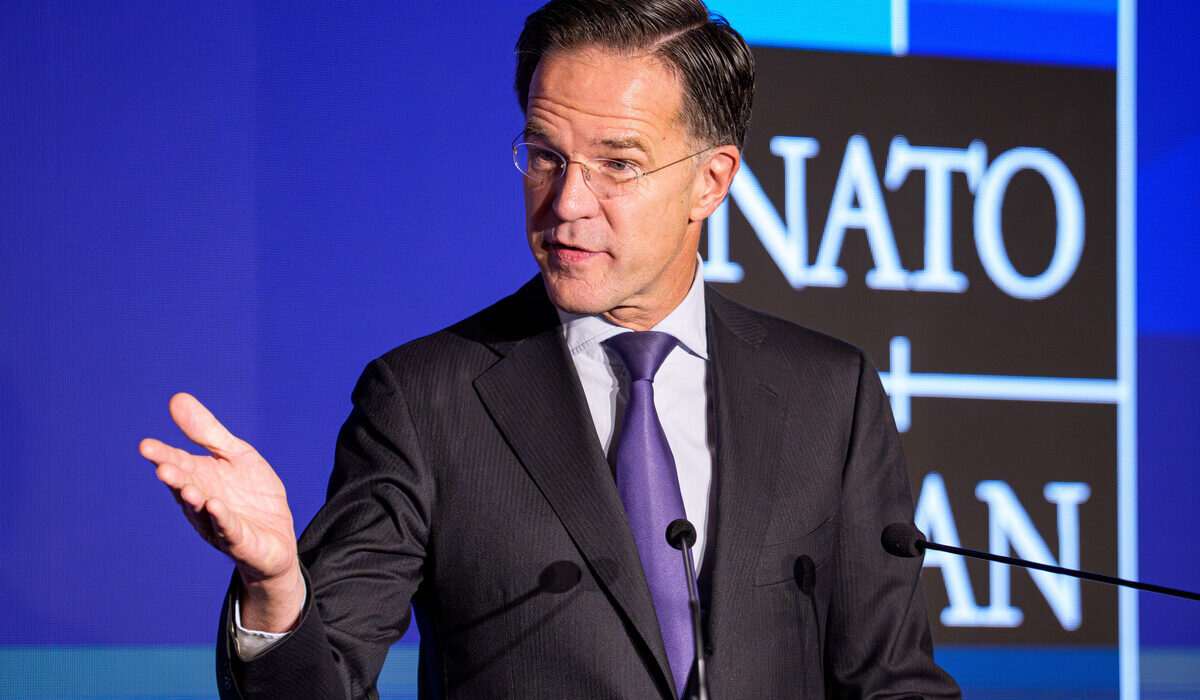
“If Putin attacks, we will first need two or three weeks to agree on who does what, and by the time we reach a decision, he may already have reached Rotterdam.”
With this dramatic warning, NATO Secretary-General Mark Rutte described the dangers he believes could emerge if Europe established a parallel military command structure without clearly defining responsibilities alongside the Alliance.
Speaking on Monday, November 23, 2026, at the annual session of the NATO Parliamentary Assembly in Berlin, Rutte warned that Europe faces an increasingly complex security environment, ranging from sabotage against critical infrastructure to relentless cyberattacks, drone incidents and maritime security threats in the Black Sea.
His central message was unmistakable: Europe must strengthen its defence capabilities rapidly, but without creating competing military structures that could undermine NATO’s ability to respond decisively in a crisis.
“We Are All Targets”: Hybrid Warfare Is Already Threatening Europe
Rutte described a security landscape in which threats are no longer confined to conventional battlefields.
“One day, it could be an arson attack on a factory or drones causing disruption at an airport. The next, it could be sabotage on railways, attacks against merchant ships at sea, or cyberattacks,” he said.
He placed particular emphasis on the growing intensity of digital threats.
“These cyberattacks, at this moment, are relentless,” Rutte warned.
The NATO chief referred to a dangerous incident in Poland on Friday, November 20, as well as several serious developments in the Black Sea in recent weeks.
According to Rutte, NATO is working closely with Romania, Bulgaria and Turkey to address these emerging security challenges.
The concerns extend far beyond military installations.
Gas pipelines, undersea cables, electricity networks, railways, ports and digital communications infrastructure form interconnected systems that support European economies.
An attack on one part of this network could have consequences across multiple countries.
“We are all targets, and we are all affected,” Rutte stressed.
His warning reflects growing concern within NATO that hostile activities below the threshold of conventional warfare could disrupt European societies without triggering an immediate military confrontation.


Russia’s War Machine Will Not Disappear When the Ukraine War Ends
One of Rutte’s most significant warnings concerned Russia’s military-industrial capacity and its potential to remain operational even after a future peace agreement in Ukraine.
“We know that Russia’s war machine is currently operating at full speed. Its war economy continues to grow, and it will not stop when, as we hope, the war against Ukraine eventually ends,” he said.
He added:
“This entire machine exists, and it will continue to exist.”
The remarks highlight NATO’s concern that a ceasefire or negotiated settlement in Ukraine would not automatically eliminate the longer-term military threat posed by Moscow.
Russia’s defence factories, weapons production lines, military infrastructure and mobilisation capabilities could remain operational regardless of developments on the battlefield.
For NATO, the challenge is therefore not limited to supporting Ukraine.
It also involves preparing for a European security environment in which Russia retains substantial military capabilities and the ability to exert pressure on neighbouring countries.
Rutte’s message was that credible deterrence requires sustained investment, military readiness and a stronger European defence industry.
“600 Million Europeans Depend on 340 Million Americans”
Rutte delivered an unusually direct assessment of Europe’s continued dependence on the United States.
“It is somewhat strange that, while 600 million people live on NATO’s European territory, we depend excessively on a country eight hours away by plane, with a population of 340 million, to defend ourselves against 140 million Russians,” he said.
“That is not sustainable in the long term.”
His remarks come amid growing pressure on European governments to assume a larger share of the financial and operational burden of collective defence.
Although European military expenditure has increased, the United States continues to provide capabilities that are essential to NATO operations.
These include strategic airlift, satellite intelligence, advanced command-and-control systems, surveillance assets and other high-end military technologies.
Rutte did not advocate weakening transatlantic ties.
Instead, he argued that European countries must become militarily stronger within NATO, reducing their excessive dependence on Washington while preserving the Alliance’s integrated command structure.
The distinction is crucial.
For Rutte, greater European defence responsibility should reinforce NATO rather than produce a rival military organisation.
“Putin Could Already Be in Rotterdam”: Rutte’s Warning Against a Parallel European Army
The most striking part of Rutte’s intervention concerned proposals for a European army.
The NATO chief warned that establishing a large European military structure alongside national armed forces and NATO could create confusion over command responsibilities and delay decisions during a crisis.
“What I would recommend avoiding is a situation in which all countries have their own armed forces working together within NATO, and on top of that there is also a large European structure,” he said.
He then offered the hypothetical example of a Russian attack.
“If Putin attacks, we will first need two or three weeks to agree on who does what,” Rutte warned, suggesting that the delay could have disastrous consequences.
His reference to Rotterdam was not a prediction that Russian forces would reach the Dutch port city.
It was a hypothetical illustration intended to highlight the dangers of overlapping command structures and unclear military responsibilities.
Rutte pointed to the United States as an example of an integrated military system operating under a unified federal command.
“If there is a European army, there cannot be national armies operating alongside it,” he argued.
He acknowledged, however, that such a transformation would be extremely difficult to achieve in the near future.
“I do not think this will happen anytime soon, because it touches on the fundamental issue of sovereignty.”
The comments expose one of Europe’s central defence dilemmas: how to develop greater strategic autonomy without undermining national sovereignty or NATO’s existing military structures.
NATO Targets Four Million Artillery Shells a Year
Rutte also called for a substantial expansion of defence production, particularly in areas where the war in Ukraine has exposed serious capability gaps.
He identified air defence systems, drones, counter-drone technologies and long-range precision-strike capabilities as urgent priorities.
According to the figures he presented, NATO countries could reach the capacity to produce approximately four million artillery shells annually by 2027.
That would be almost double the production level projected for 2025.
The figures illustrate the scale of NATO’s efforts to expand its industrial base after years in which European defence production was structured around comparatively limited peacetime demand.
The war in Ukraine has demonstrated the enormous consumption of artillery ammunition in prolonged high-intensity warfare.
It has also highlighted the importance of drones, electronic warfare and layered air defence systems.
For European governments, the challenge is no longer simply to allocate more money to defence.
It is to ensure that factories, supply chains and industrial facilities can deliver the necessary equipment quickly enough.
Black Sea Security: Turkey, Romania and Bulgaria on NATO’s Front Line
Rutte’s references to the Black Sea carry particular significance for NATO’s southeastern flank.
The region has become a strategically sensitive area because of Russia’s war against Ukraine, maritime trade routes, energy infrastructure and the proximity of NATO member states.
The Secretary-General highlighted NATO’s cooperation with Turkey, Romania and Bulgaria in responding to security incidents and emerging threats.
Maritime security is a central concern.
Commercial shipping, offshore infrastructure and access to major ports are essential to regional economic stability.
Disruptions in the Black Sea can also affect international grain exports, energy transportation and broader supply chains.
For Greece, developments in the region have important implications through maritime trade, energy markets and the security of southeastern Europe.
The involvement of Turkey also underlines the importance of the Black Sea within NATO’s wider regional defence planning.
“Citizens Must Know What to Do if War Breaks Out”
Rutte’s warnings extended beyond military equipment and defence budgets.
He also emphasised the need to prepare European societies for major emergencies.
“We must strengthen the resilience of our societies. We need to involve citizens,” he said.
He pointed to Norway, Sweden, Denmark and Finland as examples of countries that have developed comprehensive approaches to civil preparedness and national resilience.
These systems combine military readiness with public information, emergency planning and the protection of essential infrastructure.
According to Rutte, citizens in these countries have received guidance on how to respond in the event of war.
“They have made clear to their citizens what they should do if war breaks out: at the very least, not obstruct the armed forces, but instead provide assistance.”
The approach reflects the concept of total defence, in which governments, businesses, public services and citizens all contribute to national resilience.
Such preparations can include maintaining emergency supplies, protecting communications networks, ensuring continuity of essential services and supporting military logistics.
Rutte’s remarks suggest that NATO increasingly views societal resilience as an essential component of deterrence.
A country capable of maintaining essential functions during a crisis is also better positioned to withstand coercion, sabotage and hybrid attacks.
Europe’s Strategic Dilemma: More Autonomy Without Weakening NATO
Rutte’s intervention comes as the European Union continues to debate how to strengthen its strategic autonomy.
The need for greater European defence capabilities is widely recognised, but disagreements remain over how those capabilities should be organised.
Some European initiatives focus on joint procurement, common financing, industrial cooperation and the development of shared military technologies.
Others have raised the possibility of deeper integration, including a European military command or a more ambitious common defence structure.
Rutte’s warning is directed primarily at the danger of duplication.
In his view, Europe should avoid creating parallel institutions that could complicate military decision-making at precisely the moment when speed and clarity are most important.
The issue is particularly relevant for countries belonging to both the European Union and NATO, including Greece.
Protecting borders, maritime routes, energy infrastructure and digital networks requires coordinated defence planning, clear responsibilities and interoperable military capabilities.
For NATO, the priority is to ensure that European defence investments translate into operational strength rather than institutional competition.
The Real Warning: Europe Cannot Afford to Lose Time
Rutte’s speech in Berlin offered a broader warning about the future of European security.
Russia’s military-industrial capacity remains a concern. Hybrid threats are affecting critical infrastructure. Cyberattacks continue to challenge governments and businesses. Meanwhile, European countries remain heavily dependent on American military capabilities.
Against that backdrop, Rutte is urging NATO members to increase defence spending, accelerate weapons production and strengthen civilian preparedness.
But his warning about Rotterdam points to another vulnerability: the risk of political and military paralysis.
A continent with powerful armies, advanced weapons and substantial economic resources could still struggle to respond effectively if responsibilities are unclear and decisions take too long.
Rutte was not predicting an imminent Russian invasion of Western Europe. He was warning that, in a future crisis, Europe’s greatest weakness could be the time lost deciding who is responsible for defending it.
Source: pagenews.gr