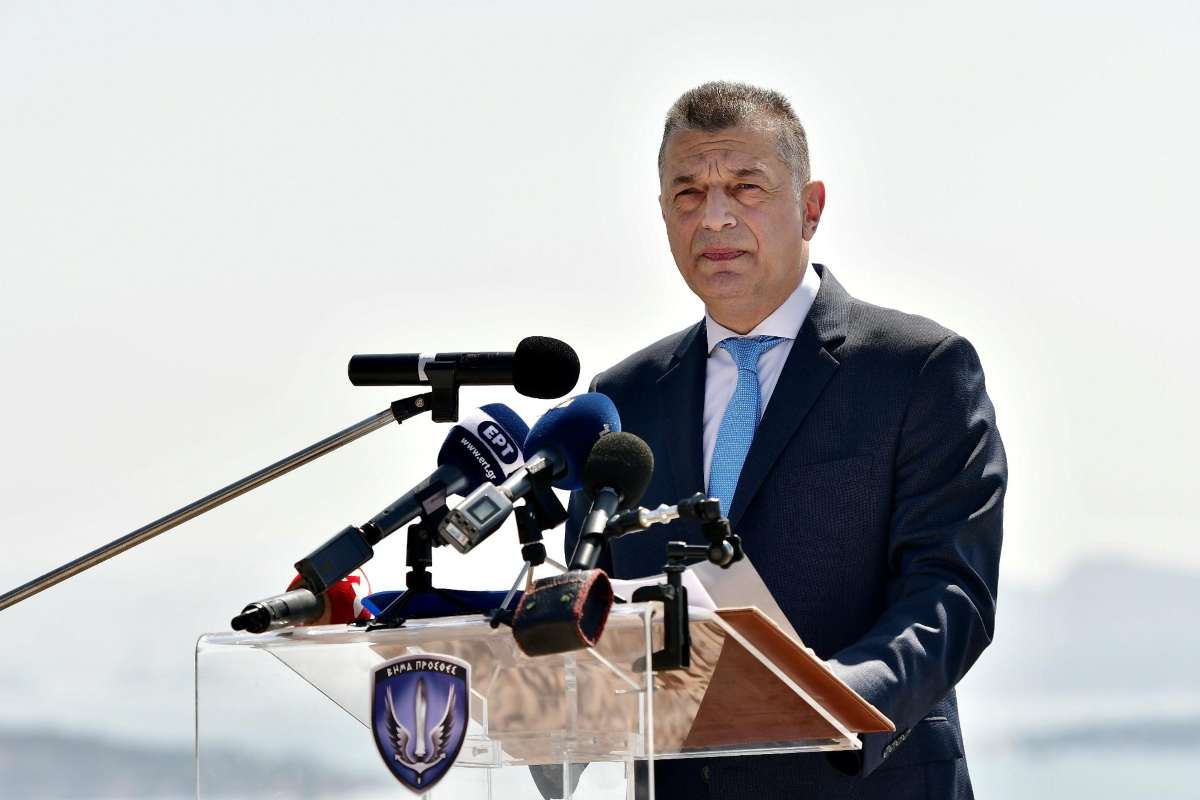
“The islands are under our sovereignty, they have always been under our sovereignty, and they will remain under our sovereignty. Our Armed Forces are there, doing an outstanding job.”
With this unequivocal message, General Alkiviadis Stefanis responded to renewed Turkish claims concerning the demilitarization and sovereignty of Greek islands and islets in the Aegean.
Speaking in a television interview, the former Greek defense minister examined Ankara’s regional ambitions, Greece’s strengthening international partnerships and the increasingly volatile security environment surrounding Europe.
Stefanis also delivered a sharp rebuke to NATO Secretary-General Mark Rutte, arguing that public statements exposing the Alliance’s difficulties in responding rapidly to a potential Russian attack undermine its credibility and deterrence.
From 152 to 500 Islands: Ankara Expands Its Claims
Stefanis stressed that Turkey’s attempts to challenge Greek sovereignty in the Aegean are not new. What has changed, he argued, is the number of islands and islets being incorporated into Turkish claims.
“First of all, this is not the first time they have said this. However, they have increased the number from 152 to 500. They are therefore adding more islands.”
According to Stefanis, Ankara’s increasingly assertive rhetoric reflects its desire to maintain the image of a dominant regional power while addressing domestic political audiences.
“Turkey needs to say something. After everything that has happened, Turkey needs to send a message to everyone — both to the region, demonstrating that it remains the leading power, and to its domestic audience.”
The general also highlighted what he described as a long-term effort to shape the perceptions of younger generations in Turkey regarding the Aegean.
“It also needs to shape the climate and mentality of the next generation. They are taught to believe that Greece has taken their islands. If we look at their school textbooks, this is how they educate their youth.”


COP31’s Disappointing Outcome and Ankara’s Growing Frustration
Stefanis linked Turkey’s renewed assertiveness to the disappointing outcome of the COP31 climate conference in Antalya.
In his assessment, the failure to secure meaningful progress placed additional pressure on the Turkish leadership and raised questions about its diplomatic effectiveness.
“Following the enormous failure of the climate conference in Antalya, participants have started blaming the organizing countries, Australia and Turkey.”
He also criticized the handling of negotiations by the Turkish side, arguing that it had failed to secure sufficient consensus.
“They blame him for never managing to find a text that could be agreed upon, even in principle.”
Stefanis placed Turkey’s latest NAVTEX concerning maritime surveys off Kaş within the same broader context, suggesting that Ankara is increasingly uncomfortable with developments in its immediate neighborhood.
Trump, Erdoğan and Greece’s Strategic Partnerships
Stefanis also addressed Turkish media reports expressing frustration over the strengthening of relations between Washington and Athens, despite President Donald Trump’s relationship with Turkish President Recep Tayyip Erdoğan.
He rejected the suggestion that Greece’s diplomatic and strategic achievements are the result of preferential treatment.
“Greece does not receive anything as a favor. It achieves results through negotiations — not only with the United States, but also with France and Israel.”
His remarks highlight the importance of Greece’s international defense, diplomatic and strategic partnerships, which contribute to strengthening its position in the Eastern Mediterranean.
Athens’ growing network of international cooperation allows Greece to pursue its national interests independently of Ankara’s regional ambitions.
“The Islands Will Remain Under Greek Sovereignty”
The strongest message of Stefanis’ intervention concerned Greek sovereignty in the Aegean.
He dismissed Turkish theoretical arguments and territorial claims as incapable of changing the reality on the ground.
“Professors, strategists and analysts may say all these things about the islands. What matters is that realism and reality tell us that the islands are under our sovereignty, have been under our sovereignty, and will remain under our sovereignty.”
Stefanis paid tribute to both the Greek Armed Forces and the inhabitants of the country’s border islands.
“Our Armed Forces are there, doing an outstanding job. But so are the heroic residents. They are Greeks, they have always been Greeks, and they will remain Greeks.”
He emphasized that Athens should remain focused on established realities rather than being distracted by recurring Turkish claims.
“Various discussions may take place in this area, but what we hold on to is reality and realism.”
The Greece–Cyprus Electricity Interconnection and Turkish Naval Activity
Turning to maritime surveys associated with the electricity interconnection project, Stefanis argued that Greece should continue pursuing its activities without allowing unnecessary militarization of the process.
He referred to the presence of Greek and Turkish naval vessels in the survey area, describing Ankara’s response as part of an established pattern of challenging Greek rights.
“Without militarizing the surveys, we saw that two Greek frigates were there, along with one Turkish frigate.”
According to his account, the Turkish vessel issued a verbal warning, received a response from the Greek side and subsequently departed.
Stefanis compared the incident with recurring Turkish warnings directed at aircraft approaching Greek islands.
“We must not forget that helicopters or aircraft approaching the Aegean islands receive the same message from radars on the Turkish coast: ‘You are entering Turkish airspace.’”
“We ignore it, of course. We do not even respond. We report it to the competent organization because it constitutes a violation of our rights, and we move forward.”
His assessment was clear:
“This is an established Turkish tactic that we assess and analyze. We should not be worried.”
Ukraine’s War Is Expanding Beyond Its Traditional Front Lines
Stefanis expressed concern over developments suggesting that the confrontation between Ukraine and Russia is expanding geographically, with implications for European and Mediterranean security.
Commenting on reports of Ukrainian operations far beyond the main battlefield, including in Libya, he argued that Kyiv is seeking to demonstrate its ability to exert pressure on Russian interests outside the immediate conflict zone.
“Ukraine is demonstrating to Russia that nowhere is entirely safe for you. And that is what we have seen.”
He described the reported developments in Libya as particularly significant, illustrating the increasingly international dimensions of the conflict.
In his assessment, Ukraine’s actions also represent a response to the intensification of Russian attacks in recent days.
The expansion of hostilities beyond Ukraine’s borders raises broader questions about regional stability and the risk of further escalation.


An Eyewitness Account From Kyiv and Odesa
One of the most striking moments of the interview came when Stefanis described his recent experience in Ukraine during Russian attacks.
The former defense minister revealed that he was in the country when strikes occurred, including an incident within a short distance of the Greek embassy.
“I happened to be in Ukraine when the attacks began. I was in Odesa and Kyiv, and one of the strikes was approximately 500 to 600 meters from the Greek embassy.”
He described the emergency alerts sent to mobile phones, the air raid sirens and instructions directing civilians toward shelters.
“Warning messages arrive on everyone’s mobile phones before people go down to the shelters. It is similar to our 112 emergency alert system. Phones ring everywhere, there are sirens and announcements.”
What troubled him most, however, was the extent to which Ukrainian civilians had become accustomed to living under the constant threat of attack.
“After nearly five years, people have become so accustomed to this situation. That is deeply troubling, because many people have also been killed.”
“It shows how little value human life ultimately seems to have. People are being killed next to you, and you continue your life as normal.”
His testimony highlighted the profound human consequences of a prolonged conflict in which extraordinary dangers have become part of everyday life.
Stefanis Rebukes Mark Rutte: “Such Statements Undermine NATO’s Credibility”
Stefanis reserved some of his strongest criticism for NATO Secretary-General Mark Rutte, following remarks concerning the Alliance’s difficulties in coordinating a rapid response to a potential Russian attack.
The general acknowledged that decision-making challenges have existed since NATO’s establishment, given the different national interests and political priorities of its member states.
“The NATO Secretary-General should know that this phenomenon has existed since NATO was established. NATO is an organization that manages the national interests of a large number of countries. Therefore, reaching a decision is not easy.”
However, Stefanis questioned the wisdom of publicly highlighting these institutional weaknesses at a time of heightened geopolitical tension.
“This issue should have been addressed and resolved without such announcements. Statements like these do not help. Above all, you lose your credibility as an organization when you publicly say such things.”
For Stefanis, the priority should be institutional reform and greater operational effectiveness rather than public acknowledgments of the Alliance’s vulnerabilities.
NATO’s Decision-Making Problem: Lessons From Afghanistan
Drawing on his personal experience serving within NATO in 2004, Stefanis recalled the difficulties surrounding negotiations over the International Security Assistance Force (ISAF) in Afghanistan.
“I remember when I was serving at NATO in 2004, we were trying to agree on the plan for ISAF, the force in Afghanistan. People were saying that soldiers were being killed while we were unable to reach an agreement.”
According to Stefanis, negotiations over the rules of engagement took four and a half months because of the different national restrictions and political considerations of participating countries.
“It took four and a half months to agree on the rules of engagement because every country has its own restrictions and political considerations.”
The former defense minister argued that these institutional difficulties must be addressed in light of today’s security challenges.
“As NATO, you can deploy the greatest military force that can be assembled anywhere in the world. Therefore, procedures and institutional arrangements must change.”
His argument highlights the gap between NATO’s considerable military capabilities and the political processes required to mobilize them effectively.
Russia’s Wartime Readiness and Europe’s Strategic Challenge
Stefanis also highlighted the difference between Russia’s prolonged wartime mobilization and the institutional constraints facing European countries.
Russia, he argued, has operated under conditions of military mobilization for several years, making faster and more effective Western coordination increasingly important.
He also discussed the reported incident involving a Swedish military aircraft, suggesting that NATO authorization procedures had taken place without the aircraft ultimately opening fire.
Stefanis raised the possibility of operational or political factors influencing the outcome, without presenting either explanation as an established fact.
He concluded with a warning about the unpredictability of the international security environment:
“The situation is incredibly fluid, and we do not know how it will develop.”
Greece’s Strategic Message: Sovereignty, Partnerships and Deterrence
From Turkish claims in the Aegean to the widening Russia–Ukraine confrontation and NATO’s institutional challenges, Stefanis’ intervention emphasized three fundamental priorities: preparedness, credibility and strategic composure.
For Greece, his message remained unequivocal.
Greek sovereignty is not altered by Ankara’s declarations. International partnerships, diplomatic negotiations and credible defense capabilities remain essential pillars of national security.
At a time of mounting geopolitical uncertainty, Stefanis argues that both Greece and its allies must focus on strengthening their ability to act rather than publicly exposing their vulnerabilities.
Source: pagenews.gr