The New Energy Axis of the Mediterranean Runs Through the 3+1 Partnership
 ΧΡΟΝΟΣ ΑΝΑΓΝΩΣΗΣ 7 '
Πηγή Φωτογραφίας: AP The New Energy Axis of the Mediterranean Runs Through the 3+1 Partnership



In an era of wars, energy uncertainty and great-power competition, the 3+1 framework is evolving into something far bigger than the energy cooperation mechanism that originally brought it together.
When the 3+1 partnership between Cyprus, Greece, Israel and the United States was first established, many viewed it primarily as a regional initiative centered on the natural gas discoveries of the Eastern Mediterranean.
Today, that perception is rapidly changing.
The Eastern Mediterranean has emerged as one of the most strategically important regions in the world.
Russia’s war in Ukraine reshaped Europe’s energy calculations.
Instability continues to dominate large parts of the Middle East.
Critical maritime routes face mounting security risks.
And energy security has returned to the top of the strategic agenda for governments across the Western world.
Against this backdrop, the 3+1 framework is acquiring geopolitical significance far beyond its original mandate.
The Eastern Mediterranean as Europe’s Next Energy Bridge
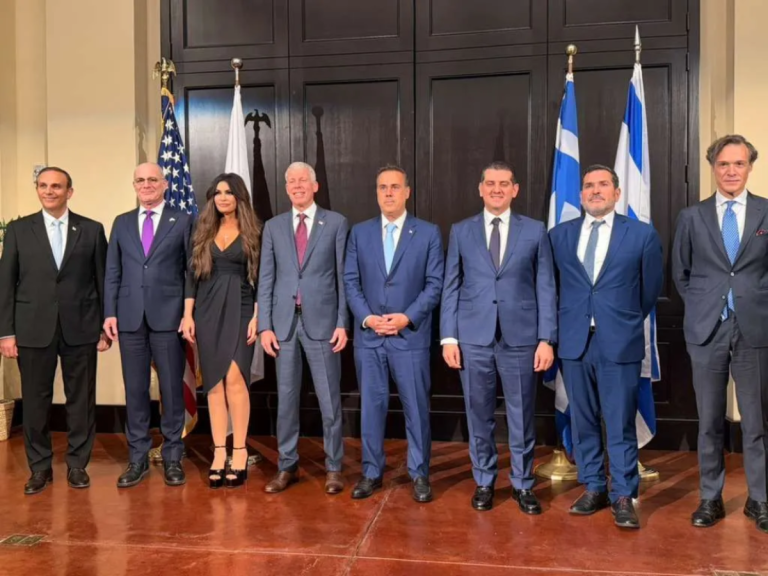
Speaking at the ministerial meeting in Houston, Cyprus Energy Minister George Papanastasiou’s successor, Michalis Damianos, highlighted a reality that is increasingly shaping regional strategy.
The Eastern Mediterranean is no longer viewed simply as a region containing energy resources.
It is increasingly seen as a critical contributor to the diversification of energy sources and supply routes for Europe and its allies.
This distinction matters.
For the first time in decades, Europe is actively searching for alternative energy corridors that reduce dependence on traditional suppliers and vulnerable geopolitical chokepoints.
The Eastern Mediterranean has the potential to become part of that solution.
Happening now: the 3+1 🇨🇾 🇮🇱 🇬🇷 🇺🇸 Energy Ministerial Meeting is under way in Houston, TX@MichaelDamianos @letymbiotis @ecsavva @CyprusMFA @cyMECI pic.twitter.com/PKWIx3OQjw
— Cyprus Embassy in US (@CyprusinUSA) June 11, 2026
The 20 Trillion Cubic Feet Opportunity
At the center of this emerging strategy stands Cyprus.
Since 2011, exploration activities in Cyprus’ Exclusive Economic Zone have resulted in six confirmed natural gas discoveries: Aphrodite, Cronos, Zeus, Calypso, Glaucus and Pegasus.
Collectively, these fields are estimated to contain approximately 20 trillion cubic feet of natural gas.
Those numbers are large enough to transform Cyprus from an energy-importing island state into a significant regional energy player.
Equally important is the presence of major international energy companies.
American giants such as Chevron and ExxonMobil have invested heavily in Cypriot offshore projects.
These companies are not simply investing in gas reserves.
They are investing in long-term geopolitical confidence and regional stability.
Their presence sends a powerful signal about the strategic importance of the Eastern Mediterranean.
Connectivity Is the New Energy Frontier
The next chapter of the region’s energy story is not just about production.
It is about connectivity.
Energy resources only acquire strategic value when they can reach consumers efficiently and securely.
This is why the Great Sea Interconnector has become one of the most important projects in the region.
The electricity link connecting Cyprus, Greece and Israel is far more than an infrastructure project.
It is a geopolitical platform.
For Cyprus, it represents the end of decades-long energy isolation.
For Israel, it provides a direct connection to the European energy market.
For Europe, it creates a new channel for integrating the Eastern Mediterranean into its broader energy architecture.
The project embodies a larger strategic vision: connecting the Middle East and Europe through infrastructure, resilience and shared interests.
America’s Strategic Return
Perhaps the most significant development is the growing role of the United States.
Washington no longer sees the Eastern Mediterranean solely through the lens of regional energy development.
It increasingly views the region as a critical arena of strategic competition and economic opportunity.
American support for infrastructure projects, investment by U.S. energy companies, and the launch of the Eastern Mediterranean Energy Center in Houston all point to a deeper strategic commitment.
The United States is helping build a pro-Western energy ecosystem that links Europe, the Eastern Mediterranean and North America.
In an increasingly fragmented world, such networks are becoming assets of strategic value.
Energy Security Means Infrastructure Security
The concept of energy security has evolved dramatically.
It is no longer limited to production volumes and supply contracts.
Today, it includes the protection of critical infrastructure.
Cyberattacks.
Hybrid threats.
Sabotage of pipelines.
Attacks on ports and LNG terminals.
Threats to subsea cables and energy transmission systems.
Recent global events have demonstrated that disruptions to energy infrastructure can produce consequences comparable to major military operations.
As a result, cooperation within the 3+1 framework is expanding beyond energy development into security coordination and resilience planning.
This evolution reflects the realities of modern geopolitics.
From Diplomacy to Deliverables
A central message emerging from the Houston ministerial meeting is that the era of declarations is giving way to the era of implementation.
Political commitments must now translate into projects.
Investments.
Infrastructure.
Technology partnerships.
Research cooperation.
And measurable outcomes.
The launch of the Eastern Mediterranean Energy Center is a clear example of this transition.
The initiative aims to bring together governments, universities, research institutions and private-sector actors under a common platform for innovation and collaboration.
Its objective is not simply dialogue.
Its objective is execution.
A New Geopolitical Map of the Mediterranean
The broader picture is becoming increasingly clear.
The Eastern Mediterranean is no longer just an energy story.
It is becoming a strategic crossroads where European energy security, American geopolitical engagement, Israeli innovation and the energy potential of Cyprus and Greece converge.
That is why the 3+1 framework matters.
It is not only about natural gas.
It is not only about electricity interconnections.
It is not only about investment.
It is about shaping the future strategic architecture of the Eastern Mediterranean.
As geopolitical competition intensifies and energy security remains a defining challenge of the 21st century, the partnership between Cyprus, Greece, Israel and the United States is evolving into one of the most consequential regional alignments in the wider Mediterranean.
The question is no longer whether the Eastern Mediterranean matters.
The question is how much influence it will exert on the global energy and geopolitical landscape in the decades ahead
Source: pagenews.gr
Διαβάστε όλες τις τελευταίες Ειδήσεις από την Ελλάδα και τον Κόσμο