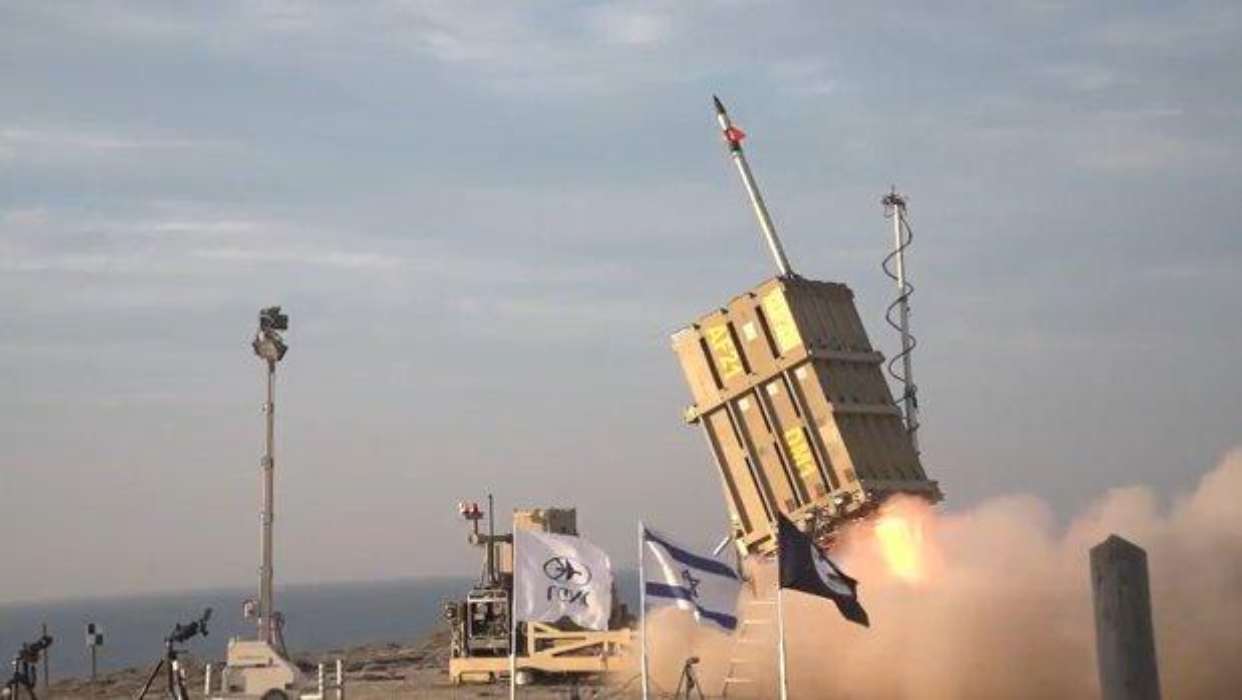
The signatures are in, and the Achilles Shield is no longer a plan on paper.
Greece and Israel signed the agreement in Tel Aviv on Monday, August 31, for a program worth roughly €3 billion, launching the implementation of a new multi-layered Greek air and missile defense architecture.
The Israeli Ministry of Defense described it as the largest defense export agreement in the history of Greek-Israeli relations and one of the largest defense deals ever signed by Israel.
The agreement was signed by senior officials from Greece’s General Directorate for Defense Investments and Armaments and Israel’s Ministry of Defense, with leading executives from Rafael, Israel Aerospace Industries and the Israeli defense establishment also participating.
But the real significance of the deal goes far beyond its price tag.
For the first time, Greece is attempting to turn multiple sensors, missiles, aircraft, ships and electronic warfare systems into one integrated combat network.
That is the strategic transformation at the heart of Achilles Shield.
What Greece Is Actually Buying
The core systems officially included in the agreement are:
- David’s Sling, developed by Rafael, for the upper layer of protection.
- BARAK MX, developed by Israel Aerospace Industries.
- SPYDER, also developed by Rafael.
- MMR multi-mission radars from ELTA Systems, an IAI subsidiary.
- A new national Command & Control system, to be developed under Rafael’s leadership.
The last element may ultimately prove to be the most important.
Missiles destroy targets.
But the network decides which target must be engaged, when, and with which weapon.
That is where modern air defense is won or lost.


From Missiles to a National “Nervous System”
Until now, Greek air defense has relied on different generations and families of systems, each with its own sensors, command structures and operational logic.
Achilles Shield is designed to change that.
The objective is not simply to add three new missile families.
It is to create a common battlespace in which the sensor that detects a target does not necessarily have to belong to the weapon system that eventually destroys it.
One radar may detect the incoming threat.
Another sensor may confirm its trajectory.
The Command & Control system can then classify the threat, calculate the priority and assign the most appropriate interceptor.
This is the essence of network-centric warfare.
Why C5ISRT Changes the Doctrine
Greek Defense Minister Nikos Dendias has described the broader architecture through the concept of C5ISRT — Command, Control, Compute, Communicate, Cyber, Intelligence, Surveillance, Reconnaissance and Targeting.
Behind the acronym lies a simple operational objective:
dramatically reduce the time between detecting a threat and neutralizing it.
Data gathered from radars, aircraft, warships, drones, satellites and other sensors must be converted almost instantly into a shared operational picture.
That picture must then lead to a firing decision.
In modern warfare, seconds have effectively become a weapon system of their own.
The Threat Is No Longer Just the Fighter Jet
There is another reason Greece needs a fundamentally different architecture.
The threat environment has changed.
A modern adversary can simultaneously deploy fighter aircraft, ballistic missiles, cruise missiles, UAVs, loitering munitions and large numbers of inexpensive drones.
Israel’s Ministry of Defense has explicitly stated that the Greek system is intended to confront a broad spectrum of threats, ranging from ballistic missiles and aerial attack to hostile UAVs.
This matters because the purpose of a saturation attack is not necessarily for every incoming weapon to be highly destructive.
Its purpose is to overwhelm the defender.
If dozens or hundreds of different threats arrive at the same time, the attacker attempts to exhaust sensors, interceptors, decision-making capacity and reaction time.
That is precisely why layered defense matters.
The Cost-Per-Kill Problem
There is also an economic logic to modern air defense.
A country cannot sustainably shoot down every inexpensive drone with an interceptor worth hundreds of thousands or millions of euros.
The cost of each engagement has become strategically important.
Different defense layers, electronic warfare systems and automated threat allocation allow the network to choose the most cost-effective response.
A small UAV requires one solution.
A cruise missile requires another.
A ballistic missile requires something far more capable.
Achilles Shield is designed to place all those possible responses under a unified command architecture.
David’s Sling: The Upper Layer
David’s Sling, with Rafael as the principal contractor, sits at the higher end of the new Greek defense architecture.
It is designed to strengthen protection against more demanding missile threats and provide an additional layer against ballistic and other high-end aerial threats.
Its significance lies not simply in replacing older systems.
It adds a level of protection that Greece increasingly needs as ballistic and precision-strike weapons become central to regional military planning.


BARAK MX: Flexibility in the Middle Layer
The BARAK MX system from Israel Aerospace Industries forms another major pillar.
Its strength is its flexible, networked architecture and its ability to use different interceptor types against different aerial threats.
Integrated with advanced sensors and the central Command & Control system, BARAK MX is expected to provide a highly adaptable intermediate layer.
It is not meant to compete with David’s Sling.
It is designed to complement it.
SPYDER: The Lower Layer Battle
The SPYDER family developed by Rafael will reinforce the shorter-range layer.
This is particularly important for defending critical infrastructure, military bases and sensitive installations against aircraft, UAVs and other aerial threats.
Modern layered defense works precisely because no single interceptor is expected to defeat everything.
Each layer has its own role.
Together, they create redundancy.
If one line of defense fails, another remains.
ELTA’s MMR Radars: First You Have to See
The fourth crucial element is the MMR multi-mission radar family produced by ELTA Systems.
This is where air defense begins.
The most advanced interceptor in the world is useless if the network does not detect the incoming target early enough and generate a reliable track.
The MMR sensors will feed the national Command & Control architecture with real-time data, helping create a shared picture of incoming threats.
In modern air defense, the sequence is simple:
detect, classify, decide, engage.
The missile is only the final step.
Rafale, F-16 Viper, Belharra — and Eventually F-35
The deeper potential of Achilles Shield lies in its future interaction with the rest of Greece’s rapidly modernizing armed forces.
Greece already operates Rafale fighters and upgraded F-16 Vipers, is receiving FDI/Belharra frigates, and has set in motion the acquisition of F-35s.
These platforms should no longer be viewed as isolated investments.
The strategic objective is for them to contribute to — and exploit — a common operational picture wherever interoperability, security protocols and system architecture allow.
This is the core ambition behind Greece’s broader Agenda 2030 defense modernization:
the platform must stop operating alone and become a node inside a network.
Achilles Shield Extends Into Space
The same logic explains why Greece’s new defense architecture increasingly includes the space domain.
Secure satellite communications, microsatellites and future observation capabilities can significantly extend situational awareness.
For a country with Greece’s geography, that matters enormously.
Space-based capabilities provide greater depth of vision and more resilient communications across land, sea and air forces.
The objective is not simply to add satellites to the inventory.
It is to incorporate them into the same chain that links detection, decision-making and engagement.
Greece Is Not Israel
This is a crucial distinction.
Greece cannot simply copy Israel’s defense model.
Its geography is fundamentally different.
Greece must protect a continental mainland, hundreds of islands, mountainous terrain, large maritime spaces, air bases, naval installations, energy infrastructure and strategic facilities spread across a very wide area.
For that reason, the popular phrase “Greek Iron Dome” is convenient but technically misleading.
Iron Dome is not part of the official list of systems included in the agreement.
The Greek architecture is based on David’s Sling, BARAK MX, SPYDER, ELTA radars and a national C2 system.
It is therefore a broader national air and missile defense network, not a copy of one specific Israeli system.
The Message to Turkey
The regional dimension is impossible to ignore.
Turkey has spent years investing heavily in drones, ballistic missiles, cruise missiles, electronic warfare and an increasingly sophisticated domestic defense industry.
Greece’s answer cannot rely exclusively on acquiring more fighter aircraft.
It needs the ability to protect air bases, naval facilities, command centers, critical infrastructure and strategic sites against coordinated attacks.
Achilles Shield therefore strengthens deterrence by making any attempt to strike critical Greek assets more difficult, more expensive and less likely to achieve its intended result.
That is the real logic of deterrence.
Not eliminating the threat.
But reducing the adversary’s confidence that the attack will succeed.
The Other Strategic Dimension: Greece–Israel
The agreement also has clear geopolitical significance.
Israel has described Greece as a key strategic partner in the Eastern Mediterranean, while the deal itself is the largest defense export agreement ever concluded between the two countries.
That level of cooperation goes far beyond a one-off arms sale.
Air defense is among the most sensitive areas of military technology.
Choosing Israeli systems as the backbone of such a critical Greek architecture creates a relationship likely to last for decades through maintenance, software, upgrades, training, spare parts and future technological evolution.
The €700 Million Opportunity for Greek Industry
The second major battle will be fought inside Greece itself:
the battle for domestic industrial value.
Greek participation in the program has been set at a minimum of around 25%, which could translate into more than €700 million in work for domestic companies.
The real value, however, should not be measured only in euros.
The strategic benefit will depend on whether Greek companies acquire technology, engineering knowledge, production capacity and long-term maintenance expertise that remain in the country after the program is delivered.
That is the difference between simply purchasing weapons and building an industrial defense ecosystem.
Source Code: The Detail That Could Matter Most
One of the most important ambitions associated with Agenda 2030 is access to source code and system-level technological know-how.
Dendias has repeatedly argued that Greece should no longer remain merely a passive buyer and user of foreign military systems.
But an important distinction remains.
Public references to “access to source code” do not yet specify exactly which subsystems are covered, what level of access Greece will receive, or what rights it will have to modify, integrate or independently evolve particular software components.
Those details will matter enormously.
True technological sovereignty does not mean merely being able to operate a system.
It means having the ability, where contractually permitted, to maintain it, adapt it and develop it further.
35 Months: Now the Hard Part Begins
The full deployment of Achilles Shield is expected within roughly 35 months, with capabilities entering service gradually.
That means today’s signing is not the end of the program.
It is the beginning.
Systems must be produced and installed.
Personnel must be trained.
Sensors must be linked.
Communications must be secured.
Software must be certified.
Different platforms must prove that they can exchange data reliably and operate as a single architecture.
And this integration process can be more difficult than purchasing the weapons themselves.
The Bigger Picture: From Platforms to Networks
That is ultimately why Achilles Shield matters so much.
Greece has already invested billions in Rafale, F-16 Viper, FDI frigates and eventually F-35s.
But warfare in the 2030s will not necessarily be decided by who possesses the best individual platform.
A decisive advantage increasingly belongs to the force that can make all of its platforms see the same battle.
Detect first.
Share information faster.
Identify which threat matters most.
Choose the best and most cost-effective interceptor.
Complete the kill chain before the adversary can react.
Achilles Shield therefore should not be measured only in missiles or billions of euros.
It is Greece’s attempt to build a single national “nervous system” for defense.
If the integration works as intended, if Greek industry gains meaningful technological participation and if the country secures genuine operational autonomy, then the Tel Aviv signatures will represent much more than another major procurement.
Source: pagenews.gr