Mitsotakis From Kastellorizo: “Stability Does Not Mean Retreat” — Greece’s New Shield Takes Shape
 ΧΡΟΝΟΣ ΑΝΑΓΝΩΣΗΣ 7 '
Πηγή Φωτογραφίας: Greek Prime Minister Office--Papamitsos//Mitsotakis From Kastellorizo: “Stability Does Not Mean Retreat” — Greece’s New Shield Takes Shape



From Kastellorizo, only a short distance from the Turkish coast, Kyriakos Mitsotakis chose to restate one of the central principles of his government’s foreign-policy doctrine.
Greece wants stability in the Eastern Mediterranean and functional relations with its neighbours. But, he stressed, de-escalation should not be confused with strategic retreat.
“Our country threatens no one. It seeks stability through functional relations based on international law. Stability does not, under any circumstances, mean retreat, nor does it mean tolerance of faits accomplis.”
Coming from Kastellorizo, the statement carries particular geopolitical weight.
Kastellorizo gives the message added significance
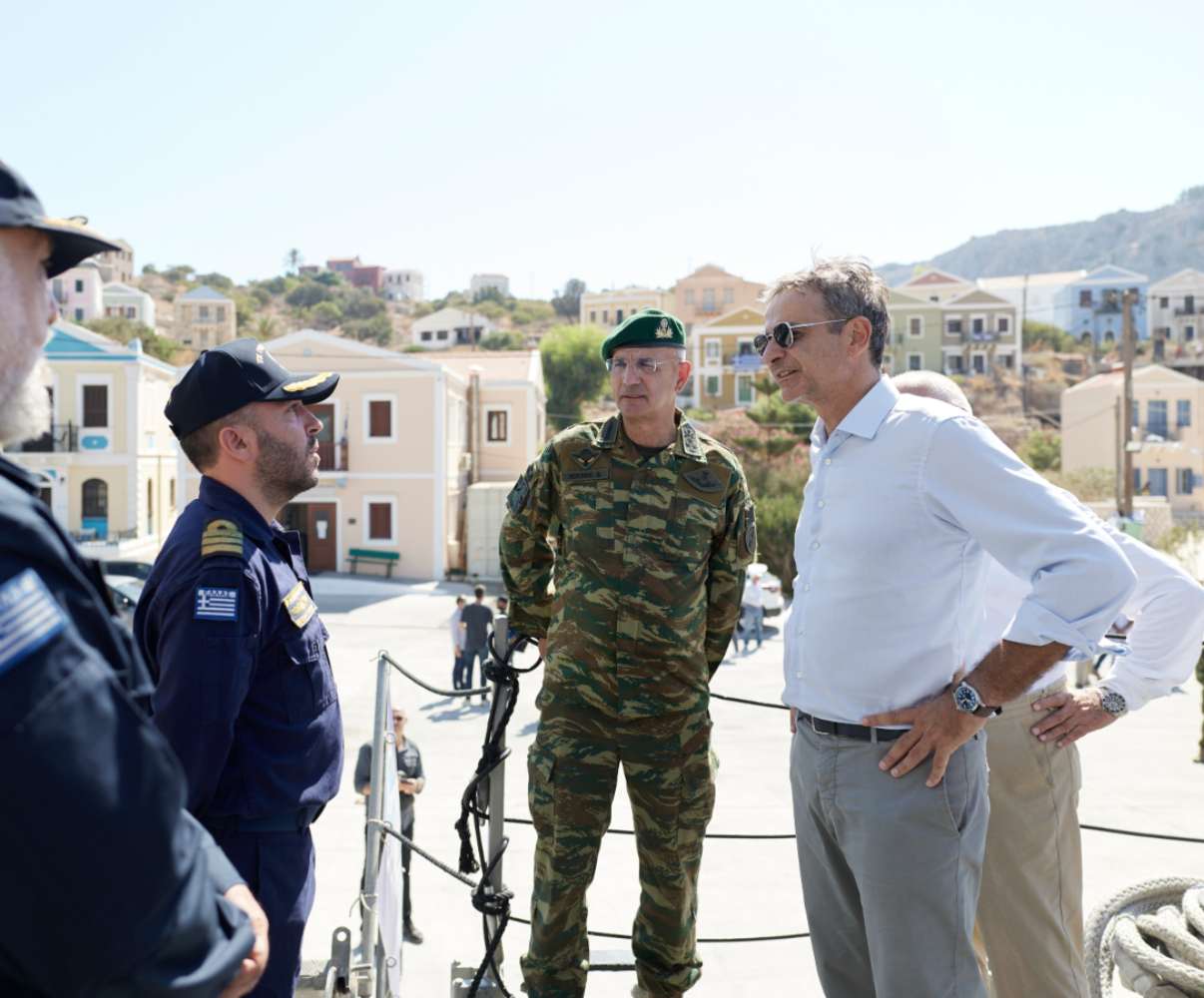
The prime minister’s visit to Kastellorizo, Ro and Strongyli combines symbolism with a broader government strategy for Greece’s remote eastern islands.
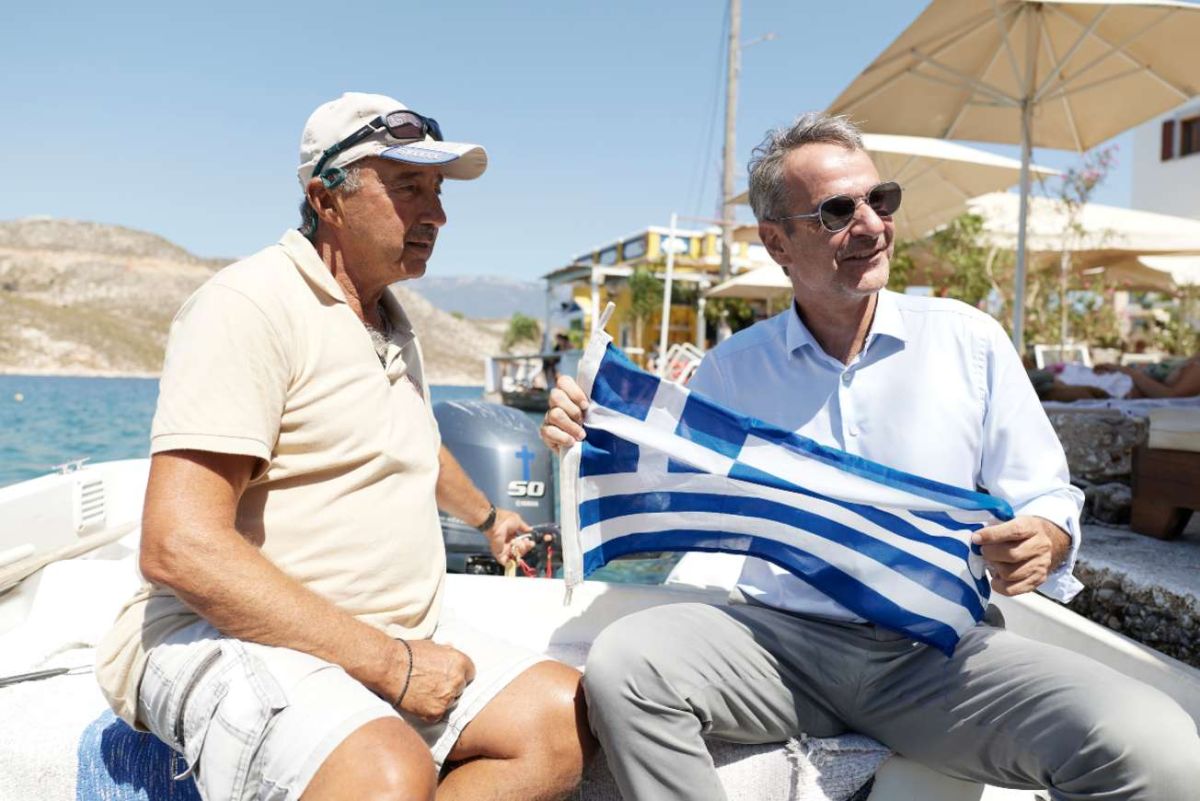
Mitsotakis paid tribute to Despina Achladioti, the legendary “Lady of Ro,” who raised the Greek flag on the tiny island for decades, while stressing that supporting border communities cannot stop at symbolism.
“Support for our border islands cannot be limited to symbolism or good intentions. It requires concrete projects and permanent incentives.”
The government’s argument is that national presence in the Aegean is sustained not only through military deterrence, but through infrastructure, public services, economic activity and permanent population.
Mitsotakis points to Greece’s strategic gains
In his review of foreign policy, Mitsotakis highlighted a series of decisions that he says demonstrate a more active Greek strategy.
These include maritime delimitation agreements with Italy and Egypt, Greece’s maritime spatial planning and the extension of territorial waters in the Ionian Sea.
He also placed military modernisation within the same strategic framework, pointing to Rafale fighter jets, Belharra frigates and the acquisition of two Italian FREMM frigates of the Bergamini class.
The message is that diplomacy and deterrence are not competing strategies.
Athens wants both.

The “Achilles Shield” moves from planning to implementation
The centrepiece of the prime minister’s defence message, however, is the “Achilles Shield.”
Mitsotakis said the ambitious air-defence project is moving from planning into implementation following the relevant interstate agreement with Israel.
“One of the most ambitious armament programmes of recent years is the ‘Achilles Shield,’ which is moving from the drawing board to implementation.”
The objective is to create a modern, multi-layered defence architecture capable of responding to an increasingly complex threat environment, including aircraft, missiles and unmanned systems.
For Greece, this is more than another weapons procurement programme.
It represents an attempt to reorganise the country’s air and missile defence around a more integrated architecture.
The crucial Greek component: control of the software
Mitsotakis also addressed one of the most sensitive questions surrounding such a technologically complex defence system: dependence on foreign technology.
According to the prime minister, the central command-and-control software will be Greek.
“For those who are concerned, the central command-and-control software will be Greek. It will be produced by the Greek companies participating in the programme and, as agreed, they will receive the operational and technological support required to develop Greek source code adapted to Greek operational requirements.”
That element could prove strategically important.
Control over source code and command architecture affects not only industrial participation but also operational autonomy, future upgrades and the ability to adapt a defence system to national requirements without total dependence on an external supplier.
A different role for Greece’s defence industry
The government is therefore trying to connect the country’s large defence procurement cycle with the rebuilding of domestic technological and industrial capacity.
For decades, one of the central criticisms of Greek defence spending was that billions could be spent abroad without producing a comparable technological dividend at home.
The “Achilles Shield” is being presented as an opportunity to change that model.
If Greek companies secure meaningful access to technology, software development and long-term support, the programme could become not only an air-defence project but also an industrial-policy instrument.
The real test will be the depth of that technology transfer and the share of high-value work ultimately performed inside Greece.
Rafale, Belharra, FREMM — and now the Shield
The broader picture emerging from Mitsotakis’ remarks is one of layered military modernisation.
Rafale fighters strengthened the Hellenic Air Force.
Belharra frigates are designed to significantly upgrade naval air defence and high-end warfare capabilities.
The planned addition of Italian FREMM vessels further expands the modernisation of the fleet.
The “Achilles Shield” is intended to add another dimension: a more integrated protective umbrella over Greek territory and critical infrastructure.
Together, these programmes form the military side of Athens’ answer to a rapidly changing security environment in the Eastern Mediterranean.
The message to Ankara — without naming Turkey
Mitsotakis did not need to explicitly name Turkey for the geopolitical meaning of his remarks to be clear.
Kastellorizo has long occupied a central place in the Greek-Turkish dispute over maritime zones in the Eastern Mediterranean.
Athens maintains that sovereignty and sovereign rights are not negotiable and that maritime delimitation must be addressed under international law and the Law of the Sea.
Turkey takes a sharply different view of how islands should affect maritime boundaries.
Against that backdrop, the phrase “stability does not mean retreat” becomes more than domestic political rhetoric.
It is a message that Athens intends to maintain dialogue with Ankara while simultaneously strengthening its military position.
The end of the “calm waters” doctrine? Not exactly
The prime minister is not abandoning the policy of reducing tensions with Turkey.
Instead, he is trying to redefine what that policy means.
The government’s position is that “calm waters” should reduce the risk of accidental escalation and create room for diplomacy — but should not freeze Greek initiatives or constrain defence planning.
That distinction has become increasingly important as the government faces domestic criticism that de-escalation could gradually turn into strategic passivity.
Mitsotakis’ response is essentially that dialogue takes place alongside deterrence, not instead of it.
From Kastellorizo, a doctrine of dialogue backed by deterrence
This is ultimately the larger political message behind the prime minister’s intervention.
Greece wants to avoid a permanent cycle of confrontation in the Aegean and Eastern Mediterranean.
But Athens is simultaneously investing heavily in its armed forces, developing new defence infrastructure and seeking greater technological autonomy.
Mitsotakis is therefore trying to establish a doctrine with two pillars: diplomatic stability and credible military deterrence.
And from Kastellorizo, he chose the sentence that best encapsulates it:
“Stability does not, under any circumstances, mean retreat, nor does it mean tolerance of faits accomplis.”
In the Eastern Mediterranean, geography gives those words considerably more weight.
Source: pagenews.gr
Διαβάστε όλες τις τελευταίες Ειδήσεις από την Ελλάδα και τον Κόσμο