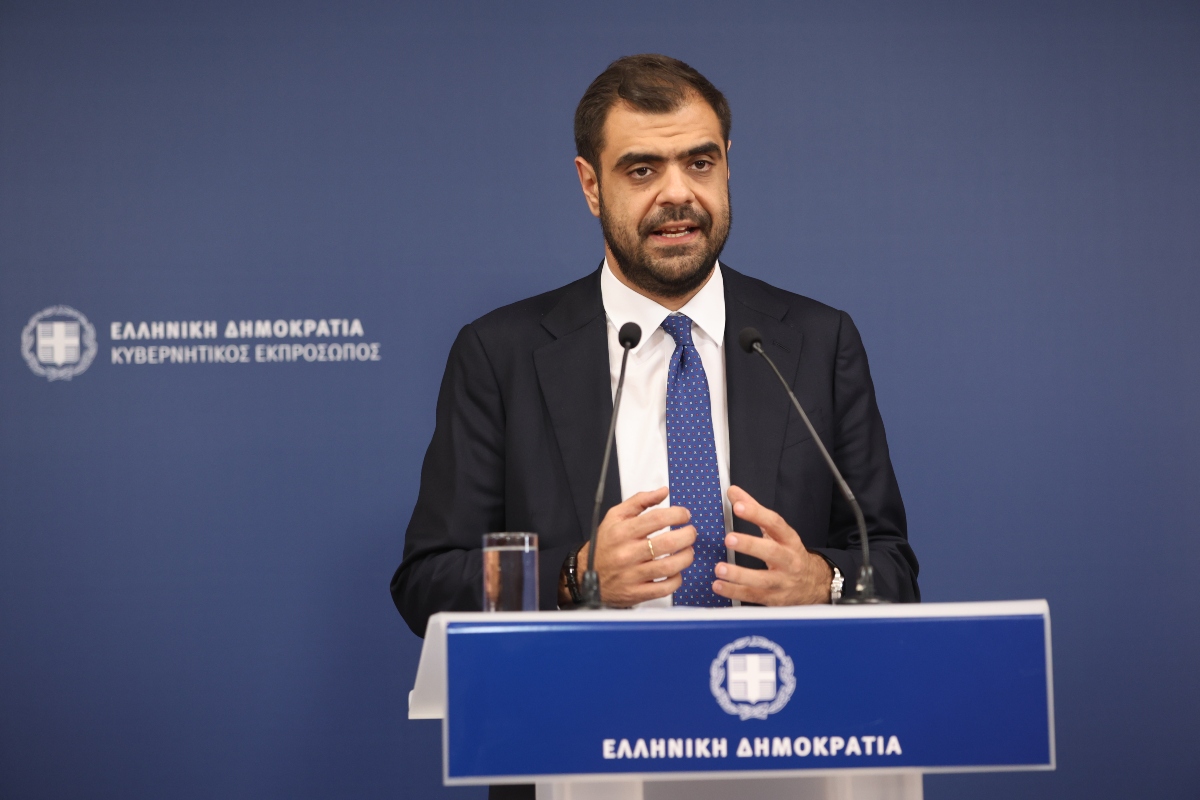
A clear message to Ankara that Greece remains committed to dialogue but will not allow it to become a mechanism limiting its sovereign rights was delivered by government spokesperson Pavlos Marinakis, with the Greece–Cyprus electricity interconnector at the heart of his intervention.
As tensions between Greece and Turkey return to the spotlight, Marinakis sought to dismantle the perception that the so-called “calm waters” of recent years constitute the central doctrine of Athens’ foreign policy.
“The foreign policy of our country under Kyriakos Mitsotakis does not carry the title ‘calm waters’,” Marinakis said in an interview with SKAI.
The message was unequivocal: dialogue with Turkey remains desirable, but it does not imply concessions on Greece’s established national positions.
“Dialogue, But No Retreat From Our National Positions”
Marinakis rejected criticism that the de-escalation pursued between Athens and Ankara amounted to a more accommodating Greek policy towards Turkey.
“Yes, we seek dialogue and we continue to seek dialogue. For us, dialogue can produce positive results, but that does not mean that we are discussing any retreat from established national positions,” he said.
The government is effectively seeking to redefine the meaning of the Greek-Turkish de-escalation.
From Athens’ perspective, “calm waters” are the desirable result of maintaining open channels of communication — not a strategic objective that overrides other aspects of Greek foreign policy.
The Cable Becomes the Critical Test
The Greece–Cyprus electricity interconnector is now emerging as a practical test of that doctrine.
Marinakis was categorical that there is no question of seeking permission from another country before proceeding with the project.
“There is absolutely no issue of permission,” he said, rejecting the notion that either the contractor or the Greek side must secure Turkish consent before carrying out the planned works.
His intervention is particularly significant because Foreign Minister Giorgos Gerapetritis has sent essentially the same message: Greece will not ask Turkey for permission to proceed with the cable.
The coordinated statements from the Foreign Ministry and the government spokesperson establish a clear line from Athens.
“We Will Not Rewrite International Law”
Marinakis went further by placing international law at the centre of Greece’s position.
“Whatever international law provides for will be done. International law does not provide for anything of that kind, and this is not the first such project to move forward. Therefore, we are not going to rewrite international law or change it because another country may not like it,” he said.
He added:
“The project will proceed as planned and in accordance with the provisions of international law.”
The wording is politically important.
Athens is signalling that it does not accept the proposition that Turkish objections can, by themselves, establish a right of consent over a project that Greece maintains is being implemented in accordance with international law.
From “Calm Waters” to an Active Foreign Policy
The government spokesperson described the Mitsotakis administration’s approach as a “proud, active foreign policy that produces results”, rejecting accusations of excessive accommodation towards Ankara.
“In seven years, under this government, things have moved forward that our predecessors could not have imagined over entire decades,” Marinakis argued.
The government points to a broader record to support that position: the strengthening of Greece’s Armed Forces, maritime delimitation agreements with Italy and Egypt, the expansion of territorial waters in the Ionian Sea to 12 nautical miles and the deepening of strategic partnerships with countries across the Eastern Mediterranean and beyond.
For the government, these developments form part of an attempt to demonstrate that dialogue with Turkey has not prevented Greece from pursuing a more assertive diplomatic and defence strategy.
Renewed Tensions Put the Athens–Ankara Strategy to the Test
The intervention comes at a sensitive moment.
Renewed Turkish challenges and disputes in the Eastern Mediterranean have once again raised questions about whether the period of relative Greek-Turkish calm can be sustained.
That is precisely why the electricity cable has acquired significance extending well beyond energy policy.
The project has become a practical test of the Greek strategy: whether Athens and Ankara can maintain political dialogue while Greece proceeds with activities it considers lawful under international law even when Turkey objects.
The answer from Athens, at least publicly, is increasingly clear.
An Energy Project With Geopolitical Weight
The Greece–Cyprus electricity interconnector is not merely another infrastructure project.
Its strategic significance stems from its potential to strengthen Cyprus’ integration into the European electricity system and deepen energy connectivity in the Eastern Mediterranean.
That also explains why disputes surrounding its implementation have acquired geopolitical significance.
For Athens, allowing objections by a third country to determine whether such infrastructure can proceed would create a precedent extending far beyond the cable itself.
The issue therefore touches on energy security, maritime jurisdiction and the wider balance of power in the Eastern Mediterranean.
Athens’ Message: Dialogue Without a Turkish Veto
The emerging Greek position can be summarized in one principle: dialogue does not give Turkey a veto over Greek policy.
Athens is not abandoning communication with Ankara and does not present renewed confrontation as desirable.
At the same time, the government is signalling that de-escalation cannot mean self-restraint whenever Turkey objects to a Greek initiative.
That distinction lies at the heart of Marinakis’ intervention.
The “calm waters” remain useful as long as they reduce the risk of confrontation and create room for diplomacy.
But according to the government, they are a means of managing Greek-Turkish relations — not the doctrine governing Greek foreign policy.
And the Greece–Cyprus electricity interconnector is becoming the case through which that distinction will be tested in practice.
The next question is therefore no longer what Athens says about the cable. It is whether the project can advance on the ground while Greece simultaneously keeps the diplomatic channel with Ankara open.
Source: pagenews.gr