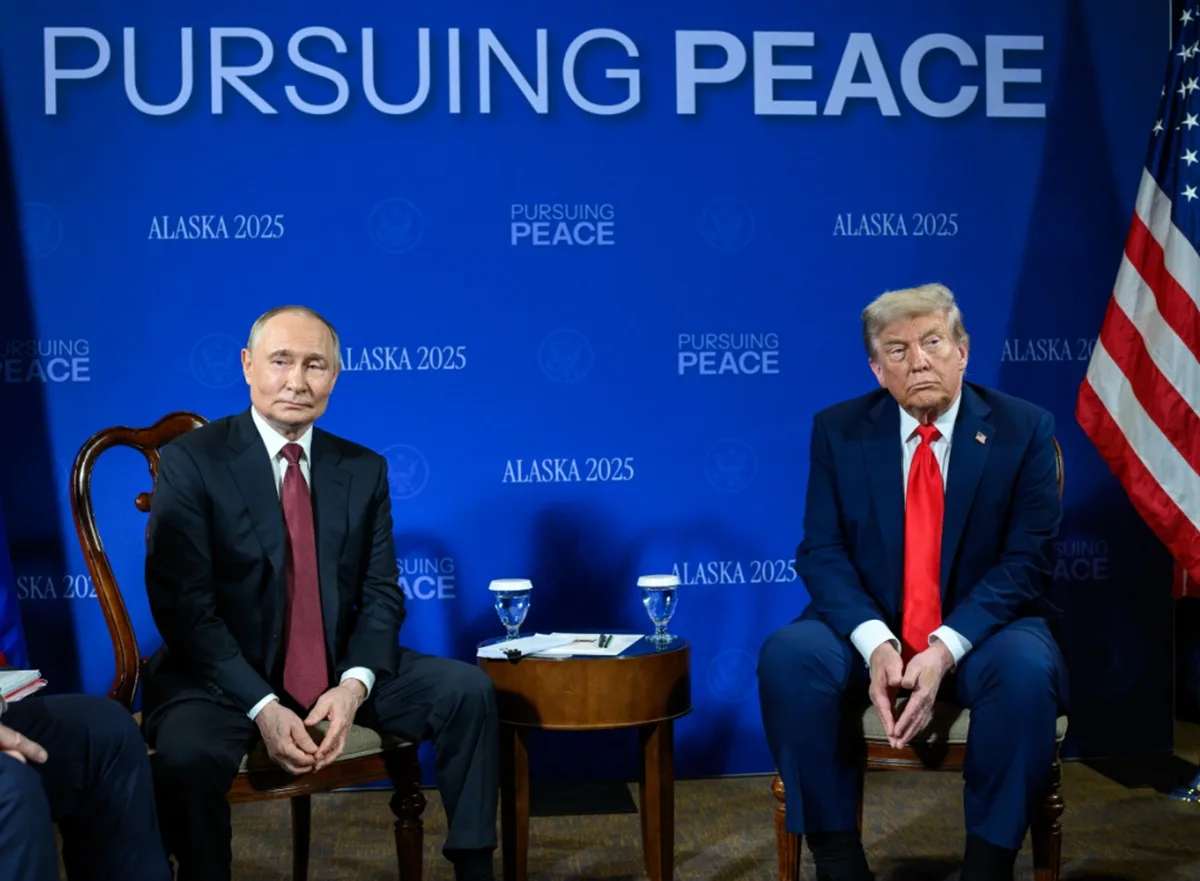
Vladimir Putin has opened a diplomatic window that, until recently, appeared almost shut.
Speaking at the Eastern Economic Forum in Vladivostok, the Russian president said he believes there is a possibility of reaching a peace agreement over Ukraine, while pointing to the United States, China and other countries as potential contributors to a settlement.
The significance, however, lies not only in what Putin said.
It lies in when he said it.
Only a day earlier, Donald Trump had effectively established a threshold for another summit with Putin: the negotiations must first be sufficiently advanced for a peace agreement to be within reach.
Moscow’s answer has now arrived.
“Is there a chance? In my view, yes, there is,” Putin said when discussing the possibility of a settlement.
This is not yet a peace proposal. There is no new ceasefire formula, territorial compromise or agreed security architecture.
But it is a political signal aimed directly at Washington.
Trump Sets the Threshold — Putin Responds
Trump has made clear that he does not want another high-profile meeting that produces symbolism without a tangible result.
Putin’s response is therefore carefully calibrated.
He acknowledges that diplomacy can work while insisting that Russia and Ukraine must ultimately be the parties that reach an agreement.
“First and foremost, Russia and Ukraine must reach an agreement between themselves. All other countries are ready to support and assist,” Putin said.
The formulation is important.
Moscow welcomes American mediation but simultaneously attempts to prevent Washington, Europe or any other external actor from becoming the ultimate arbiter of the settlement.
That distinction could become crucial when negotiations move from ceasefire diplomacy to the much harder questions of territory and security guarantees.


Moscow Talks Peace — While Keeping Up the Pressure
This is where Putin’s strategy becomes more complicated.
Russia’s softer diplomatic language has not yet been matched by comparable military de-escalation.
Moscow has continued to threaten and conduct pressure against Ukrainian infrastructure, while Putin has accused Kyiv of “state terrorism” over Ukrainian attacks inside Russia.
Russian warnings about further attacks on Ukraine’s power infrastructure are particularly significant as winter approaches.
The Kremlin is therefore maintaining two tracks simultaneously:
a diplomatic track toward Trump and a coercive military track toward Zelenskyy.
That is not necessarily a contradiction.
It may be the strategy.
Peace Itself Becomes a Weapon
Putin does not have to reject negotiations to increase pressure on Ukraine.
He can do precisely the opposite.
By presenting Russia as willing to negotiate, Moscow can try to change the central diplomatic question from “Does Putin want peace?” to “Who is preventing a peace agreement?”
That distinction matters enormously under Trump.
If Washington concludes that Moscow is genuinely prepared to negotiate, political pressure could increasingly shift toward Kyiv to demonstrate its own flexibility.
Russia would therefore gain leverage without making an immediate battlefield concession.
In this sense, Putin’s latest move should not automatically be interpreted as a retreat.
It can also be understood as an attempt to redistribute diplomatic pressure.
Kyiv Is Not Closing the Door Either
Ukraine, however, is also adapting.
Ukrainian Foreign Minister Andrii Sybiha has spoken of the possibility of renewed diplomatic momentum, suggesting that international political engagement could enter a more active phase.
That does not mean Kyiv and Moscow are suddenly close on the fundamental issues.
They are not.
But it does mean that both sides are now publicly leaving room for diplomacy while simultaneously trying to improve their negotiating positions.
And that is an important change in the political environment surrounding the war.
The Drone War Is Still Writing the Terms of the Negotiation
On the battlefield, the picture remains dramatically different.
Ukraine has intensified long-range drone attacks deep inside Russian territory, targeting refineries, energy facilities, military installations and airports.
Associated Press analysis found that more than 43,000 Ukrainian drones were intercepted over Russia and Russian-occupied Crimea between June and August, illustrating the extraordinary expansion of Kyiv’s long-range campaign.
The strategic purpose extends beyond physical destruction.
Kyiv is trying to transfer more of the economic and operational cost of the war onto Russian territory — disrupting fuel infrastructure, aviation and industrial activity while demonstrating that geographical depth no longer guarantees Moscow immunity.
Russia, meanwhile, possesses its own powerful coercive instrument: Ukraine’s energy system.
Winter Is Becoming Part of the Negotiating Table
Electricity generation, heating, gas supplies and transport infrastructure are not merely civilian or military considerations.
They determine Ukraine’s ability to endure a prolonged war.
That makes the approaching winter strategically important.
If Russia intensifies attacks against Ukraine’s energy infrastructure, Moscow could seek to increase economic and social pressure before serious negotiations begin.
Kyiv’s drone campaign against Russian energy infrastructure follows the inverse logic: raise the cost for Moscow before any ceasefire freezes the battlefield.
The result is a paradox.
The closer the two sides move rhetorically toward diplomacy, the stronger their incentive can become to improve their position immediately before negotiations.
Putin Brings China Into the Equation
Putin’s reference to China was equally deliberate.
Beijing gives Moscow a second diplomatic and economic axis beyond Washington.
Russia wants Trump engaged because the United States remains indispensable to any broader Western settlement.
But Moscow also wants to demonstrate that Washington does not hold a monopoly over the diplomatic process.
China provides precisely that strategic counterweight.
For Putin, the ideal negotiating architecture would therefore prevent Russia from appearing isolated or dependent on American goodwill.
There is, however, no publicly established joint US-China peace plan or agreed mechanism through which Washington and Beijing would jointly guarantee a settlement.
The Real Deal Is Much Bigger Than a Ceasefire
This is why any eventual Trump-Putin negotiation could become much larger than a discussion about where the shooting stops.
A durable settlement would inevitably confront several explosive questions: territory, security guarantees for Ukraine, Western sanctions against Russia, frozen Russian assets and the future military balance in Europe.
Behind all of them lies an even bigger Russian objective.
Moscow wants to redefine its relationship with Washington.
For Putin, Ukraine is therefore both a war and a gateway to negotiations over Russia’s broader position in the European security order.
Trump has his own incentive.
Ending the war could create space for a wider reset in US-Russia relations, potentially including economic ties — an issue the American president has repeatedly connected to the benefits of ending the conflict.
That possibility is precisely why European capitals will scrutinize any bilateral Trump-Putin diplomacy so closely.
Europe Faces the Most Uncomfortable Question
If Washington and Moscow begin moving toward a framework, Europe could face a fundamental strategic dilemma.
European governments want an end to the war, but not an agreement that leaves Ukraine vulnerable to another Russian attack or establishes a European security settlement without meaningful European participation.
The decisive argument may therefore move beyond the ceasefire itself.
It will become a fight over who guarantees the peace after the ceasefire.
That question involves NATO, Ukraine’s future military capabilities, European forces, sanctions relief and potentially the long-term US security commitment to the continent.
For Europe, therefore, Putin’s apparent opening is simultaneously an opportunity and a warning.
Moscow Got Trump’s Message — Now It Wants to Raise the Price
Putin’s latest statement represents a genuine change in diplomatic tone.
It does not yet represent a change in Russian strategy.
Moscow is not laying down its weapons in order to negotiate.
It is attempting to negotiate while military force continues to shape the eventual terms.
Trump has opened the door to another summit if a peace framework becomes sufficiently mature. Putin has now publicly said a deal is possible. Kyiv, meanwhile, is signaling renewed diplomatic activity.
But until concrete movement emerges on a ceasefire, territory and security guarantees, peace will remain both an objective and an instrument of pressure.
That may be Putin’s strongest card in the new phase: rather than telling Trump “no,” Moscow can say “yes — but on the right terms.”
Source: pagenews.gr