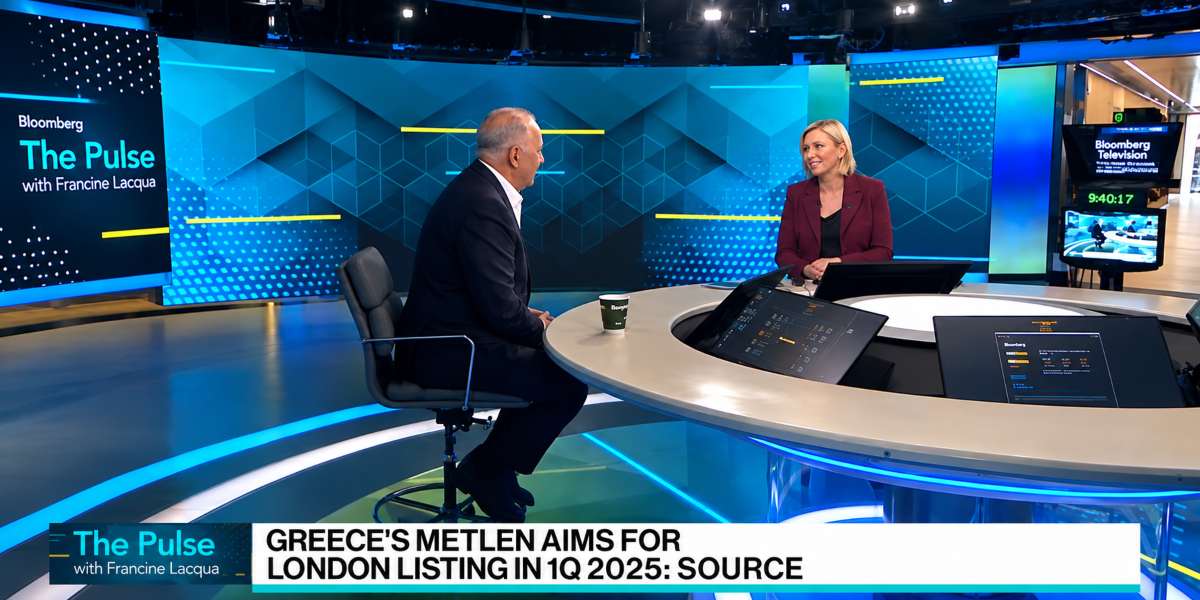
Evangelos Mytilineos has delivered a warning that goes far beyond another alarm over Europe’s energy costs.
Speaking to Bloomberg TV, METLEN’s Executive Chairman placed energy security, industrial policy, critical raw materials and the intensifying US-China competition within the same strategic framework, raising a fundamental question for Brussels: can the European Union finally transform the concept of strategic autonomy from political rhetoric into effective industrial policy?
Mytilineos warned that Europe could face an extremely difficult winter unless there is meaningful de-escalation either in the Middle East or in Ukraine.
“The LNG situation is becoming very critical,” he warned, drawing parallels with the conditions Europe experienced in late 2022 and early 2023.
But behind the energy warning lies another potentially even greater challenge: Europe risks losing the race for the raw materials on which the next generation of semiconductors, artificial intelligence, defence technologies and the energy transition will depend.


Gallium becomes a test of Europe’s industrial sovereignty
At the centre of the debate is gallium.
The metal has become one of the strategic raw materials of the new technological era, with applications ranging from advanced semiconductors and telecommunications to defence systems, renewable energy technologies and high-performance electronics.
Global supply remains highly concentrated, with China dominating production.
For Western economies, this creates a problem that cannot simply be solved by building new production capacity.
Any new producer must be confident that its investment will remain economically viable even if Beijing decides to dramatically increase supply and push global prices lower.
It is precisely here that Mytilineos identifies a fundamental difference between the United States and Europe.
Washington appears more willing to consider mechanisms capable of protecting the viability of strategic investments, including forms of price-floor support.
Europe, by contrast, remains considerably more hesitant when industrial strategy requires substantial financial commitments.
And Mytilineos’s message to Brussels was particularly sharp.
“We have the list. We know what the EU considers critical. Thank you very much.”
Behind the sarcasm lies a serious industrial argument.
Identifying strategic dependencies is not enough when the United States and China are deploying far more aggressive industrial-policy instruments to secure future supply chains.


METLEN moves from strategy to production
Mytilineos’s intervention carries particular weight because METLEN is not merely commenting on the critical-minerals race.
It is investing directly in it.
The Greek multinational is developing gallium production in Greece, targeting annual capacity of approximately 50 tonnes from 2028, with first production scheduled for the second half of 2027.
That scale could make the Greek project strategically significant for Europe, creating one of the few substantial Western alternatives to China’s overwhelming dominance of gallium production.
But the market is already moving faster than European policymaking.
METLEN has signed a long-term agreement covering approximately 25% of its expected annual gallium production with a major US technology company.
The customer has not been publicly identified, while the commercial terms remain confidential.
The agreement is highly symbolic: before the first tonne of gallium is produced, a substantial share of future Greek output has already been secured by an American buyer.
The warning Brussels cannot ignore
This is where the wider political significance of Mytilineos’s intervention becomes clear.
Europe wants European production of critical raw materials.
European industry is investing to create that capacity.
But US companies are already moving to secure part of that future European production.
This is not a contradiction in METLEN’s strategy. It is how global commodity markets operate.
Capital and long-term offtake agreements move towards markets where buyers are prepared to commit, risks can be managed and investments can achieve sufficient visibility.
That is precisely the warning for the European Commission.
If Europe genuinely wants strategic autonomy, it must also be prepared to pay for it.
Gallium prices have meanwhile risen above $3,000 per kilogram, compared with the $1,000/kg assumption used in the profitability case previously presented by METLEN.
Despite the dramatic increase in prices, the company has reported strong interest in additional offtake agreements.
The conclusion is difficult for Brussels to ignore: Europe may possess strategic resources and industrial capabilities, but unless it creates the right investment environment, global buyers will secure them first.
From gallium to LNG: Europe’s second vulnerability
Mytilineos also connected the critical-minerals challenge with the other major weakness facing European industry: energy.
His warning over LNG carries additional significance because METLEN has become an increasingly important natural-gas player in Southeastern Europe.
The company has also established a cooperation framework with Shell for the supply and trading of approximately 0.5–1 billion cubic metres of LNG annually between 2027 and 2031.
Volumes are expected to be delivered through Greece’s Revithoussa and Alexandroupolis infrastructure, with the possibility of moving gas further into European markets through the Vertical Gas Corridor.
The arrangement simultaneously strengthens Greece’s emerging position as an energy gateway connecting global LNG markets with Southeastern and potentially Central Europe.
But the wider warning remains.
Without geopolitical de-escalation, Europe could once again find itself competing aggressively for LNG supplies at precisely the moment when its industries are struggling with international competitiveness.
Trump, Xi and the new battle for strategic resources
The timing of Mytilineos’s intervention adds another dimension.
Energy, critical minerals, technology and trade have become central components of the strategic competition between Washington and Beijing.
As the United States and China prepare for their next phase of engagement, access to strategic commodities is no longer simply a commercial issue.
Critical raw materials have become instruments of geopolitical power.
China possesses extraordinary leverage across several mineral-processing and supply chains.
The United States is responding with subsidies, long-term purchasing arrangements, industrial incentives and increasingly explicit efforts to secure non-Chinese supplies.
Europe risks being caught between the two.
It wants strategic autonomy while maintaining strict state-aid and competition frameworks. It wants industrial resilience while simultaneously demanding enormous investment in decarbonisation. And it wants to reduce strategic dependencies without always providing European producers with the financial protection available to their competitors elsewhere.
Mytilineos puts Europe’s real dilemma on the table
Gallium and LNG may appear to belong to completely different markets.
In geopolitical terms, however, they tell the same story.
Europe remains dependent on external suppliers for both energy and strategic raw materials at a time when control over commodities is increasingly becoming a source of political and economic power.
China has built dominant positions across critical supply chains.
The United States is responding with stronger industrial policy, long-term contracts and mechanisms designed to protect strategic investments.
Europe remains caught in the middle.
That is why Mytilineos’s Bloomberg intervention goes beyond METLEN.
It represents a warning from within European industry itself: the era of diagnosing Europe’s strategic vulnerabilities must now give way to the era of acting on them.
Europe already knows what it needs.
It knows where its dependencies lie.
It has companies prepared to invest and, in Greece, an emerging production base capable of contributing directly to European strategic autonomy.
The question now is whether Brussels will create the conditions needed to keep strategic production — and its customers — in Europe.
Because while Europe debates its next industrial-policy framework, Washington and Beijing are already playing the next move.
Source: pagenews.gr