“Interest Rates Cannot Reopen Hormuz”
The European Central Bank is facing what may be its most difficult policy dilemma in more than a decade.
Inflation is back.
But this time, its primary source is not an overheating European economy.
It is in the Middle East.
It is in oil markets.
It is in the disruption of traffic through the Strait of Hormuz.
It is in attacks on energy infrastructure.
And it is in an increasingly dangerous reconfiguration of global energy flows.
Yet the ECB is responding with the main weapon available to it: interest rates.
On September 10, the central bank raised all three key interest rates by 25 basis points, its second increase of 2026, citing inflationary pressures generated by the Middle East war.
The ECB now projects average inflation of 3% in 2026, 2.5% in 2027 and 2.1% in 2028.
There is just one fundamental problem.
Monetary policy can reduce demand.
It cannot create more oil.


Interest Rates Cannot Reopen Hormuz
That is the paradox now at the heart of the European monetary debate.
Higher interest rates can discourage investment, make mortgages and corporate borrowing more expensive and reduce household consumption.
In other words, they can slow the European economy.
They cannot reopen the Strait of Hormuz.
They cannot increase oil exports.
They cannot repair Saudi Arabia’s East-West Pipeline.
And they cannot stop a war.
This is precisely where the risk of a policy mistake emerges: the ECB is attempting to fight a supply shock by suppressing demand.
Put more starkly, if oil is expensive because there is less oil reaching the market, the central bank can push prices down only indirectly — by making Europeans consume less.
That is a very expensive form of inflation control.
Lagarde Insists: Europe’s Growth Story Is Not Lost
Christine Lagarde acknowledges the danger.
In an interview with French newspaper Ouest-France following the latest rate increase, she linked the energy shock to the continuing Middle East conflict and damage to production and refining capacity.
But she defended the ECB’s decision, arguing that the shock could no longer be treated as temporary.
“The conflict continues. We expect volatility and pressure on energy prices to persist,” Lagarde said.
At the same time, she pushed back against the idea that Europe is condemned to permanently weak growth.
“It is not a lost cause. Europe has talent, a high level of education and significant savings, but we are not managing to mobilize them sufficiently,” she said.
Frankfurt’s official position is that the economy remains resilient enough to withstand monetary tightening.
The ECB currently forecasts growth of 0.9% in 2026, 1.4% in 2027 and 1.5% in 2028.
But the margin for error is getting dangerously small.


The Ghost of 2008
That brings back one of the ECB’s most uncomfortable historical memories.
On July 3, 2008, under Jean-Claude Trichet, the ECB raised its main interest rate by 25 basis points to 4.25%, attempting to contain inflationary pressures driven in large part by soaring oil and food prices.
Within weeks, the global financial landscape changed completely.
Lehman Brothers collapsed in September.
Money markets froze.
Economic activity plunged.
And between October 2008 and May 2009, the ECB was forced to cut its main policy rate by a total of 325 basis points, taking it down to 1%.
The comparison with today is not exact.
Europe’s banking system in 2026 is not the banking system of 2008.
But the underlying policy dilemma is uncomfortably familiar:
What happens when a central bank sees inflation clearly but fails to see the recession developing behind it?
Oil Has Survived the Shock — But for How Long?
So far, the global oil market has proved considerably more resilient than many initially expected.
Despite the prolonged conflict with Iran and severe disruption around Hormuz, most oil is still finding its way to consumers.
There are three major reasons:
- alternative transportation routes;
- extensive use of inventories;
- demand destruction across the global economy.
That adjustment has so far prevented a full-scale breakdown in oil supply.
But the system is operating with an increasingly narrow safety margin.
And the next vulnerability lies further west.
Saudi Arabia’s Pipeline Changes the Equation
The disruption of Saudi Arabia’s East-West Pipeline following a drone attack removed one of the most important mechanisms for bypassing Hormuz.
The network allowed Saudi crude to travel from the kingdom’s eastern oil-producing regions to the Red Sea, enabling exports without tankers passing through the strategic strait.
Now that escape route is under pressure as well.
At the same time, the Houthis have dramatically strengthened their position around the Red Sea and Bab el-Mandeb, creating a second major source of risk for global energy flows.
If Hormuz remains constrained while access through the Red Sea becomes increasingly dangerous, the oil market risks losing two major pressure-release valves simultaneously.
Europe would be among the regions most exposed.


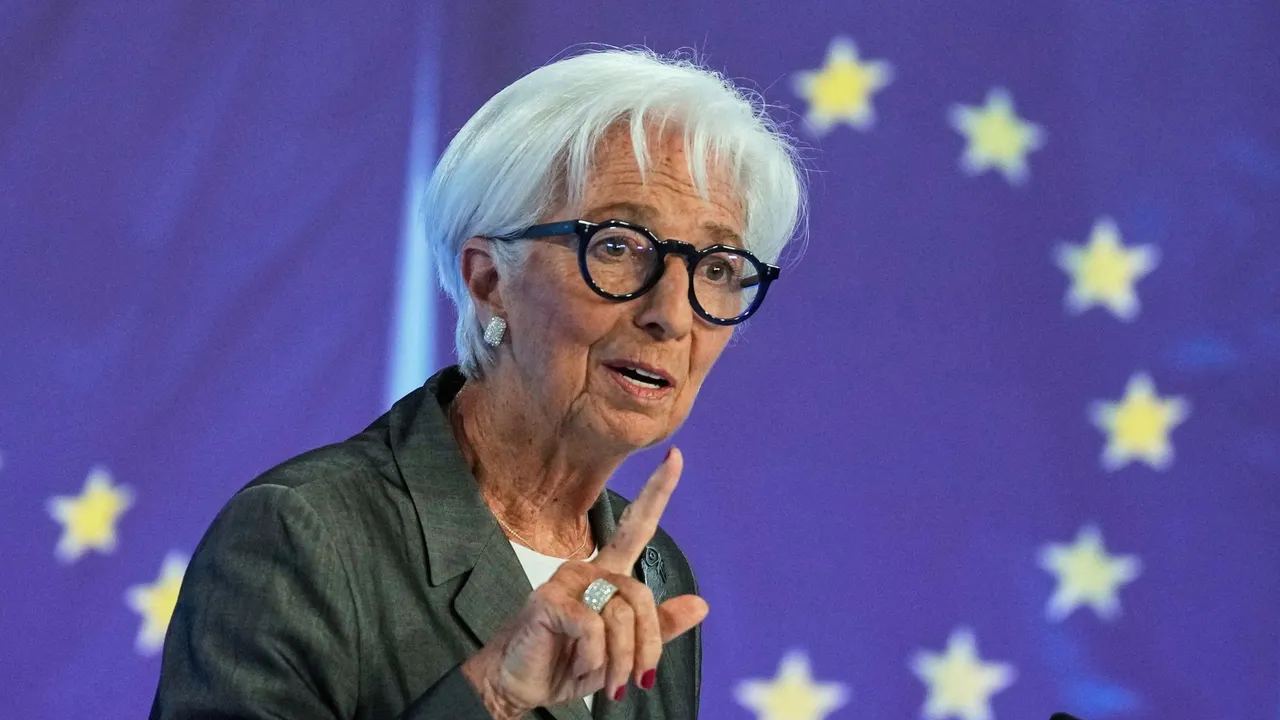
Christine Lagarde, president of the European Central Bank, speaks during the National Association of Business Economics (NABE) economic policy conference in Washington, DC, US, on Monday, Feb. 23, 2026. The theme of this year’s annual meeting is “The Great Realignment: Navigating AI, Demographic, and Geoeconomic Shifts.” Photographer: Graeme Sloan/Bloomberg
The ECB’s Dangerous Choice
That is what makes the current monetary-policy decision so difficult.
If the ECB does not raise rates and the energy shock begins feeding into wages, services and inflation expectations, Frankfurt risks losing control of inflation.
But if it raises rates too aggressively while the real economy is already paying the oil bill, it could transform an energy crisis into a European recession.
The experience of 2008 demonstrated how narrow the distance between those two outcomes can become.
This Time, Greece Enters the Crisis From a Different Position
There is, however, one major difference from previous European crises.
Greece is no longer entering the turbulence as the eurozone’s weakest link.
The transformation of the former “PIIGS” economies — Portugal, Italy, Ireland, Greece and Spain — has dramatically altered the European sovereign-risk map.
Greece represents perhaps the most striking turnaround.
Its sovereign credit rating has recovered by between nine and thirteen notches from its crisis-era lows — one of the strongest sovereign credit recoveries among developed economies.
Greek debt is also projected to fall toward 137% of GDP in 2026, while Italy is expected to overtake Greece as the eurozone’s most indebted major economy.
The symbolism is difficult to miss.
Fifteen years ago, Europe was asking whether Greece could survive.
Today, the more uncomfortable debt question increasingly concerns Italy.
Greece’s Market Comeback
The shift is also visible in the Greek capital market.
The successful public offering connected with Star Bulk’s admission to Euronext Athens attracted €656.3 million in valid demand and was covered more than six times.
More than 7,500 investors participated, with strong interest from both institutional and retail investors.
The timing matters.
At a moment when Europe is confronting recession risk and geopolitical turmoil is disrupting global shipping, a major Greek-linked shipping company has attracted demand several times larger than the shares being offered in Athens.
That does not make Greece immune to the next European downturn.
But it shows that the country would enter one from a fundamentally different starting point.
Androulakis: PASOK’s Problem May Be Its Political Target
The economy is simultaneously becoming the decisive battlefield in Greek domestic politics.
Nikos Androulakis used the Thessaloniki International Fair to present a programme that avoided some of the extravagant spending promises associated with opposition politics in previous years.
But PASOK faces a different strategic problem.
Its political targeting remains heavily focused on the centre-left at precisely the moment when Alexis Tsipras’ return is increasing competition for that same electoral pool.
That leaves a crucial question:
Who is competing effectively for the political centre?
Androulakis again insisted that PASOK’s goal is to become the largest party, even if only by a single vote, while ruling out a coalition with New Democracy.
At the same time, he argues that Greece will not face political paralysis.
The unresolved question is how.
If New Democracy remains the largest party without securing a majority and PASOK rejects cooperation with it, the arithmetic of the next government becomes considerably more complicated.
In a period of heightened economic and geopolitical uncertainty, governability itself could become a more powerful electoral issue than current polling suggests.
Nova: A Deal That Could Reshape Telecoms and Media
Meanwhile, speculation continues around a potential acquisition of Nova by Greek businessman Giannis Alafouzos.
Greek media reports suggest advanced negotiations may be taking place.
For now, however, this remains reported deal activity rather than an officially announced transaction.
If confirmed, its significance would extend well beyond a conventional corporate acquisition.
Nova combines telecommunications, subscription television and premium sports content.
A change in control could therefore affect several markets simultaneously:
- telecommunications;
- pay television;
- sports broadcasting rights;
- and the wider balance of power in Greece’s media industry.
Europe Is Trapped Between Oil and Interest Rates
Ultimately, all these developments lead back to the same problem.
The global economy has returned to an environment in which geopolitics can determine inflation more powerfully than conventional economic models.
The ECB controls the price of money.
It does not control Hormuz.
It does not control Bab el-Mandeb.
It does not control the Houthis.
And it does not control the war with Iran.
That is why Lagarde’s great gamble is no longer simply whether she can defeat inflation.
It is whether she can defeat inflation without defeating European growth first.
The lesson of 2008 is how expensive one policy miscalculation can become.
2026 will show whether the ECB learned it.
Source: pagenews.gr