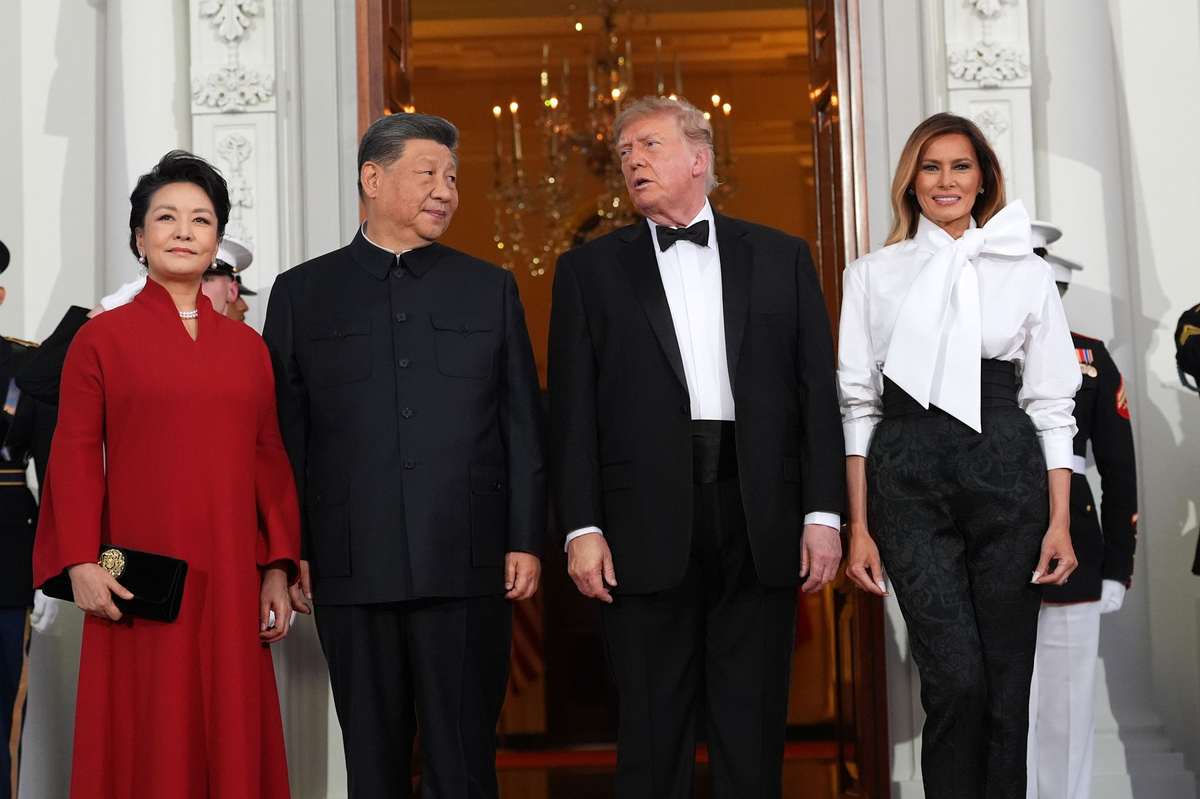
Donald Trump raised his glass.
Across the table sat Xi Jinping.
Around them were some of the people who command a significant part of America’s technological power: Elon Musk, Nvidia CEO Jensen Huang, Apple CEO Tim Cook and AMD chief Lisa Su.
The message was carefully choreographed.
The United States and China may be strategic competitors, but the world’s two largest economies can still sit at the same table.
Almost every detail of the White House state dinner was designed to reinforce that message — from the wine to the flowers, the menu, the gifts and the historical references in Trump’s speech.
But behind the ceremony lay a much harder question:
Was Washington witnessing the beginning of a US–China reset — or simply a temporary truce between two superpowers preparing for a much longer confrontation?
From Ancient Athens and Sparta to Sun Tzu
Trump gave his remarks an unusually historical frame.
He contrasted the ancient traditions behind the two countries, describing China through thousands of years of history stretching from Sun Tzu to Sun Yat-sen, while placing the United States within a Western tradition running through Jerusalem, Rome, the democracy of ancient Athens, the military legacy of Sparta and ultimately Philadelphia.
The political message was clear.
These are two fundamentally different political systems and civilizations.
But Trump argued that difference does not necessarily make confrontation inevitable.
“President Xi and I understand that we represent different systems, but the bonds between our peoples endure,” Trump said, emphasizing the long history of commercial and cultural exchange between Americans and Chinese.
Xi’s visit was accompanied by elaborate White House ceremony and military honors — a deliberate display of American state power wrapped inside diplomatic hospitality.


An American Eagle for Xi
The symbolism continued with Trump’s gift.
The US president presented Xi with a sculpture of a bald eagle, the national emblem of the United States.
The choice captured the tone of the entire visit.
American power was never far from view.
But it was being presented through ceremony rather than confrontation.
That distinction matters because only days earlier Trump had used the UN General Assembly to deliver a much more aggressive message about American power.
With Xi, the tone changed.
Xi: “We Are at Another Historic Crossroads”
Xi responded in a markedly different register.
The Chinese president described his talks with Trump as candid and substantive and called for the two countries to find a new way for major powers to coexist.
“Today, we stand at another historic crossroads in China–US relations,” Xi said.
He connected Trump’s ambition to “Make America Great Again” with China’s own objective of national rejuvenation and modernization.
His broader message was that Washington and Beijing should behave as responsible major powers and prevent strategic competition from becoming uncontrolled confrontation.
But Beijing’s language of cooperation should not be mistaken for strategic retreat.
China arrived in Washington with considerably more economic and technological leverage than it possessed during earlier periods of US–China engagement.
And that became apparent once the ceremony ended and the actual summit results were examined.
The Dinner Was Grand. The Breakthrough Was Much Smaller
The most tangible economic outcome was relatively limited.
Washington and Beijing extended their trade truce for another two months, providing additional time for negotiations and preventing an immediate return to another escalation in tariffs.
That matters.
But it did not resolve the underlying disputes.
Tariffs.
Technology restrictions.
Chinese purchases of US goods.
Rare earths.
Artificial intelligence.
Taiwan.
All remain unresolved.
The summit therefore produced something closer to managed competition than strategic reconciliation.


Rare Earths Have Changed the Balance
One of the most important changes in the Trump–Xi relationship lies beneath the surface.
Trump has repeatedly used America’s enormous consumer market and tariffs as leverage against Beijing.
China has leverage of its own.
And rare earth minerals are among its most powerful instruments.
They are critical to industries ranging from electric vehicles and advanced electronics to aerospace, renewable energy and sophisticated defense systems.
Beijing’s dominant position across key parts of the rare-earth supply chain gives it the ability to impose significant costs on Western industries if trade confrontation escalates.
China has already demonstrated its willingness to use restrictions on critical materials as economic leverage.
That makes the current confrontation fundamentally different from a simple tariff war.
Washington can pressure China. China can increasingly impose costs on Washington in return.
That Is Why Musk, Cook, Huang and Lisa Su Mattered
The guest list may have revealed more about the future of US–China relations than the menu.
Elon Musk.
Tim Cook.
Jensen Huang.
Lisa Su.
These were not simply celebrity CEOs invited to decorate a state dinner.
Their companies sit precisely at the intersection of American and Chinese economic power.
China is simultaneously a market, manufacturing base, competitor, regulatory power and critical component of global supply chains.
And above all of those relationships now sits another strategic competition:
Artificial intelligence.


The Next Superpower Race Runs Through Chips
The US–China rivalry is increasingly moving beyond trade deficits and tariffs.
Semiconductors.
Advanced computing.
AI models.
Data centers.
Energy.
Critical minerals.
Quantum technologies.
Industrial capacity.
These are becoming components of national power.
Trump and Xi discussed artificial intelligence, while Beijing has increasingly emphasized international governance and human oversight of rapidly developing AI systems.
Trump delivered a much more competitive message at the UN.
“Whoever wins Super Intelligence wins,” he said, arguing that the United States remains ahead of China.
The terminology was characteristically Trump.
The strategic logic was not.
Technological supremacy is increasingly inseparable from geopolitical supremacy.
And that makes companies such as Nvidia and AMD relevant not merely to Wall Street, but to national security.
Taiwan Is Where the Courtesies End
There is one issue no state dinner can remove.
Taiwan.
According to accounts of the summit, Xi pressed Trump on opposition to Taiwanese independence.
Beijing regards Taiwan as part of China and has not renounced the use of force to achieve what it calls reunification.
Washington maintains its longstanding “One China” policy alongside unofficial relations with Taiwan and commitments under US law to support Taiwan’s ability to defend itself, while avoiding a blanket public guarantee about how it would respond to every possible military scenario.
That ambiguity has helped structure the relationship for decades.
But as Chinese military capabilities expand, Taiwan remains the most dangerous potential flashpoint between the two powers.
Behind the glasses raised at the White House therefore lies a very different reality:
Washington and Beijing may be able to manage their rivalry, but they have not resolved its most dangerous potential military confrontation.
A Wine From the Nixon Era
Even the wine carried geopolitical history.
The dinner opened with Schramsberg Blanc de Noirs, evoking the American sparkling wine associated with Richard Nixon’s historic 1972 opening to China and the celebrated “Toast to Peace.”
The symbolism was impossible to miss.
Nixon’s visit helped open a new strategic era between Washington and Beijing.
But 2026 is not 1972.
China is no longer an economically isolated power being drawn gradually into a US-led international system.
It is an economic, technological and military heavyweight competing with Washington across much of that system.
The wine recalled Nixon.
The guest list revealed how dramatically the world has changed since then.
American Ingredients, Chinese Influences
The menu carried the same diplomatic language.
American ingredients were combined with subtle Chinese influences.
The opening course featured yellow squash velouté, wild mushrooms, crisp pancetta and scallion oil.
The main course paired sesame-crusted fish with baby bok choy and roasted eggplant.
Dessert brought together vanilla crémeux, walnut frangipane, sour cherry confit and ice cream made with White House honey.
Red — a color carrying strong cultural symbolism in China — dominated parts of the decoration, while historic White House tableware reinforced the American side of the visual narrative.
Nothing was accidental.
Food had become diplomacy.
Melania, Peng and the Soft-Power Front
The visit also had a carefully constructed cultural component.
Melania Trump and Peng Liyuan participated in cultural diplomacy around Washington, adding another layer to an event designed to communicate normalization and mutual respect.
Fashion became part of that presentation as well, with Melania combining Saint Laurent and Dolce & Gabbana for the state dinner.
The flowers, clothing, gifts, museum diplomacy and menu were all elements of the same political language.
But soft power cannot erase hard power.
And that is where Xi’s visit connects with the much larger question surrounding Trump’s foreign policy.
Days Earlier, Trump Declared: “America Is Back”
At the United Nations, Trump presented a very different image.
“America is back,” he declared, portraying the United States as economically, militarily and technologically dominant.
His language toward Iran was confrontational.
His rhetoric about American power was unmistakable.
Yet when Xi arrived in Washington, Trump chose negotiation, ceremony and personal diplomacy.
That is not necessarily contradictory.
Major powers use different tools against different rivals.
But the contrast demonstrates something important:
China cannot be dealt with through threats and tariffs alone.
Its economic scale, industrial capacity, control of critical supply chains and growing technological capabilities make it a qualitatively different competitor.
How Much Power Does Washington Still Have?
Trump himself provided one of the week’s most revealing lines at the UN.
While discussing his preferred term “Super Intelligence,” he joked:
“Let’s see if I have any power. Maybe I do and maybe I don’t. We’re going to find out pretty soon.”
The comment concerned AI terminology rather than a confession about American foreign-policy weakness.
Yet it unintentionally captured the larger question hanging over Trump’s diplomatic week.
The United States remains the world’s leading military power and one of its dominant economic and technological centres.
But Washington increasingly operates in a system where other major powers possess their own leverage.
Iran has resisted sustained military and economic pressure.
European governments do not automatically support every American initiative.
Russia continues to pursue its own objectives in Ukraine.
And China possesses the economic, technological and strategic weight to negotiate with Washington rather than simply respond to American demands.
Critics of Trump’s foreign policy point to these constraints as evidence that American influence has limits. The White House argues instead that Trump’s approach uses different combinations of economic pressure, military strength and negotiation to advance US interests.
This Is Not Friendship — It Is Management of a Rivalry
That may be the most important conclusion from Xi’s visit.
There was no grand US–China settlement.
Taiwan was not resolved.
The tariff dispute was not resolved.
The semiconductor conflict was not resolved.
Rare-earth dependence was not resolved.
The AI race was not resolved.
But the trade truce was extended and, more importantly, both governments chose to keep negotiating.
For two nuclear powers whose economies influence virtually every major global market, managing competition is itself strategically significant.
This Is a Different Kind of Cold War
The fundamental difference from the 20th century is that the United States and China do not occupy two largely separate economic systems.
Their economies remain deeply interconnected.
American technology companies still depend, to varying degrees, on Chinese consumers, manufacturing networks and Asian supply chains.
China still benefits from access to global markets, capital and technology.
At the same time, both governments are attempting to reduce their strategic dependence on the other.
That produces an unusual relationship:
competition without complete decoupling; cooperation without genuine strategic trust.
Perhaps that is why the state-dinner image was so revealing.
Trump and Xi raised their glasses to a new chapter.
But sitting around them were executives whose companies occupy the front lines of the next great US–China contest.
The battle over chips, artificial intelligence, critical minerals and ultimately which power will shape the rules of the next technological era.
Source: pagenews.gr