IMF Warning for Greece: 4.2% Inflation and Five Economic Risks That Could Derail Growth
 ΧΡΟΝΟΣ ΑΝΑΓΝΩΣΗΣ 12 '
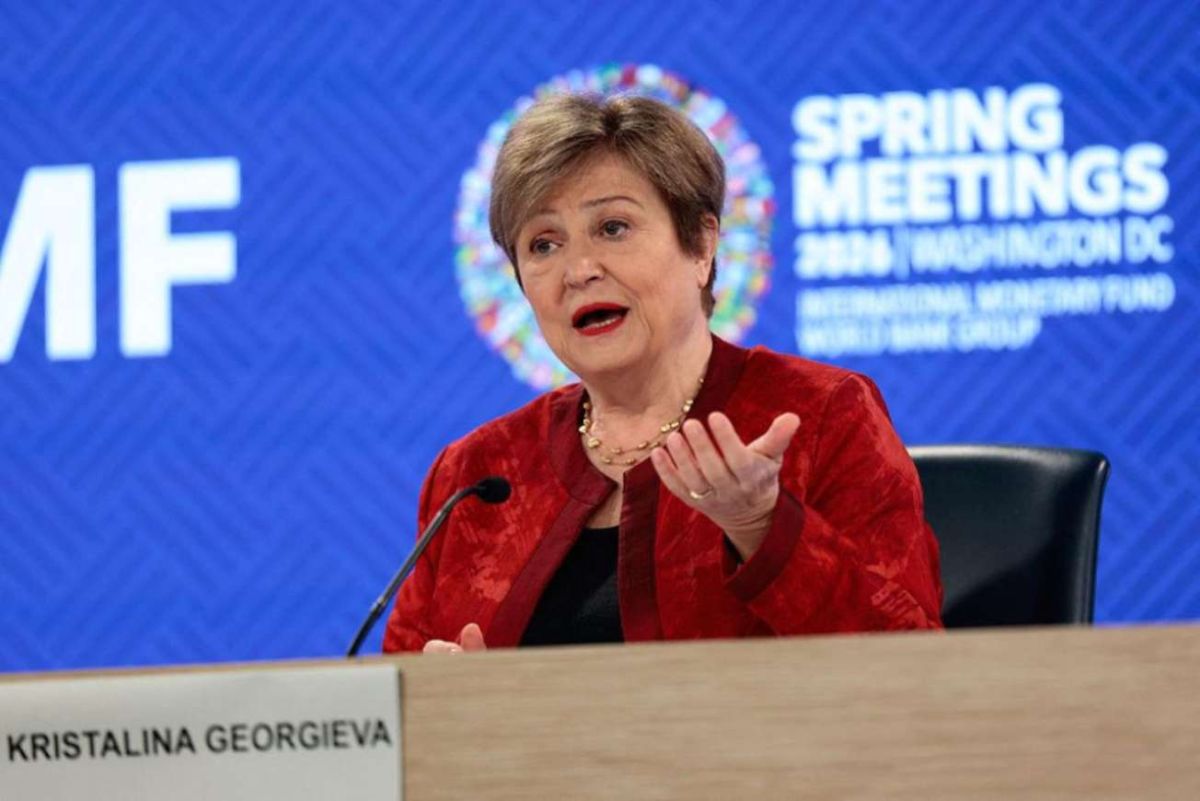
Πηγή Φωτογραφίας: AP Photo//IMF Warning for Greece: 4.2% Inflation and Five Economic Risks That Could Derail Growth



Greece’s economy is projected to continue expanding faster than the eurozone average, but the International Monetary Fund’s October 2026 World Economic Outlook presents a challenging picture for the next two years.
According to the IMF forecasts, Greek gross domestic product is expected to grow by 1.8% in both 2026 and 2027, down from 2.1% in 2025.
Although these figures point to continued economic expansion rather than recession, they also suggest that Greece is unlikely to experience a meaningful acceleration in growth next year.
Inflation remains one of the country’s most pressing economic challenges.
Consumer price growth is forecast to reach 4.2% in 2026, before easing to 3.6% in 2027, remaining above the eurozone average throughout the period.
At the same time, Greece’s current account deficit is projected to widen to 6.6% of GDP in 2026, before narrowing to 5.9% in 2027.
Together, these indicators reveal an economy that continues to expand but remains exposed to international shocks, particularly those involving energy prices, financing conditions and external demand.
Greece’s Growth Advantage Over the Eurozone Comes Without Acceleration
The IMF expects Greece to maintain a positive growth differential compared with the eurozone.
With GDP projected to expand by 1.8% in 2026, Greece would outperform the eurozone’s estimated 1.1% growth rate by 0.7 percentage points.
In 2027, the gap is expected to narrow slightly to 0.6 percentage points, as eurozone growth improves to 1.2%.
This relative advantage is encouraging, but it does not provide a complete picture of Greece’s economic performance.
The quality of growth, productivity gains, real household incomes and the availability of investment financing remain equally important.
Comparisons with other southern European economies also reveal a more nuanced picture.
For 2026, the IMF projects growth of 2.5% in Spain, 2.1% in Portugal and 2.9% in Cyprus.
Greece is therefore expected to outperform the eurozone average while growing more slowly than several other economies in southern Europe.
The central challenge is whether the country can translate continued economic expansion into stronger productivity, higher real wages and more sustainable investment.
Inflation at 4.2%: The Cost-of-Living Squeeze Continues
The IMF’s inflation forecast is among the most significant findings for Greece.
Consumer prices are expected to rise by 4.2% in 2026, compared with a projected eurozone inflation rate of 3.1%.
In 2027, Greek inflation is forecast to decline to 3.6%, still above the eurozone’s projected 2.8%.
The expected slowdown in inflation does not mean prices will return to their previous levels.
It means that prices are projected to continue increasing, although at a slower pace.
If the IMF’s forecasts materialize, Greece’s average price level in 2027 would be approximately 8% higher than in 2025, based on the cumulative effect of the two annual inflation rates.
For households, this raises an important question: will wages, pensions and other sources of income increase sufficiently to preserve purchasing power?
If nominal income growth fails to keep pace with inflation, consumers will continue to face pressure on their real spending capacity.
Businesses are also vulnerable.
Persistent inflation can increase the cost of energy, raw materials, transportation and services, squeezing profit margins and potentially discouraging investment.
The impact will vary across industries, depending on their ability to absorb higher costs or pass them on to customers.
Greece’s 6.6% Current Account Deficit Highlights External Vulnerabilities
Another major concern is Greece’s external balance.
The IMF expects the current account deficit to widen from 5.7% of GDP in 2025 to 6.6% in 2026.
Although the deficit is projected to narrow to 5.9% in 2027, it would remain above its 2025 level.
The current account measures an economy’s transactions with the rest of the world, including trade in goods and services and income flows.
A large deficit indicates a need for net financing from abroad.
This does not automatically signal an imminent financial crisis.
The implications depend on the composition of the deficit and how it is financed.
Long-term productive foreign investment, for example, can offer greater stability than short-term financial inflows.
Nevertheless, a substantial external deficit can increase an economy’s sensitivity to changes in international investor sentiment and financing conditions.
For Greece, the challenge becomes particularly important when higher energy prices increase the import bill.

Risk Scenario One: A Prolonged Energy Shock
One of the most serious external threats identified in the IMF’s global assessment is the possibility of prolonged energy-market disruption.
Continued or escalating conflict in the Middle East could keep oil and natural gas prices elevated.
For an economy dependent on imported energy, the consequences could be significant.
Higher energy prices increase the cost of imports, manufacturing, transportation and services.
Businesses may attempt to pass these additional costs on to consumers, contributing to persistent inflation.
Households, meanwhile, may be forced to allocate a larger share of their income to essential energy expenses.
This can reduce spending on other goods and services, weakening domestic demand.
The IMF distinguishes between energy-price increases driven primarily by geopolitical uncertainty and those resulting from actual supply disruptions.
Physical disruptions to energy supplies can produce more persistent effects on inflation and economic output.
For Greece, a prolonged energy shock could therefore create simultaneous pressure on consumer prices, economic growth and the external balance.
Risk Scenario Two: Inflation Erodes Household Purchasing Power
Private consumption is a major component of economic activity.
When prices rise faster than disposable income, households are forced to reduce spending or change their consumption patterns.
Lower-income households are particularly vulnerable because essential expenses such as food, energy and housing account for a larger proportion of their budgets.
A sustained loss of purchasing power can weaken demand across the wider economy.
Retailers, service providers and smaller businesses may experience slower sales growth, while households postpone discretionary purchases.
The projected decline in unemployment could provide some support by increasing the number of people earning wages.
However, stronger employment does not automatically guarantee higher real incomes.
If inflation remains elevated, the improvement in labor-market conditions may be partly offset by rising living costs.
This is one of the principal mechanisms through which persistent inflation can become a broader macroeconomic challenge.
Risk Scenario Three: Weak Eurozone Demand Threatens Exports and Tourism
The IMF forecasts eurozone growth of just 1.1% in 2026 and 1.2% in 2027.
For Greece, economic conditions across Europe are particularly important.
The country’s exports, tourism revenues and investment flows are closely connected to European markets.
A further slowdown in the eurozone could weaken demand for Greek goods and services.
Tourism is especially sensitive to changes in household purchasing power across major European source markets.
The effects may not necessarily appear as a sharp decline in visitor arrivals.
Instead, travelers could shorten their stays, reduce spending per trip or choose less expensive accommodation and services.
Consequently, tourism arrivals could remain relatively resilient even as real revenue growth comes under pressure.
Weak European demand could also affect Greek exporters and companies integrated into international supply chains.
This makes the broader eurozone outlook a critical factor in Greece’s economic performance.
Risk Scenario Four: Higher Borrowing Costs and Delayed Investment
The IMF also warns about the possibility of a sudden tightening in global financial conditions.
Such an outcome could result from fiscal concerns, financial-market volatility or a sharp correction in elevated asset valuations, including those associated with artificial intelligence.
For Greece, tighter financial conditions could translate into higher borrowing costs for businesses and new investment projects.
Rising financing expenses can reduce the expected profitability of investment and encourage companies to postpone expansion plans.
Smaller businesses may be particularly sensitive to changes in credit availability.
The eventual impact would depend on the duration of financial-market turbulence, banking-sector liquidity and access to alternative financing.
The IMF’s global assessment does not provide a separate numerical estimate of the potential reduction in Greek GDP under this scenario.
Nevertheless, the risk is relevant to an economy seeking to strengthen investment, productivity and long-term competitiveness.
Risk Scenario Five: Growing Pressure on Public Finances
Persistent inflation and another energy shock could increase demands for government support.
Households and businesses facing higher costs may require targeted financial assistance.
However, support measures carry fiscal costs.
Broad or prolonged subsidies can absorb resources that might otherwise be available for public investment, infrastructure or future emergencies.
This challenge becomes more difficult when economic growth slows.
Weaker growth can reduce the momentum of tax revenues while increasing demand for government intervention.
The IMF’s general policy approach emphasizes temporary, targeted support for vulnerable groups alongside the preservation of fiscal sustainability.
For Greece, the effectiveness of public spending would therefore become especially important in the event of another major external shock.
The objective would be to protect those most exposed to rising costs without creating unsustainable long-term fiscal commitments.
Falling Unemployment Offers a Positive Counterweight
Despite the risks, the IMF forecasts include positive developments.
Greece’s unemployment rate is expected to decline from 8.9% in 2025 to 8% in 2026 and 7.6% in 2027.
This points to continued improvement in the labor market.
Lower unemployment can support household incomes, strengthen domestic consumption and reduce certain social pressures.
However, the ultimate benefit will depend on job quality, wage growth and the cost of living.
The eurozone unemployment rate is projected to remain at 6.3% in both 2026 and 2027.
Greece is therefore expected to continue recording higher unemployment than the currency union average, although the gap should narrow.
The combination of lower unemployment and persistent inflation illustrates the mixed nature of the country’s economic outlook.
More people may be employed, but their purchasing power will depend on whether wage increases keep pace with rising prices.
The Chain Reaction That Could Put Greece Under Pressure
The five principal risks identified in the analysis are interconnected.
A prolonged energy shock could raise import and production costs.
Higher costs could keep inflation elevated, reducing household purchasing power.
Weaker consumption, combined with more expensive financing, could discourage business investment.
At the same time, a deteriorating current account balance could increase external financing requirements.
If economic growth weakened further, demands for additional government support could intensify.
This potential chain reaction would create pressure on several parts of the economy simultaneously.
It is important, however, to distinguish such a downside scenario from the IMF’s central forecast.
The Fund’s baseline projections still envisage continued economic growth in Greece.
The risks describe developments that could undermine that outlook, rather than outcomes that are expected to occur.
The Key Economic Challenge for 2027
The IMF’s October 2026 projections portray a Greek economy that continues to expand, create jobs and outperform the eurozone average.
At the same time, persistent inflation and a substantial current account deficit remain important vulnerabilities.
The projected growth rate of 1.8% in both 2026 and 2027 suggests stability rather than renewed acceleration.
Energy-market developments, European economic conditions and the ability to attract productive investment will be central to the country’s performance.
The outlook also highlights the importance of improving productivity, strengthening export capacity and reducing exposure to repeated external shocks.
The defining question is not simply whether Greece will continue growing faster than the eurozone, but whether that growth will translate into stronger purchasing power, sustainable investment and a more balanced external position.
The answer will determine how resilient the Greek economy proves to be in the face of future international disruptions.
Source: pagenews.gr
Διαβάστε όλες τις τελευταίες Ειδήσεις από την Ελλάδα και τον Κόσμο