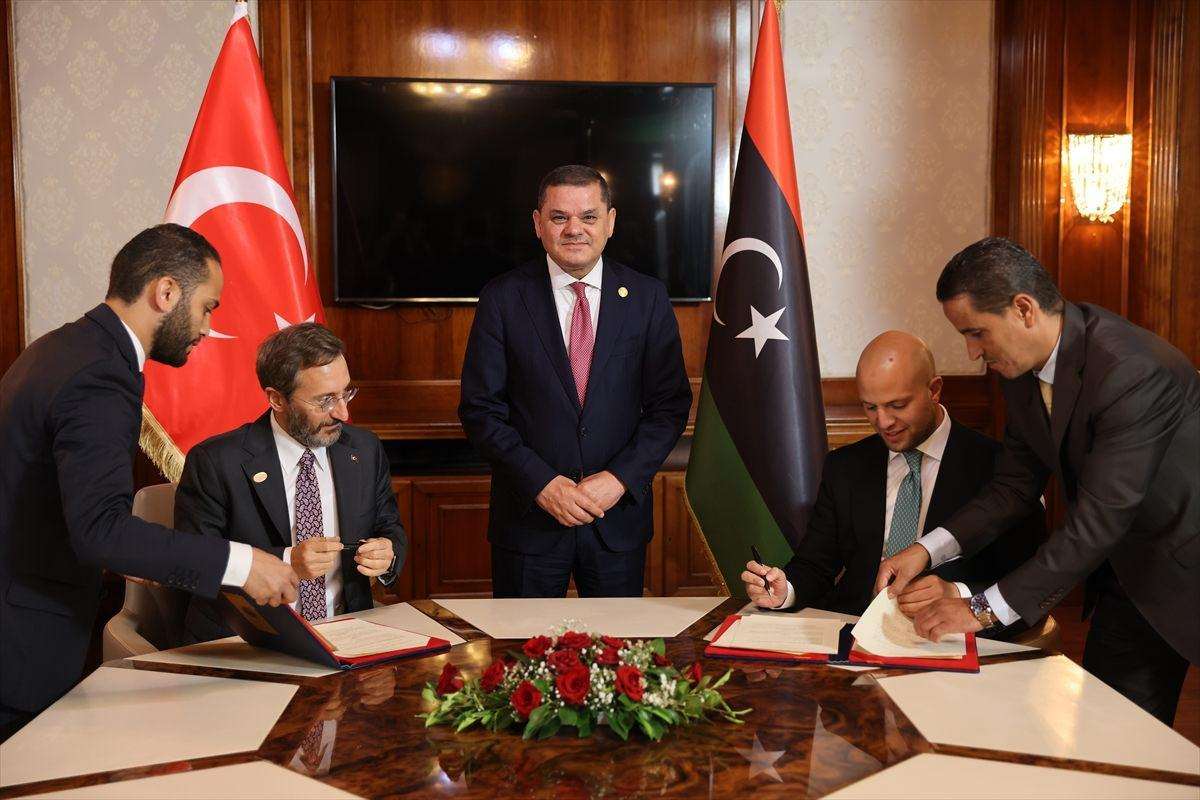
A new diplomatic confrontation is unfolding in the Eastern Mediterranean following the decision by Libya’s House of Representatives on October 20, 2026, to approve the controversial maritime memorandum signed with Turkey in 2019.
Greece has responded by taking the issue to the United Nations, seeking to formally register its objections and prevent the agreement from being used to challenge Greek maritime rights.
According to diplomatic sources, Greece’s Permanent Representative to the United Nations, Ambassador Aglaia Balta, sent a letter to UN Secretary-General António Guterres following instructions from Foreign Minister George Gerapetritis.
Athens maintains that the memorandum is legally invalid under its interpretation of international maritime law and cannot create rights or obligations for third countries.
The latest development is particularly significant because Libya’s eastern-based parliament had previously opposed the agreement.
Its decision to approve the memorandum reflects changing political relationships between Ankara and eastern Libya, adding a new dimension to the regional dispute.
Greece Takes Its Objections to the United Nations
The Greek diplomatic response is designed to establish a formal international record of Athens’ objections.
Ambassador Aglaia Balta raised the issue during closed consultations at the UN Security Council on October 21.
According to diplomatic accounts, she warned that the Libyan parliament’s decision could have implications for regional security and stability.
The central argument advanced by Greece concerns the geographical configuration of the Eastern Mediterranean and the maritime rights of its islands.
“Geography does not change,” was the message attributed to the Greek intervention.
Athens argues that bilateral maritime arrangements cannot disregard the legitimate rights of third states or override applicable principles of international law.
Greece also reiterated its support for the reunification of Libya’s institutions and for efforts to prevent external interference from further destabilising the country.
The Greek position therefore places the maritime dispute within the wider context of regional security.
Gerapetritis: “The Memorandum Will Not Be Implemented”
Greek Foreign Minister George Gerapetritis delivered one of Athens’ clearest responses during an October 21 interview with journalist Pavlos Tsimas on Mega News radio.
He emphasised that the agreement was not new, having originally been signed in November 2019.
Gerapetritis questioned the authority of the western Libyan government that concluded the memorandum at the time and argued that Turkey had used its influence in Libya to advance its geopolitical objectives.
His central message was unequivocal:
“The memorandum will not be implemented.”
The foreign minister maintained that the agreement could not produce lawful consequences because, in Greece’s view, it conflicts with international maritime law.
He also indicated that Athens would not rely solely on legal objections.
Instead, Greece intends to pursue diplomatic initiatives designed to prevent the memorandum from having practical consequences.


Athens Signals Further Diplomatic Action
Gerapetritis described the tools available to Greece in its response to the latest developments.
“We will activate our mechanisms,” he said, referring to Greece’s ability to act through European and international institutions.
Athens has already briefed European partners and international interlocutors, while further diplomatic engagement is expected.
The minister also referred to Greece’s role in European decision-making concerning Libya, including financial and security-related matters.
His comments indicated that Athens views the memorandum as more than a bilateral arrangement between Turkey and Libya.
For Greece, the agreement raises questions affecting the wider region and therefore requires an international response.
These remarks did not amount to an announcement of sanctions or other specific punitive measures.
Greek Foreign Ministry: “Geography and the Law of the Sea Do Not Change”
The Greek Ministry of Foreign Affairs rejected the Libyan parliament’s approval of the memorandum.
In its official response, Athens argued that the parliamentary decision could not alter what Greece considers the agreement’s unlawful character.
“Geography and the International Law of the Sea do not change through unilateral, legally unfounded parliamentary decisions,” the ministry stated.
Greece maintains that Turkey and Libya do not possess the relevant opposite or adjacent coastlines necessary to justify the particular maritime delimitation established by the memorandum.
The dispute centres on the treatment of Greek islands, particularly Crete, whose maritime entitlements are not reflected in the Turkish-Libyan delimitation.
Athens argues that these islands generate maritime rights under international law and that those rights cannot simply be disregarded by an agreement between two other countries.
Greece also urged Libya to avoid actions that could undermine stability in the Eastern Mediterranean.


European Union: The Agreement Cannot Affect Third Countries
The European Union reacted to the Libyan parliament’s decision by reaffirming its longstanding opposition to the 2019 memorandum.
In a statement issued on October 21, the EU expressed serious concern over the approval of the agreement.
Brussels reiterated the position it has maintained since December 2019: the memorandum infringes the sovereign rights of third states, does not comply with the Law of the Sea and cannot produce legal consequences for countries that are not parties to it.
The European position is particularly important for Athens because it places the dispute within the broader framework of EU external relations and the protection of member states’ rights.
It also demonstrates that the disagreement extends beyond the bilateral relationship between Greece and Turkey.
Von der Leyen: “Solidarity with Greece and Cyprus”
European Commission President Ursula von der Leyen publicly addressed the development.
She expressed the Commission’s deep dissatisfaction with the Libyan parliament’s decision and reiterated the EU’s position on the maritime agreement.
“We reaffirm our solidarity with Greece and Cyprus,” she stated.
Von der Leyen stressed that the European position remained unchanged and that the memorandum could not undermine the sovereign rights of third countries.
Her intervention gave the European response additional political significance.
It also reinforced the connection between the maritime dispute and the EU’s broader approach to security in the Eastern Mediterranean.
Kaja Kallas Raises the Issue with Turkish Foreign Minister Hakan Fidan
The controversy was also raised directly with Ankara.
EU High Representative for Foreign Affairs and Security Policy Kaja Kallas discussed the issue with Turkish Foreign Minister Hakan Fidan.
The European position communicated during the exchange was that the memorandum “violates the sovereign rights of third states.”
The contact demonstrated that Brussels was not limiting its response to public statements.
Instead, the EU was also conveying its objections through direct diplomatic engagement with Turkey.
Ankara Pushes Back: The Agreement Is Based on International Law
Turkey rejects the Greek and European objections.
Following the Libyan parliament’s decision, the Turkish Ministry of Foreign Affairs welcomed the approval of the memorandum.
Ankara maintained that the agreement “is based on the principles of international law and equity” and protects the mutual rights and interests of Turkey and Libya.
Turkish officials have consistently defended the 2019 arrangement as a legitimate maritime delimitation.
The disagreement reflects fundamentally different interpretations of maritime entitlements in the Eastern Mediterranean.
Turkey is not a party to the United Nations Convention on the Law of the Sea, while Greece and the European Union rely on the convention and relevant principles of international law to support their positions.
The legal dispute concerns, among other issues, the effect of islands on maritime delimitation and the rights that coastal states can claim in overlapping maritime areas.
Egypt Rejects the Agreement’s Implications
Egypt has also expressed opposition to the Turkish-Libyan memorandum.
On October 21, the Egyptian Ministry of Foreign Affairs stated that the Libyan parliament’s decision could not produce legal consequences for Egypt.
Cairo’s position reflects its own maritime interests and its relationship with Greece, with which it signed a partial exclusive economic zone delimitation agreement in 2020.
Greek Foreign Minister George Gerapetritis held a telephone conversation with Egyptian Foreign Minister Badr Abdelatty to discuss the latest developments.
Their exchange focused on the memorandum and its potential consequences for regional security and stability.
The diplomatic coordination between Athens and Cairo remains important because both countries have interests in the legal framework governing maritime boundaries in the Eastern Mediterranean.
Israel Also Criticises the Turkish-Libyan Agreement
Israel joined the countries criticising the Libyan parliament’s decision.
The Israeli Foreign Ministry condemned the development, arguing that Turkey’s actions were contributing to instability in the Eastern Mediterranean.
Israel’s position comes against the background of broader tensions in Turkish-Israeli relations and differing strategic approaches to regional security.
The responses from Israel, Egypt and the European Union illustrate the wider diplomatic repercussions of the Libyan parliamentary vote.
They do not, however, mean that all these governments share identical regional objectives or approaches to Turkey.
Why Eastern Libya’s Change of Position Matters
One of the most significant aspects of the latest development concerns Libya’s internal political divisions.
The maritime memorandum was originally signed in 2019 by the internationally recognised government based in Tripoli, in western Libya.
For years, authorities in eastern Libya, including political institutions associated with military commander Khalifa Haftar, opposed the arrangement.
The House of Representatives’ decision on October 20, 2026, therefore represents a substantial change.
The parliament approved the memorandum and reversed earlier decisions rejecting agreements with Turkey.
This development reflects Ankara’s growing engagement with eastern Libyan actors and the changing balance of political relationships within the divided country.
For Greece, the concern is not limited to the legal status of the agreement.
It also involves Turkey’s expanding ability to secure support from different centres of power in Libya.
That shift could influence future diplomatic negotiations, economic cooperation and energy-related activities.
Crete, Offshore Gas and the Battle Over Maritime Boundaries
The underlying dispute has significant implications for energy exploration and maritime infrastructure.
The Turkish-Libyan memorandum establishes a maritime boundary between Turkey and Libya that Greece disputes because it does not account for the maritime entitlements Athens attributes to Greek islands, particularly Crete.
The waters south of Crete have attracted interest in offshore hydrocarbon exploration.
They also form part of a wider strategic region involving shipping routes, energy infrastructure and international connectivity.
Greece argues that the memorandum cannot lawfully be used to obstruct activities undertaken in maritime areas where it claims sovereign rights.
Turkey, meanwhile, maintains that its agreement with Libya protects legitimate maritime interests.
The competing positions create a risk of diplomatic and operational disputes if energy exploration or other maritime activities take place in contested areas.
The Greece–Cyprus Electricity Interconnector
The broader geopolitical environment also affects the planned electricity interconnection between Greece and Cyprus, known as the Great Sea Interconnector.
The project is intended to strengthen energy connectivity in the Eastern Mediterranean and reduce Cyprus’s electricity isolation.
However, maritime research and infrastructure projects in the region have become entangled in wider disputes over jurisdiction and maritime rights.
The Turkish-Libyan memorandum does not itself determine the legal status of the interconnector.
Nevertheless, the wider disagreements over maritime zones could affect the political and operational environment in which such projects proceed.
For Athens, this reinforces the importance of securing international support for its interpretation of maritime law.
Greece’s 12-Nautical-Mile Right: What Gerapetritis Said
During his interview, Gerapetritis was also asked whether Greece was considering extending its territorial waters to 12 nautical miles south and west of Crete.
The foreign minister reiterated that Greece possesses the sovereign right to extend its territorial sea in accordance with international law.
He made clear, however, that the exercise of that right would be determined by the Greek state itself.
Athens would decide when and how to act, rather than allowing Turkish or Libyan initiatives to dictate its decisions.
His remarks did not constitute an announcement of an immediate extension.
They reaffirmed Greece’s established position that it retains the right to make such a decision.
What Happens Next in the Eastern Mediterranean?
The letter to the UN Secretary-General, the intervention by Ambassador Aglaia Balta at the Security Council and the European diplomatic response represent the opening phase of Greece’s renewed effort to challenge the Turkish-Libyan memorandum.
Athens aims to preserve international opposition to the agreement and prevent it from being used to justify actions affecting Greek maritime rights.
Ankara, by contrast, views the Libyan parliament’s approval as additional political support for the 2019 arrangement.
The next stage will depend on whether the parties move beyond diplomatic declarations towards concrete maritime, energy or administrative measures.
The situation also raises broader questions about Libya’s political future, Turkey’s regional partnerships and the European Union’s ability to influence developments in the Mediterranean.
The Turkish-Libyan memorandum remains a major source of disagreement. Greece is taking its objections to the United Nations, while Turkey continues to defend the agreement and Libya’s changing political alignments introduce new uncertainty into an already complex regional landscape.
Source: pagenews.gr