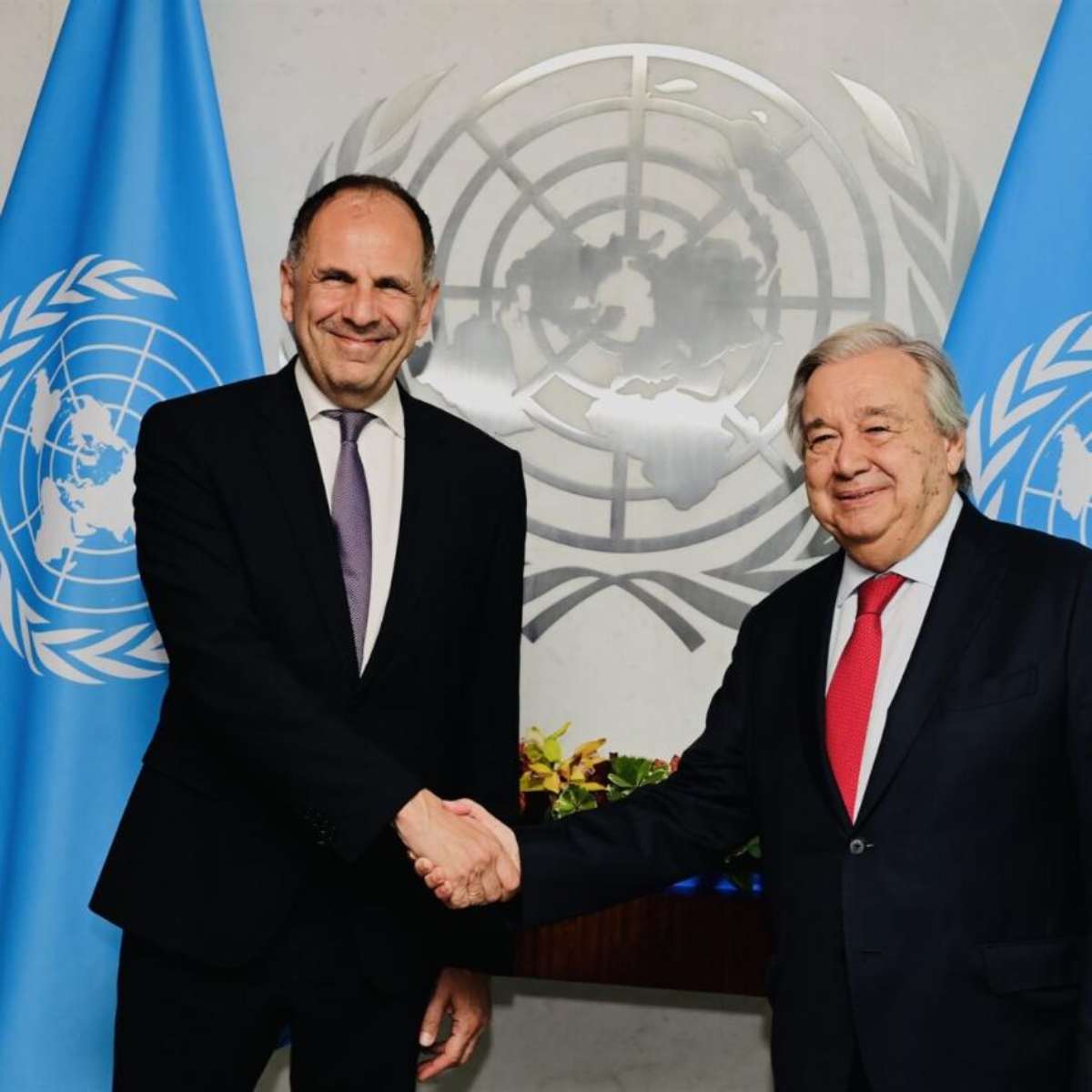
George Gerapetritis is travelling to New York for a week of high-level diplomacy during Greece’s October presidency of the United Nations Security Council.
His programme includes chairing two high-level sessions, meeting Secretary-General António Guterres and participating in the October 29 debate on emerging technologies and maritime security, which Prime Minister Kyriakos Mitsotakis will chair.
The substantive objective extends beyond raising Greece’s international profile. Athens is seeking to connect issues central to its interests—safe navigation, infrastructure protection and international law—with the broader international peace and security agenda.
The presidency provides an opportunity to initiate discussions and coordinate diplomacy. Its influence will depend on other members’ responses and the follow-through.
Why maritime security is a strategic choice
The subject has a direct connection to Greece’s economy and foreign policy.
Secure maritime routes underpin trade, energy supplies and shipping. Attacks on vessels, interference with navigation systems and threats to ports and subsea infrastructure affect countries far beyond the immediate location of a crisis.
This allows Greece to present its concerns as part of a shared international problem.
The diplomatic value lies in building cooperation around concrete interests: protecting crews, maintaining reliable transport and strengthening infrastructure resilience.


From drones to cyberattacks
Greece’s concept note for the October 29 meeting describes a changing threat environment.
It addresses artificial intelligence, autonomous and remotely operated systems, uncrewed aerial and surface vehicles, and cybertechnologies.
Its central observation is that increasingly accessible technologies can enable actors with limited conventional capabilities to generate significant effects at sea. Meanwhile, the digitalisation of vessels and ports creates opportunities for efficiency alongside new vulnerabilities.
The discussion therefore concerns both emerging weapons and the security of systems on which everyday maritime operations depend.
Gerapetritis’s message on a rules-based international order
When Greece assumed the presidency, the foreign minister identified the promotion of:
“An international order based on principles and rules, and the strengthening of the United Nations’ role in promoting peace.”
This approach carries particular significance for Greek diplomacy. Common rules can constrain unilateral action and provide a framework for managing disputes between states.
For that principle to carry practical weight, however, it must be connected to workable proposals and the ability to build consensus.
The Eastern Mediterranean in the background
Greece’s presence in New York comes amid continuing disagreement over the Turkey–Libya maritime memorandum and maritime zones.
The maritime security agenda provides an opportunity to highlight the importance of international maritime law. The announced programme does not, however, establish that the October 29 session will address the resolution of that particular dispute.
The distinction matters: an international debate can strengthen the framework for Greece’s arguments and partnerships without constituting a delimitation ruling or automatic acceptance of every Greek position.
The political opportunity is to broaden support for shared principles. Applying them still requires sustained diplomacy.


The European dimension
For Europe, protecting maritime transport and infrastructure is connected to energy security, economic resilience and access to international markets.
Greece’s initiative creates opportunities for cooperation with European countries and states elsewhere facing similar risks.
This offers Athens a potential source of influence: connecting different regional experiences with common security requirements.
Holding the national presidency of the Security Council does not, however, amount to representing the EU as a whole. European coordination requires its own political work.
Children and women: The credibility of a broader agenda
On Monday, October 26, Gerapetritis will chair the high-level meeting on “Children and Armed Conflict.”
On Tuesday, October 27, he will chair the open debate on “Women, Peace and Security,” alongside a related side event co-organised with UNESCO and UN Women.
These subjects have independent importance. They concern the protection of vulnerable populations, the prevention of violence and women’s participation in peace processes.
They also give Greece’s presence broader substance. A country seeking support for international law strengthens its credibility through consistent engagement in protecting people beyond its immediate national interests.
The meeting with Guterres
On Wednesday, October 28, the foreign minister will meet the UN secretary-general.
The encounter provides an opportunity for political consultation and coordination. The announced programme does not specify the agenda or promise a particular outcome.
Its significance will depend on the issues raised, any subsequent initiatives and continued engagement with the organisation.
Earlier, on Sunday, October 25, Gerapetritis will attend the Federation of Hellenic Societies of Greater New York’s event marking Greece’s October 28 national anniversary.


Turning the presidency into influence
Greece’s high-level presence culminates on October 29, when Mitsotakis chairs the discussion on emerging technologies and maritime security.
The initiative’s success will depend on whether it identifies common priorities, expands cooperation and generates follow-up on proposals for safer transport and infrastructure.
The Security Council remains a forum shaped by competition among major powers. Its presidency does not alter decision-making rules or give Greece an additional veto.
It does offer a concrete opportunity: to connect Greek experience and priorities with problems facing the wider international community. That is the week’s central diplomatic test.
Source: pagenews.gr