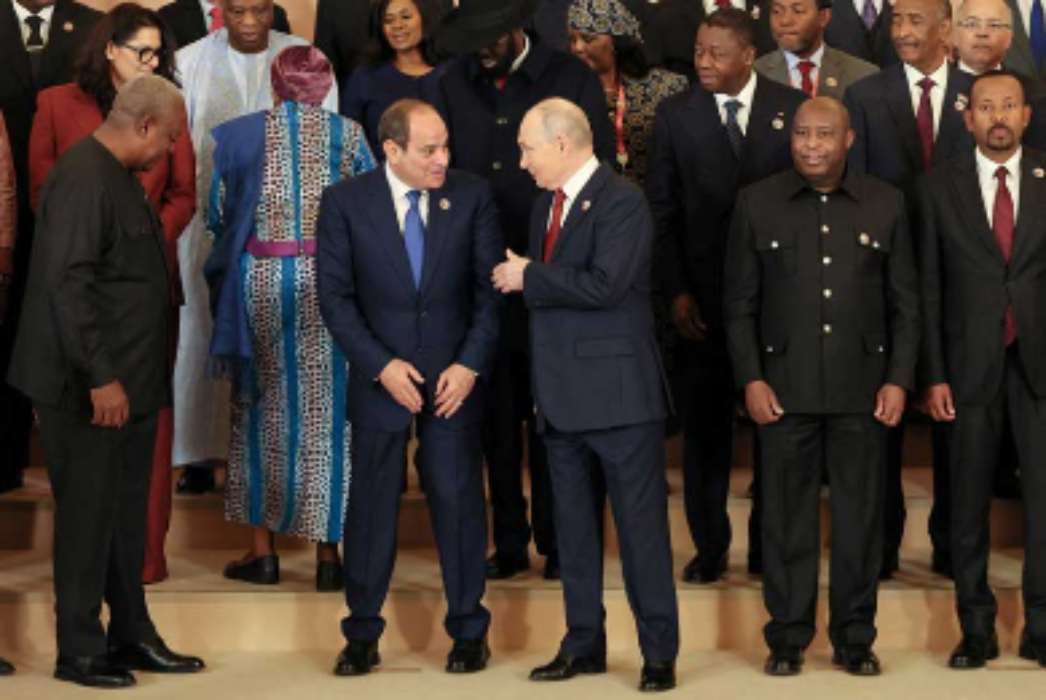
The summit was Russian-African, but the interests converging in Moscow extended well beyond the Kremlin’s relationship with the continent. Egyptian President Abdel Fattah el-Sisi’s participation in the third Russia–Africa Summit on October 28–29 highlighted a broader competition: who will finance, connect and influence African economies in the years ahead?
For China, Egypt offers a particularly useful combination of geography, infrastructure and diplomatic relationships. The Suez Canal connects Asian markets with the Mediterranean, while Cairo maintains political influence across both the Arab world and Africa.
Closer Egyptian-Russian relations could, under certain conditions, also advance Chinese interests. But overlapping ambitions must translate into concrete projects, financing and reliable commercial routes.
Cairo as a bridge to Africa
In her analysis for Modern Diplomacy, academic Nadia Helmy argues that Beijing benefits indirectly from Egypt’s active participation in forums connecting Africa with Russia.
The argument rests on the expansion of developing countries’ options. More partners can mean additional investment sources, greater bargaining power and a stronger voice in international decision-making.
For Egypt’s leadership, that flexibility has practical value. Cooperation with different power centres allows Cairo to pursue economic and political benefits across several relationships.
Egypt’s influence grows when it can connect different partners while retaining room to pursue its own priorities.


Suez gives geopolitics an economic foundation
Egypt’s importance to China is already reflected in their bilateral cooperation. During President Xi Jinping’s visit to Egypt on September 1–2, 2026, the two countries agreed to deepen their comprehensive strategic partnership.
Their joint communiqué includes cooperation under the Belt and Road Initiative, support for the Suez Canal Economic Zone and encouragement for joint projects in renewable energy, artificial intelligence, digital transformation and local manufacturing.
That framework offers opportunities beyond moving goods. Industrial facilities, warehouses and logistics services could increase the economic value retained within Egypt.
For Beijing, the prospect provides a manufacturing and commercial presence in a critical location. For Cairo, the objective is to ensure that investment delivers jobs, exports and the transfer of expertise.
What Russia adds
Sisi’s meeting with Vladimir Putin in Moscow covered two particularly significant projects: the El Dabaa nuclear power plant and the establishment of a Russian industrial zone within the Suez Canal Economic Zone.
The presidents also discussed expanding cooperation in trade, tourism, health, education and scientific research.
The simultaneous presence of Chinese and Russian interests in Egypt creates opportunities for complementary investment. It also creates coordination demands: industrial projects require energy, functioning transport networks, market access and clear rules.
The geographical proximity of different investments could become an advantage. Their actual economic integration will depend on commercial agreements and implementation.
BRICS and the financing challenge
BRICS provides another platform for engagement between Egypt, China and Russia. Its usefulness to Cairo is closely connected to access to partnerships and development resources.
Egypt has been a member of the New Development Bank since 2023. Established by the founding BRICS countries, the institution finances infrastructure and sustainable development projects.
Broader financing options are particularly valuable to economies with substantial investment needs. Likewise, discussions about transactions in local currencies concern efforts to reduce certain foreign-exchange pressures.
The effectiveness of these options will be measured by borrowing costs, capital availability and the speed at which projects are completed. Political partnerships gain durability when they produce measurable economic results.
Secure trade routes remain essential
Commercial and investment ambitions depend on stability across the surrounding region. Egypt sits alongside critical conflict zones and transport routes, from Sudan and the Horn of Africa to the Red Sea.
During his meeting with Putin, Sisi raised regional de-escalation, respect for sovereignty and territorial integrity in the Horn of Africa, and Egypt’s water security, which he described as an existential issue.
For China’s strategy of connecting markets, security has a direct economic dimension. Disruptions to transport can affect delivery times, insurance premiums and operating costs.
Egypt’s diplomatic presence therefore gains additional value when it helps manage risks threatening the infrastructure on which commerce depends.
Sisi’s next test
The Moscow summit adopted a framework for future cooperation, including an action plan for 2027–2029 and a declaration on the civilian use of artificial intelligence.
Egypt’s challenge is to put such commitments to work alongside its relationships with China and other partners. For Beijing, the opportunity lies in an Egypt with functioning infrastructure, broader access to African markets and the capacity to support long-term investment.
The next test will be concrete: which factories begin operating, which networks are completed and how much economic value remains in Egypt. Those outcomes will determine the strength of the bridge Sisi is trying to build.
Source: pagenews.gr