BRICS Calls for ‘Maximum Restraint’ as Middle East War Deepens — But Divisions Remain
 ΧΡΟΝΟΣ ΑΝΑΓΝΩΣΗΣ 7 '
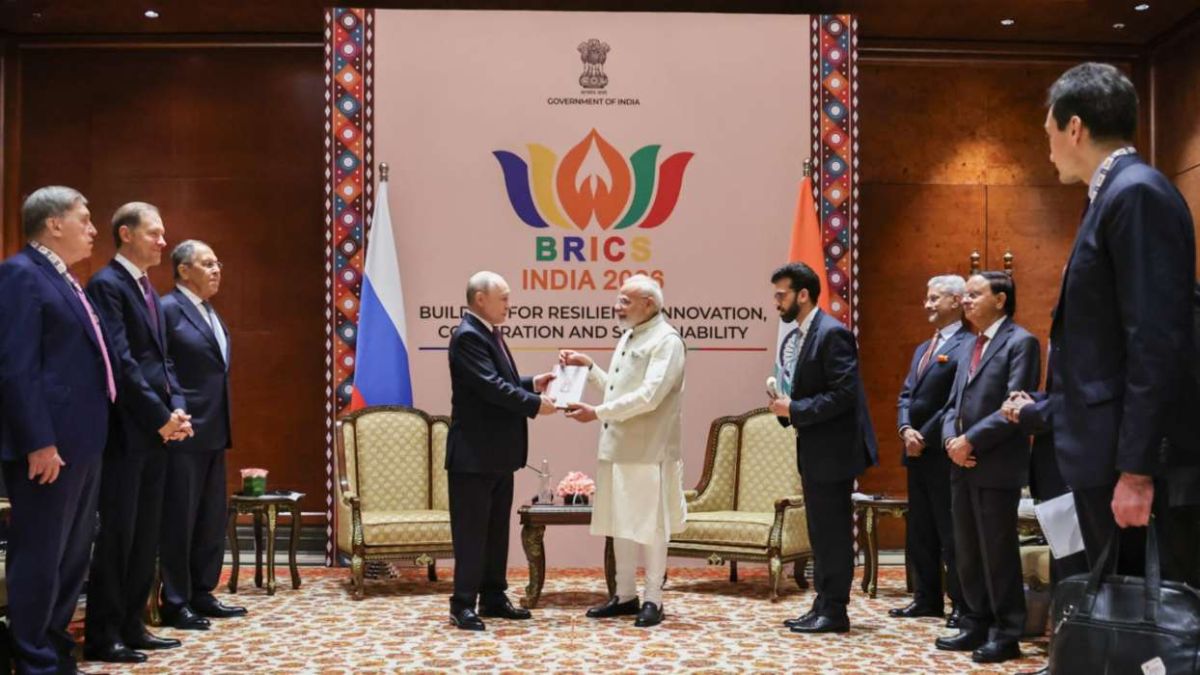
Πηγή Φωτογραφίας: AP Photo//BRICS Calls for ‘Maximum Restraint’ as Middle East War Deepens — But Divisions Remain



The BRICS countries want to present themselves as the political and economic voice of a more multipolar world.
But the New Delhi summit showed how difficult it remains to turn that ambition into a common geopolitical strategy.
Leaders of the ten-member group adopted a joint declaration on Saturday expressing “deep concern” over the escalation in the Middle East and calling for maximum restraint.
“We express deep concern over the continued escalation of tensions in the Middle East/West Asia,” the New Delhi Declaration said, while urging all sides to avoid actions that could worsen the crisis.
The language was deliberately cautious.
And for good reason.
Behind it lies one of the hardest internal balancing acts the expanded BRICS grouping has yet faced.
Iran and the UAE at the Same Table
The bloc now includes both Iran and the United Arab Emirates.
Tehran is directly involved in confrontation with the United States, while the UAE has found itself on the opposite side of key regional tensions and has moved to restrict some commercial and financial links with Iran.
Reaching consensus was therefore far from straightforward.
The final text amounted to a diplomatic compromise.
The BRICS called for de-escalation.
But they did not identify a single party as responsible.
Unity Without a Common Enemy
That is also the bloc’s central weakness.
The BRICS can agree that war should be avoided.
It is far harder for them to agree on who is responsible for it — or on what, exactly, should be done next.
China and Russia maintain relationships with Tehran that are very different from those of the UAE.
India, meanwhile, is trying to preserve working ties with almost every side.
That helps explain why New Delhi pushed for a multilateral approach and language that respects differing national positions.
BRICS remains a coalition of interests — not a NATO-style alliance.
Xi Wants a Bigger Role for BRICS
China, however, is clearly trying to raise the bloc’s strategic profile.
Xi Jinping used the summit to push the idea that BRICS should play a more active role in helping de-escalate the Gulf crisis.
For Beijing, this is about more than the Middle East.
China wants BRICS to look increasingly like an institutional counterweight to a global order still dominated by the United States and Western-led institutions.
Where BRICS Became Much Tougher: Tariffs
If the geopolitical language was cautious, the economic language was much sharper.
The declaration voiced “serious concern” over the growth of unilateral tariff and non-tariff measures that BRICS members argue distort global trade and undermine the multilateral trading system.
The text warns that rising protectionism could hurt trade flows, disrupt supply chains and increase uncertainty for emerging economies.
Donald Trump is not named.
But the political context is obvious.
The US president has repeatedly used tariffs as an instrument of foreign policy and has previously threatened countries that support BRICS efforts to reduce dependence on the dollar.
Even Tougher on Sanctions
The New Delhi Declaration goes further on sanctions.
BRICS countries reject what they describe as unilateral coercive economic measures imposed outside the framework of the United Nations Security Council.
The language matters enormously for two members in particular:
Russia.
And Iran.
Both economies have spent years under extensive Western sanctions regimes.
The Real Economic Front with Washington
This is where the BRICS find much more common ground than they do on war and security.
The members may disagree sharply over regional conflicts.
They may compete with one another.
They may even sit on opposing sides of the same geopolitical disputes.
But many share one strategic concern:
the ability of the United States to use access to the dollar system, sanctions, secondary sanctions and tariffs as tools of geopolitical pressure.
That may be the strongest binding force inside BRICS today.
Not a common ideology.
But a common desire for more economic room to manoeuvre outside Washington’s reach.
Oil Above $100 Turns War into an Economic Crisis
The summit is taking place as the Gulf conflict is already moving beyond the military sphere.
Disruption around the Strait of Hormuz has helped push oil prices above $100 a barrel, while instability around the Red Sea has placed additional pressure on another critical trade and energy corridor.
That means the Middle East crisis is not simply a diplomatic problem for BRICS members.
It is a problem of:
- energy security,
- inflation,
- freight costs,
- supply chains,
- trade,
- and growth.
That gives India, in particular, a powerful incentive to push for de-escalation.
New Delhi Gains from Playing Balancer
For Narendra Modi, the joint declaration is also a diplomatic achievement.
India managed to bring together countries with sharply different strategic interests behind one text.
Xi Jinping’s presence in India for the summit adds another geopolitical layer.
India and China remain strategic competitors.
But pressure from the United States is creating incentives for selective cooperation.
That may be one of the most consequential developments of the current global moment.
BRICS Is Still Not an ‘Anti-G7’
The bloc has scale.
It has population.
It has raw materials.
It has major markets and growing financial weight.
But it is still not a unified geopolitical alliance.
The New Delhi summit demonstrates that clearly.
On major questions of war and security, internal differences remain so significant that common language has to remain carefully neutral.
On economic sovereignty, however, convergence is much stronger.
And that is where the real message to the West lies.
The Bigger Threat to the West Is Not a ‘BRICS NATO’
BRICS does not need to become a military alliance to alter the global balance.
Nor does it need to agree on every war.
It only needs to keep building mechanisms that reduce emerging economies’ dependence on Western instruments of economic power.
Alternative payment systems.
More trade in national currencies.
New financing structures.
More diversified trade networks.
And greater resistance to unilateral sanctions.
The New Delhi summit therefore reveals two BRICS at once.
A geopolitical bloc that still struggles to speak with one voice.
And a geoeconomic bloc that is becoming much clearer about what exactly it wants to challenge.
Not necessarily the West as a whole.
But the West’s ability to set the rules of the economic game on its own.
Source: pagenews.gr
Διαβάστε όλες τις τελευταίες Ειδήσεις από την Ελλάδα και τον Κόσμο